Inside New York City's Ten Most Coveted Restaurant Reservations
In a city where nearly anything can be purchased for a price, one of the most elusive luxuries in New York is surprisingly ordinary: a table for two.
There are restaurants where a considerable fortune, an impeccable wardrobe and a distinguished surname may still prove insufficient to secure a reservation. At one, generations of New Yorkers have guarded their standing tables with the devotion ordinarily reserved for family heirlooms. At another, diners descend into an unassuming townhouse to experience some of the most celebrated cooking in the world. Elsewhere, beneath the glow of brass lamps and surrounded by equestrian paintings, dinner unfolds inside the meticulously conceived world of Ralph Lauren.
What makes these restaurants so extraordinarily desirable? Is it the food, the clientele, the personalities behind them, the intimacy of the dining rooms, or simply the irresistible human fascination with that which is difficult to obtain?
The answers are as varied as the neighborhoods in which these establishments reside. From the historic streets of East Harlem to the fashionable sidewalks of SoHo, from the brownstones of the West Village to the cultural grandeur of Lincoln Center, we explore ten of Manhattan's most elusive dining destinations, the remarkable people who created them, what awaits beyond their doors, and what it takes to secure a place at their tables.
Welcome to The Impossible Table.
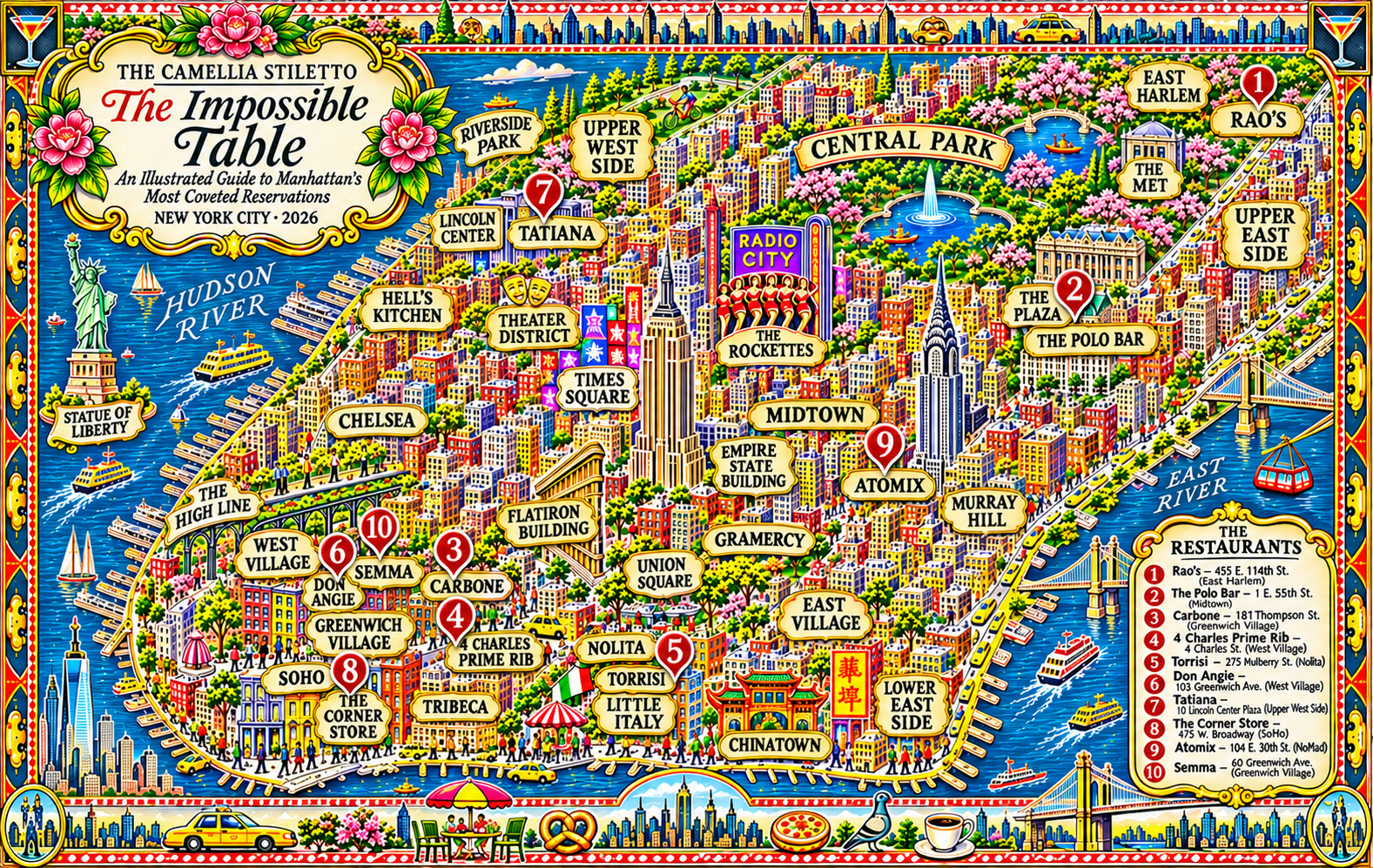
An illustrated guide to Manhattan's most coveted reservations, 2026. Artistic interpretation; not to scale.
01 — Rao’s
East Harlem / Established 1896
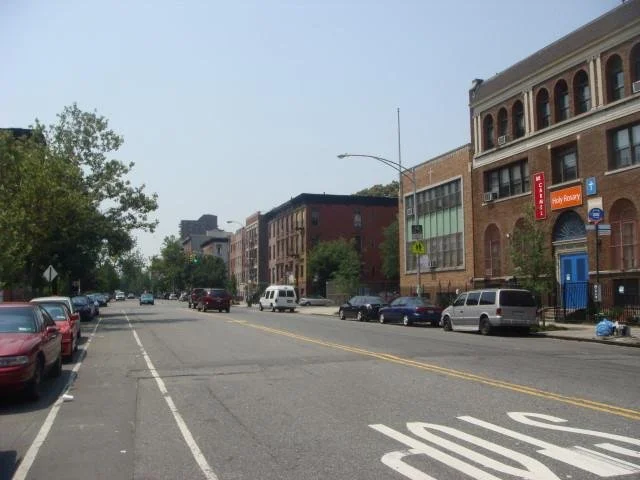
East Harlem, Manhattan — a neighborhood steeped in the history of Italian immigration and New York's old neighborhood traditions.
Of all the restaurants in Manhattan, perhaps none is more fascinating in its exclusivity than a little Italian establishment tucked away on the corner of East 114th Street and Pleasant Avenue. Far removed from the fashionable addresses of Madison Avenue and the grand dining rooms of Midtown, Rao’s occupies a remarkably unpretentious corner of what was once the heart of Italian Harlem.
In 1896, Charles Rao, an immigrant from the southern Italian town of Polla, acquired a small neighborhood saloon. What began as a gathering place for Italian immigrants would eventually become one of the most coveted dining destinations in America.
The extraordinary thing about Rao’s is that it did not achieve its exclusivity by deliberately courting the wealthy and famous. Rather, its exclusivity grew out of a determination not to abandon the ordinary neighborhood customers who had sustained it for generations.
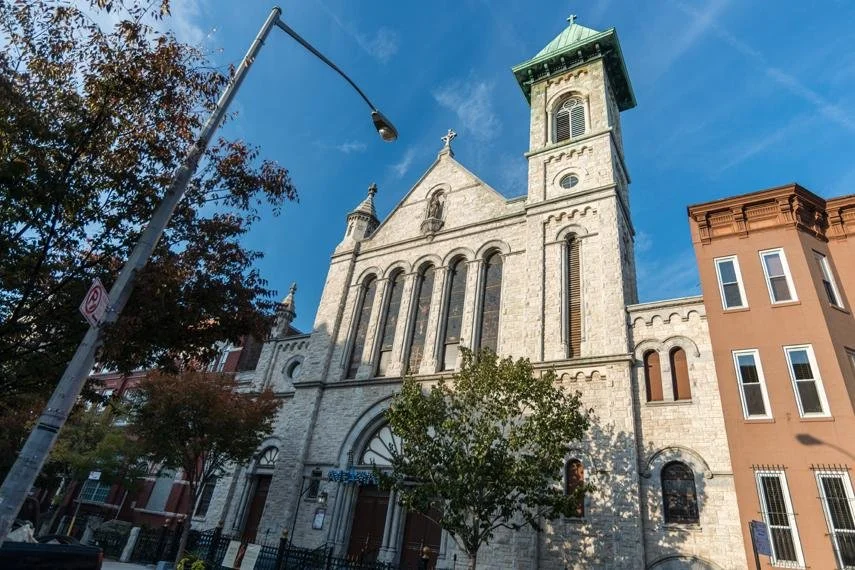
The architectural heritage of East Harlem recalls the neighborhood’s Italian immigrant history.

Rao’s, at 455 East 114th Street and Pleasant Avenue. Behind this modest red storefront lies one of America’s most elusive restaurant reservations.
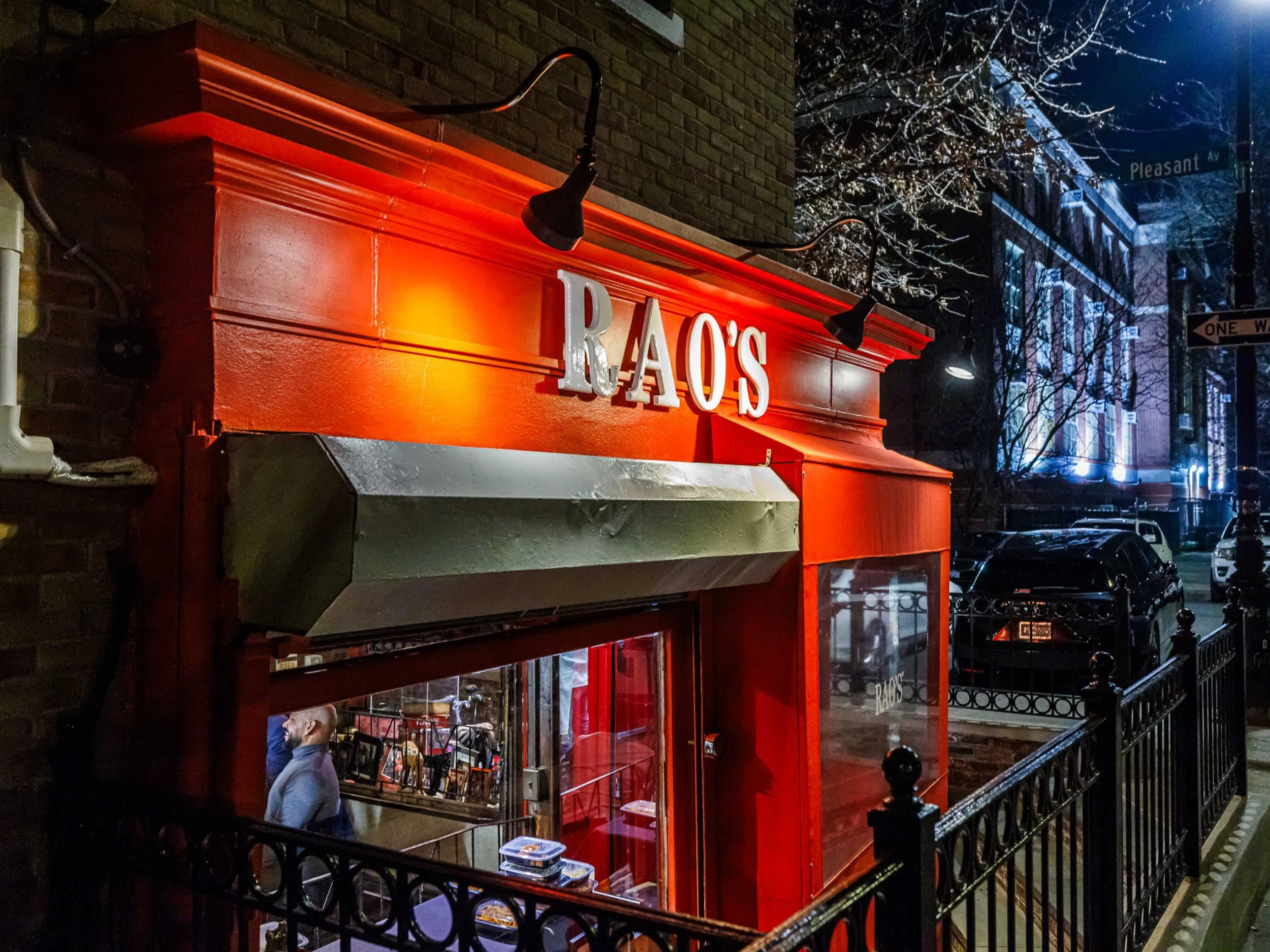
The famous red entrance to Rao’s, where having a reservation is considerably more important than having a fortune.
The Ten Tables
In 1977, the formidable New York Times restaurant critic Mimi Sheraton awarded Rao’s three stars, transforming a neighborhood institution into a culinary sensation. Suddenly, people from all over Manhattan wanted to dine in a restaurant that had only ten tables.
Rather than displacing the loyal customers who had supported the family for decades, the proprietors devised an extraordinary arrangement known as “table rights.” Regular patrons were assigned recurring reservations, whether weekly, fortnightly, monthly or quarterly. These privileges could be extended to friends, relatives and business associates, and in some families have endured across generations.
The patrons do not legally own the tables, but their longstanding dining privileges are treated with something approaching the sanctity of private property.
A billionaire might therefore find himself unable to secure a reservation that a neighborhood tradesman has enjoyed for decades. In a city otherwise remarkably accommodating to wealth, this is one of the more delightful peculiarities of Rao’s.
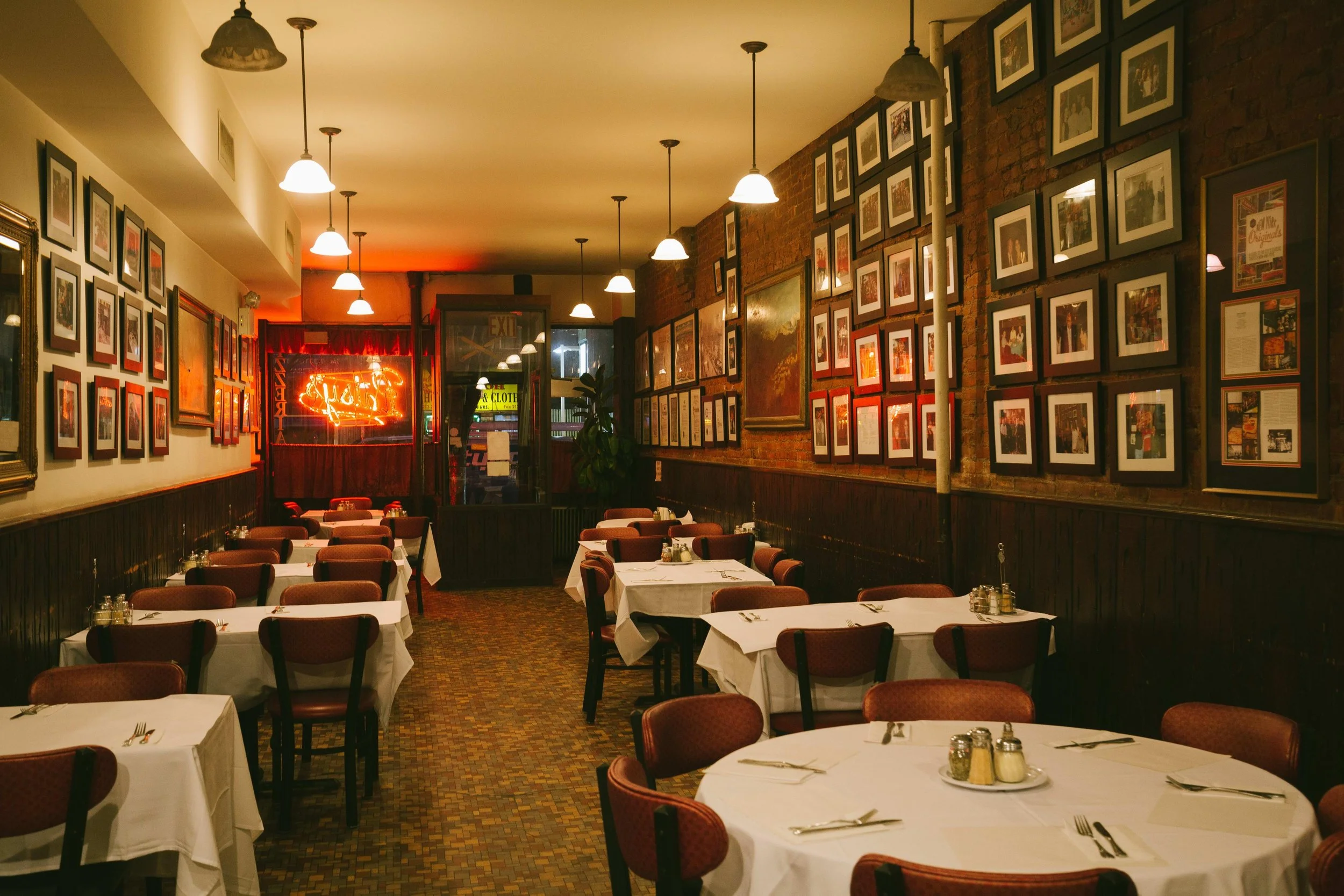
White tablecloths, modest furnishings and walls crowded with decades of photographs. This remarkably unassuming dining room is home to some of the most coveted tables in America.
The Man Who Said No
Frank Pellegrino Sr. (1944–2017), affectionately known as “Frankie No,” became nearly as famous as the restaurant itself. His nickname was earned through decades of declining requests for reservations, often from some of the most influential people in America.
Pellegrino was an accomplished character actor, appearing in Martin Scorsese’s Goodfellas and portraying FBI bureau chief Frank Cubitoso in The Sopranos. At Rao’s, however, he played a considerably more powerful role: he was the custodian of its ten tables.
Among the restaurant’s celebrated patrons were Frank Sinatra, Billy Joel, Martin Scorsese and prominent figures from the worlds of politics, law enforcement, business and entertainment. Pellegrino was known to serenade his guests, and spontaneous singing became part of the restaurant’s distinctive atmosphere.
In 1992, he found an ingenious way to accommodate the thousands of people he could not accommodate at dinner. He introduced Rao’s famous tomato sauce to the retail market, transforming a little East Harlem restaurant into a nationally recognized household name.
Following his death in 2017, his son, Frank Pellegrino Jr., continued the family legacy alongside co-owner Ron Straci, himself an attorney.
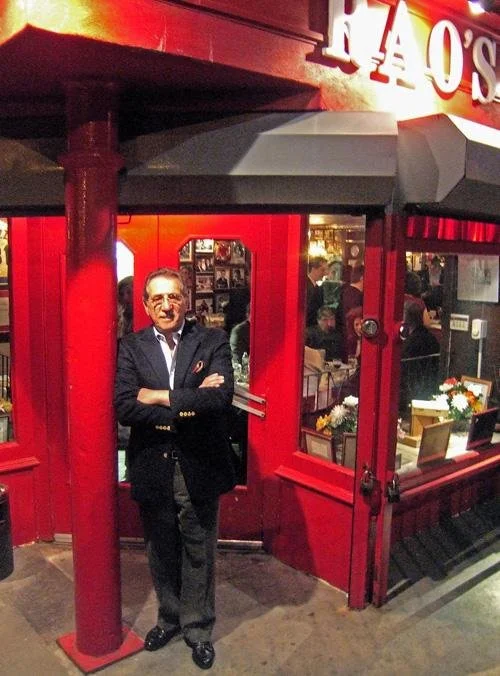
Frankie No — the legendary gatekeeper of Rao’s.

Two generations of the Pellegrino family, entrusted with preserving one of Manhattan’s most extraordinary dining traditions.
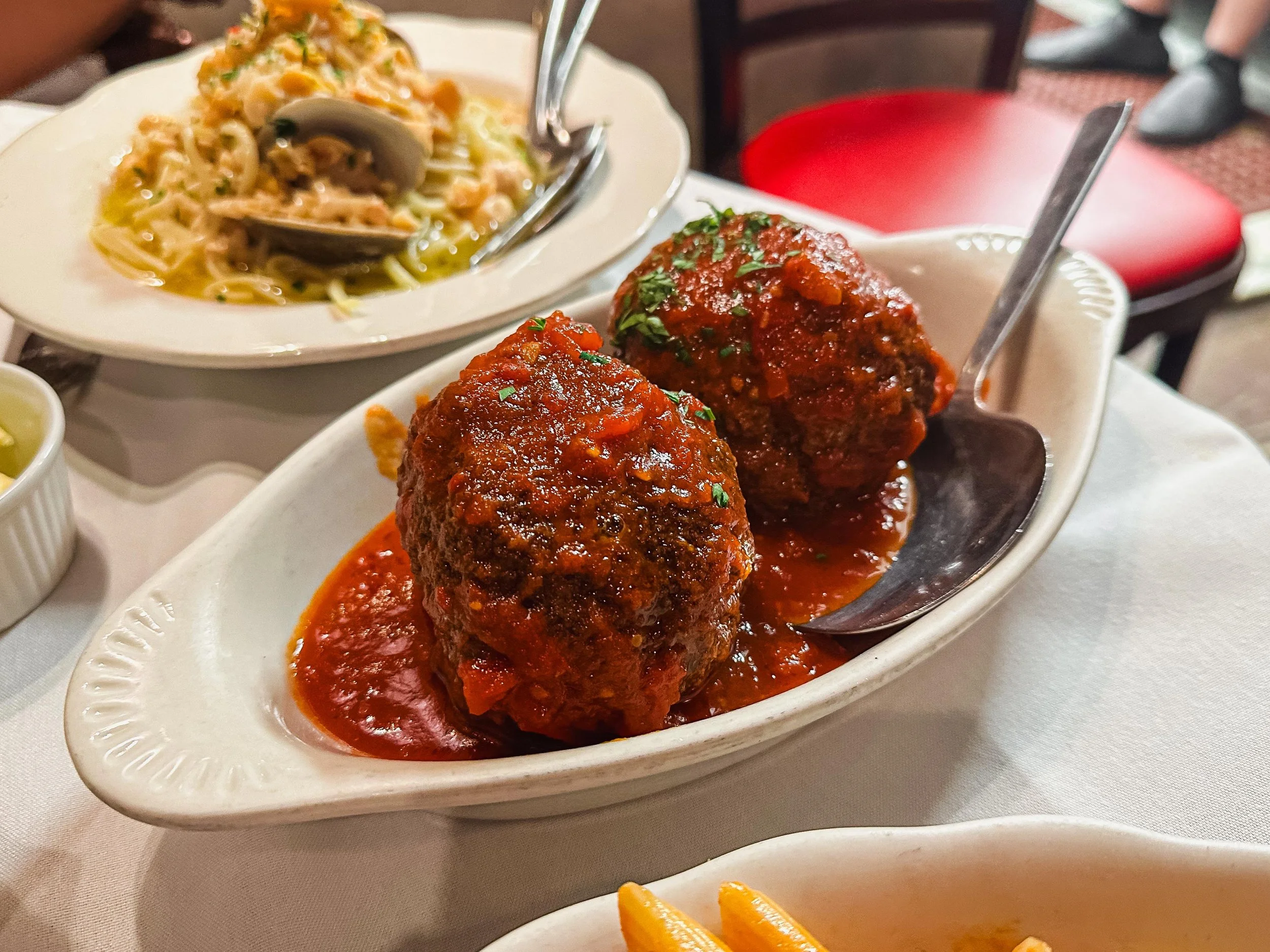
Rao’s celebrated Italian-American meatballs, generously served with its signature tomato sauce.
What Is Served Behind the Red Door?
There is nothing particularly theatrical about the presentation of the food at Rao’s. The cooking is unapologetically southern Italian, with generous portions intended to be shared rather than admired from a distance.
The celebrated meatballs are prepared with beef, veal and pork. Other specialties include Uncle Vincent’s lemon chicken, seafood salad with lobster, shrimp and calamari, fried calamari with hot peppers, and a substantial veal chop accompanied by cherry peppers.
The dishes are traditionally recited by the staff at the table, a charming departure from the elaborate printed menus of contemporary fine dining.
The Price of Exclusivity
Perhaps the greatest surprise is that dinner at Rao’s is not extraordinarily expensive by Manhattan standards. In May 2025, two journalists from The Infatuation reported a total dinner bill of $340, including beverages, tax and gratuity.
The real luxury, therefore, is not the meal itself but the privilege of being permitted to order it.
How to Secure a Table
There is no public online reservation system, no midnight scramble for newly released tables and no conventional waiting list. The restaurant operates principally by invitation through its established network of regular patrons.
Occasionally, a dinner at Rao’s is offered through a charitable auction. Such opportunities can command thousands of dollars.
The most reliable approach, however, remains the most old-fashioned: knowing someone who has a table.
In an age in which nearly everything can be acquired through technology, money or influence, Rao’s remains a delightful anomaly. Its most valuable currency is an invitation.
Address: 455 East 114th Street, New York, NY 10029
Neighborhood: East Harlem
Michelin distinction: No Michelin star.
Historic culinary recognition: Three stars from The New York Times, awarded by Mimi Sheraton on August 19, 1977.
Dinner: Monday through Friday
Dress code: Smart casual; jackets encouraged.
Reservations: By invitation.
Website: www.raos1896.com
02 — The Polo Bar
Midtown Manhattan / Established 2015
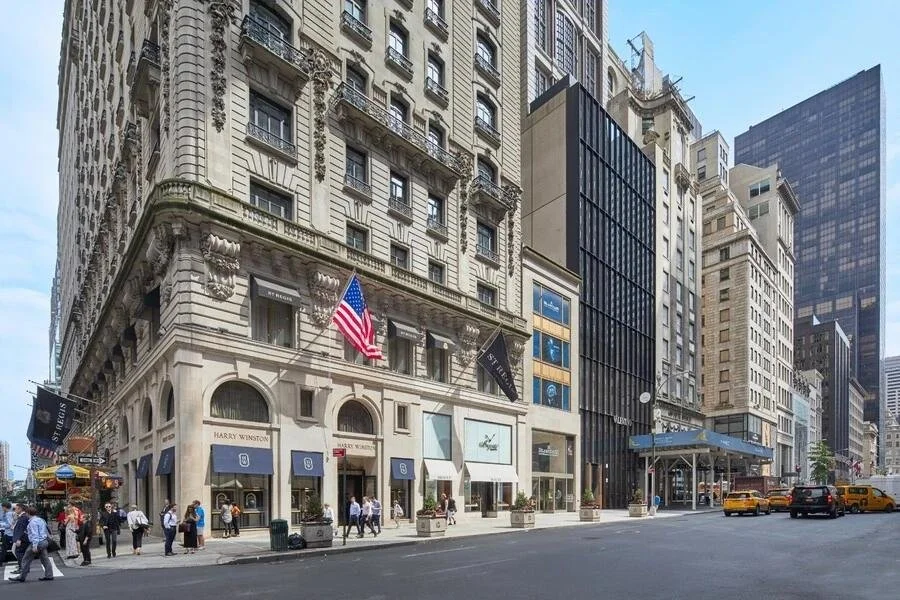
Fifth Avenue, Midtown Manhattan — the historic epicenter of American luxury, fashion and society.
Long before Ralph Lauren opened The Polo Bar in January 2015, its address near the corner of Fifth Avenue and East 55th Street was associated with a particularly glamorous chapter of Manhattan society.
It was here that La Côte Basque once entertained Jacqueline Kennedy, Babe Paley, C. Z. Guest and Truman Capote. The ladies of New York society gathered over elegant French lunches, exchanging the sort of confidences that would eventually provide Capote with the material for his notorious 1975 Esquire story, “La Côte Basque, 1965,” an indiscretion that cost him some of his most treasured friendships.
Decades later, Ralph Lauren brought to the address his own distinctive interpretation of American sophistication.
Born Ralph Lifshitz in the Bronx in 1939, the son of Jewish immigrants, Ralph Lauren began his fashion empire in 1967 with a collection of neckties. Without formal training as a fashion designer, he built an internationally recognized brand around an extraordinary understanding of aspiration. He understood that people were not merely purchasing a jacket, a pair of riding boots or a cashmere sweater; they were purchasing something of the world those objects represented.
His interpretation of American luxury drew upon the country estates of the East Coast, the sporting traditions of the English aristocracy, the glamour of old Hollywood and the rugged romance of the American West.
The Polo Bar is perhaps the most immersive expression of that philosophy. For the duration of an evening, one can inhabit the world that Ralph Lauren has spent decades creating. The difficulty, of course, is securing an invitation into that world.
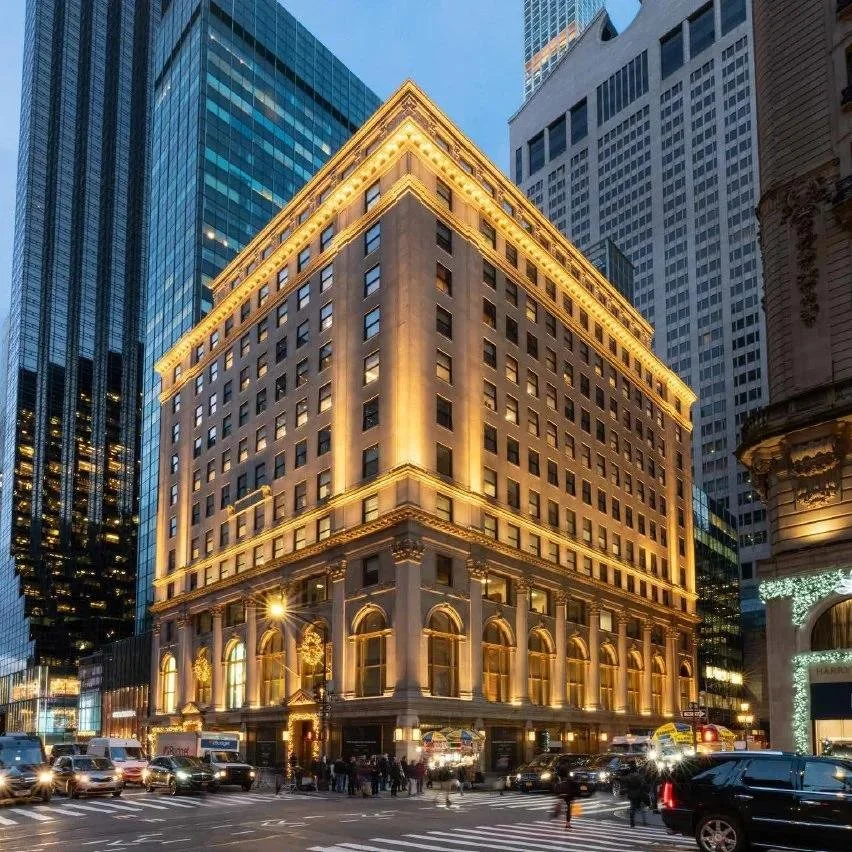
The fashionable intersection of Fifth Avenue and East 55th Street, where Ralph Lauren established his Manhattan dining destination.
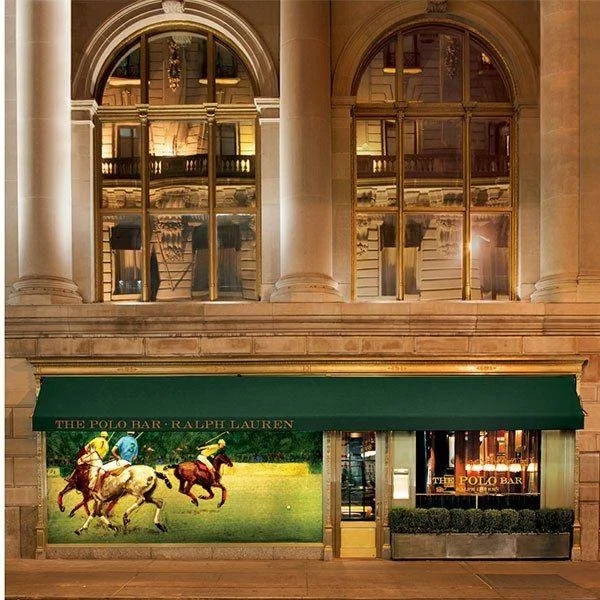
The Polo Bar’s distinctive exterior, where equestrian imagery offers the first glimpse into Ralph Lauren’s carefully conceived world.
The reception area, where admission to Ralph Lauren’s carefully orchestrated world begins.
Beyond the Velvet Rope
The experience of dining at The Polo Bar begins before one has even crossed the threshold. Restaurant critic Gael Greene described a young man stationed outside with a clipboard, checking the names of arriving guests. There is something distinctly reminiscent of an exclusive private club about the arrangement, although The Polo Bar is ostensibly a public restaurant.
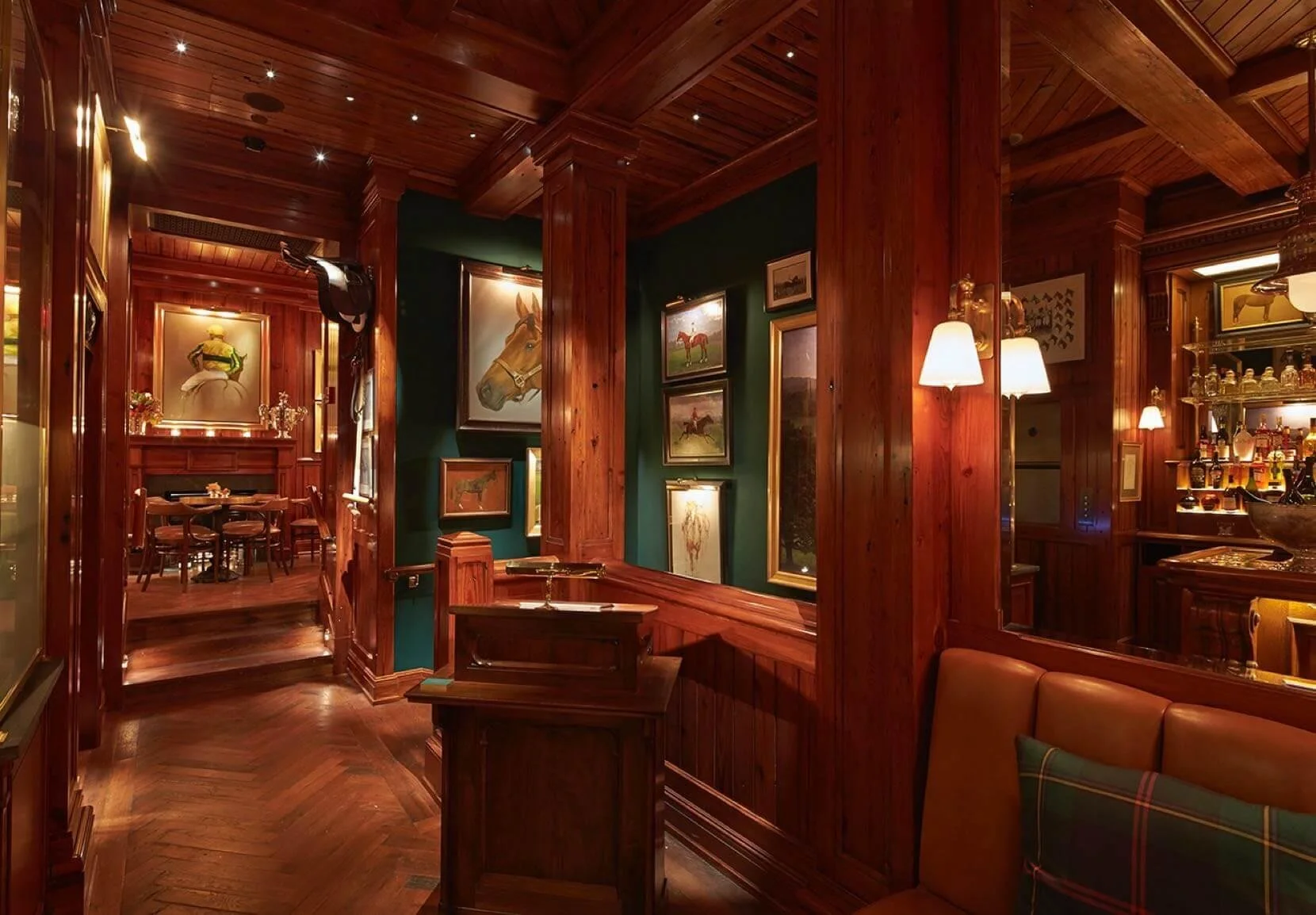
Once admitted, guests encounter an interior that could almost have been lifted from an English country house. Rich wood paneling, equestrian paintings, polished brass, tartan fabrics and carefully selected antiques establish the atmosphere before the first course is served.
A staircase leads to the principal dining room below street level, where saddle-colored leather banquettes, subdued lighting and beautifully appointed tables create a remarkably intimate atmosphere.
Nothing about the surroundings appears accidental. Ralph Lauren has accomplished something considerably more ambitious than decorating a restaurant: he has translated an entire fashion philosophy into a physical environment.
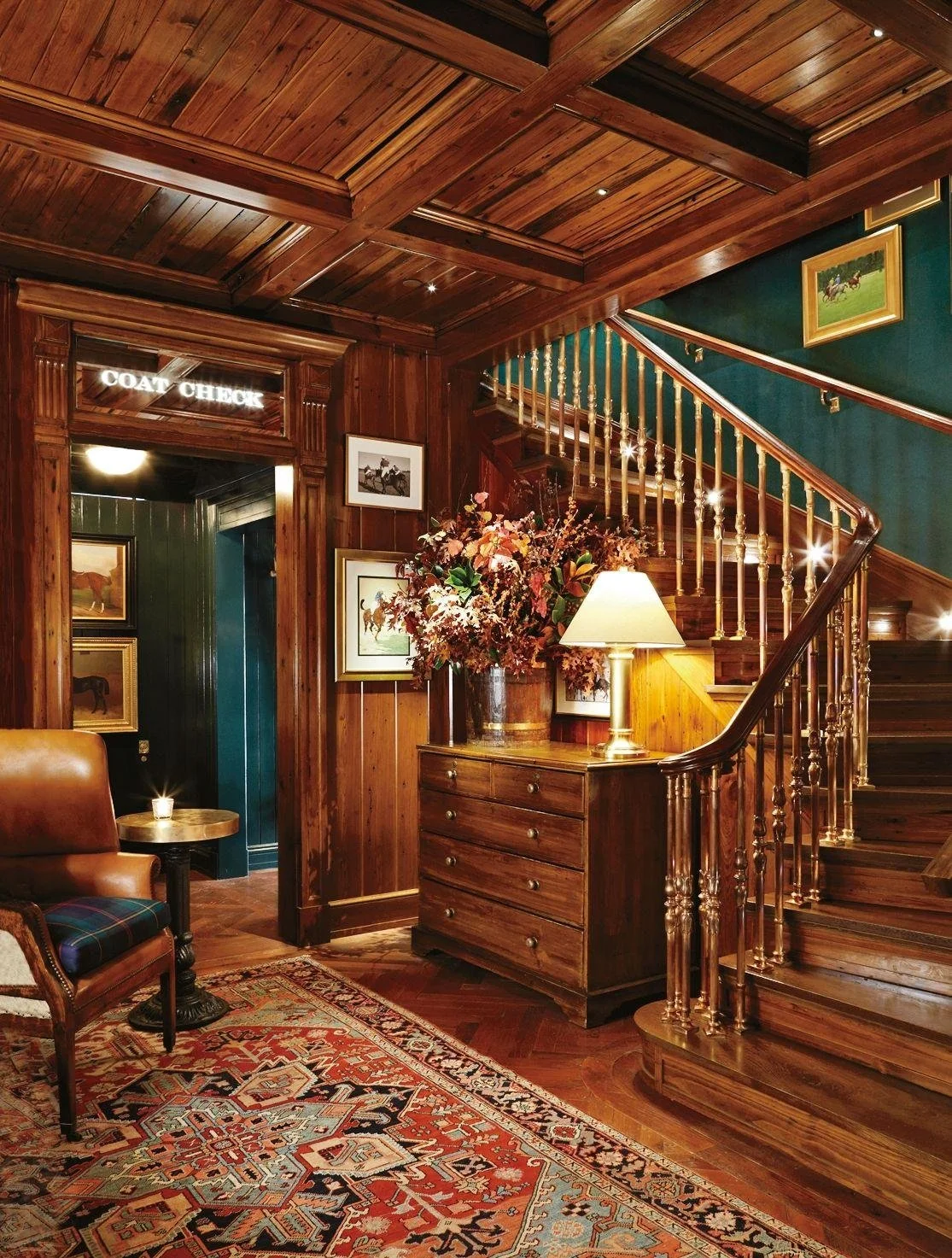
The staircase leading to the downstairs dining room, with its rich architectural detailing and equestrian artwork.
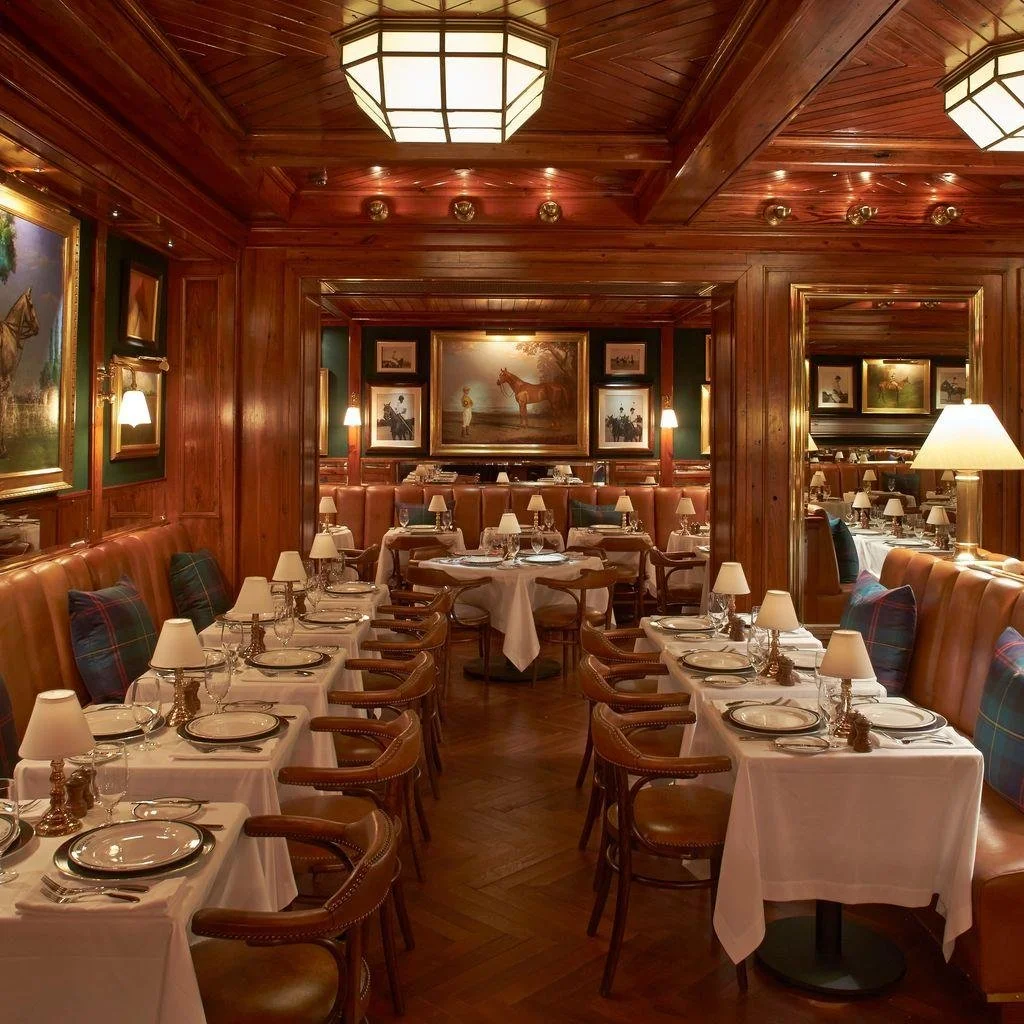
The principal dining room — an interpretation of traditional American sporting elegance, complete with saddle-colored leather, rich woodwork and equestrian paintings.
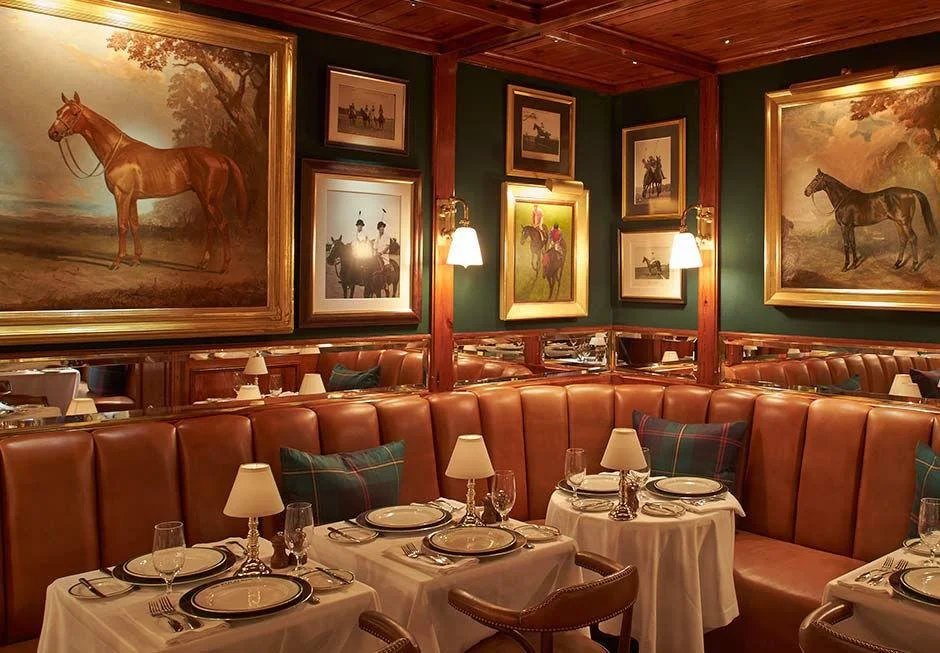
Equestrian paintings, traditional tartan and saddle-colored leather reflect Ralph Lauren’s enduring fascination with the sporting life.
Impeccably Dressed, Impeccably Appointed
For a fashion designer, naturally, the appearance of the staff is every bit as important as the appearance of the dining room. When The Polo Bar opened, the waitstaff were outfitted in specially tailored Ralph Lauren uniforms comprising gray flannel trousers, Oxford shirts, striped silk neckties and traditional wingtip shoes. The effect was less that of conventional restaurant waiters than of impeccably dressed attendants at an established private club.
The attention to detail extends to the table itself. The crystal glassware and silver bar accessories were drawn from the Ralph Lauren Home collection, while the porcelain dinner service was commissioned from England especially for the restaurant.
Despite accommodating approximately 140 diners at its opening, the principal dining room was designed to preserve a remarkable sense of intimacy. The arrangement of the banquettes, the small individual table lamps and the abundance of warm, natural materials soften what might otherwise have been an imposing interior.
The Equestrian Room
Beyond the principal dining room lies a more secluded sanctuary. The Equestrian Room, reached through an inconspicuous doorway, accommodates private gatherings away from the activity of the main restaurant.
Here, guests can arrange individually tailored menus, personalized floral arrangements and specially printed materials for their occasions. It is an opportunity to entertain in surroundings that possess the character of a beautifully appointed private residence without the considerable responsibility of maintaining one.
Privacy is taken seriously throughout The Polo Bar. Photography is restricted to members of one's own party, and video recording and live streaming are prohibited.
In a city increasingly accustomed to broadcasting its social life, the privilege of dining somewhere that actively protects the privacy of its patrons is itself a form of luxury.
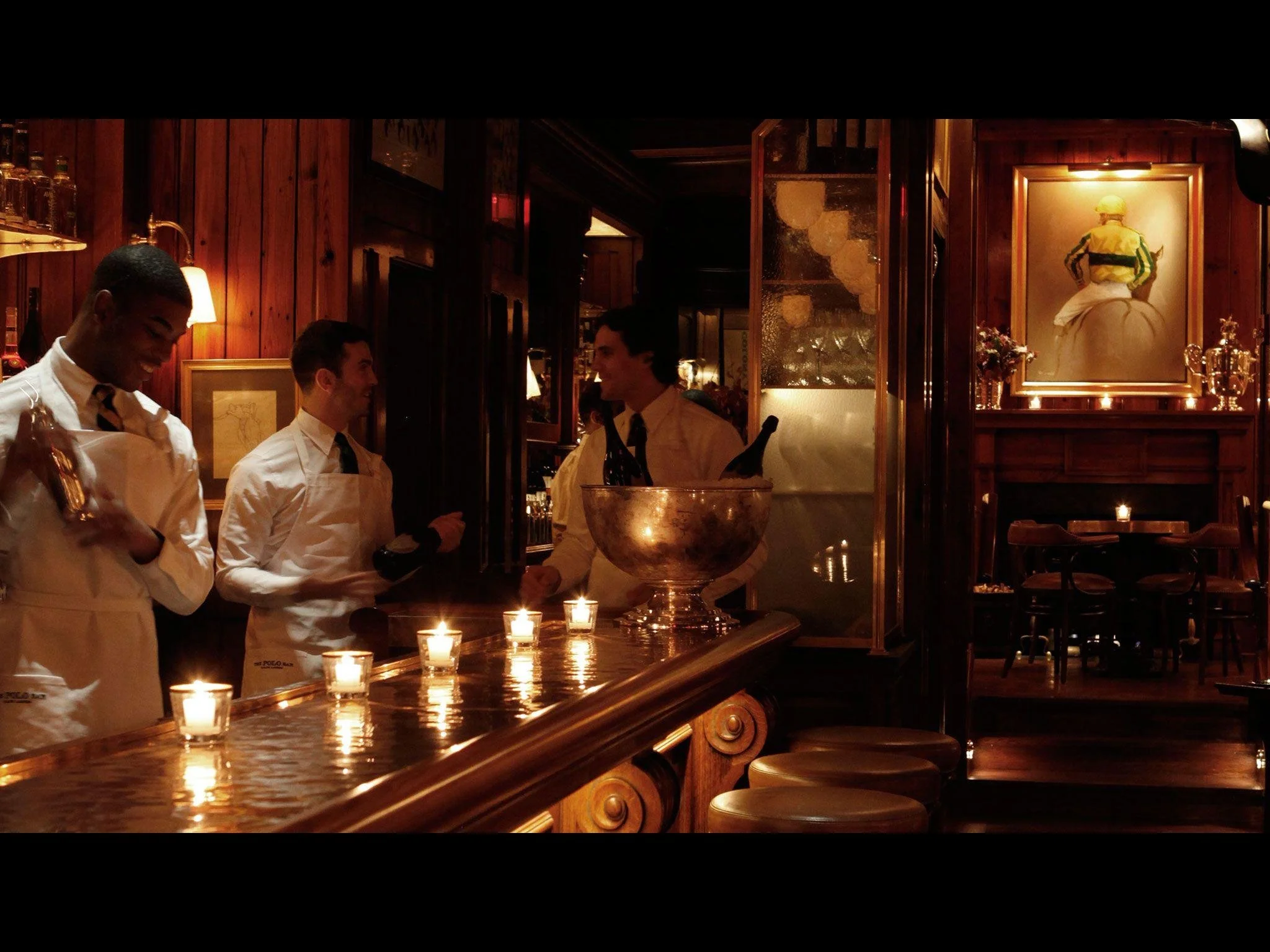
At The Polo Bar, the attire of the staff is an extension of the designer’s distinctive aesthetic.
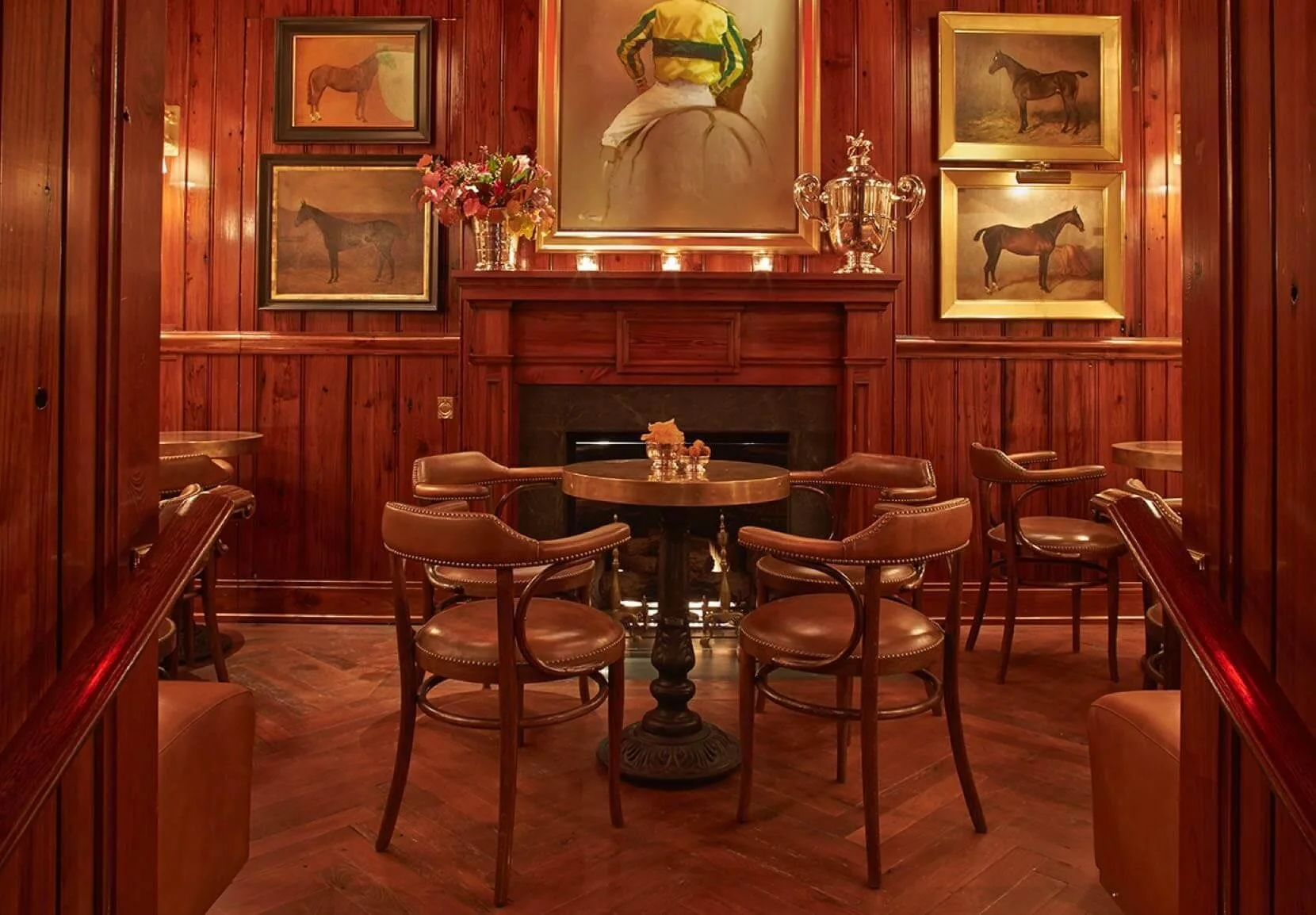
The Equestrian Room, a secluded setting for private celebrations and intimate gatherings.
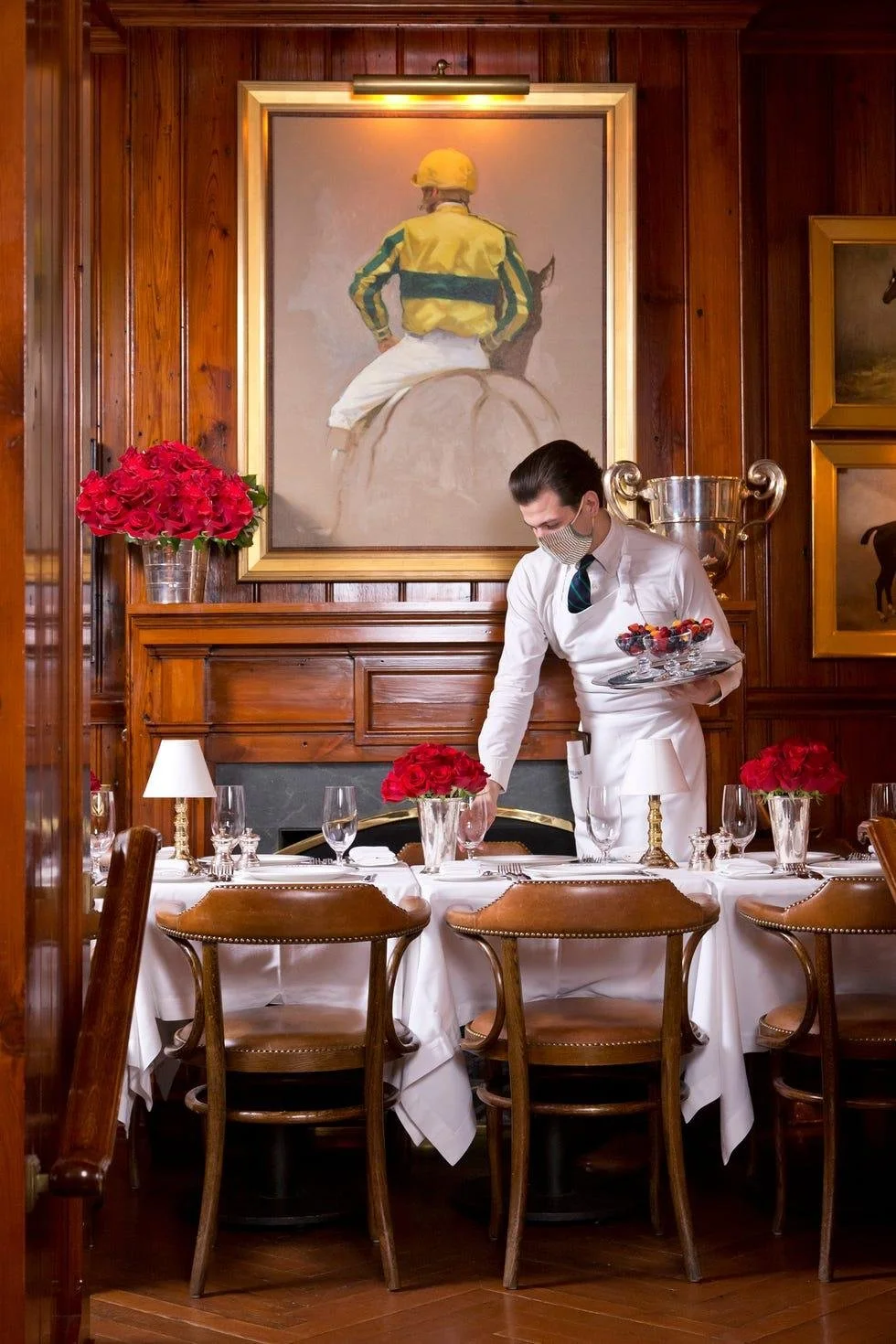
Private entertaining at The Polo Bar, where the smallest details contribute to the occasion.
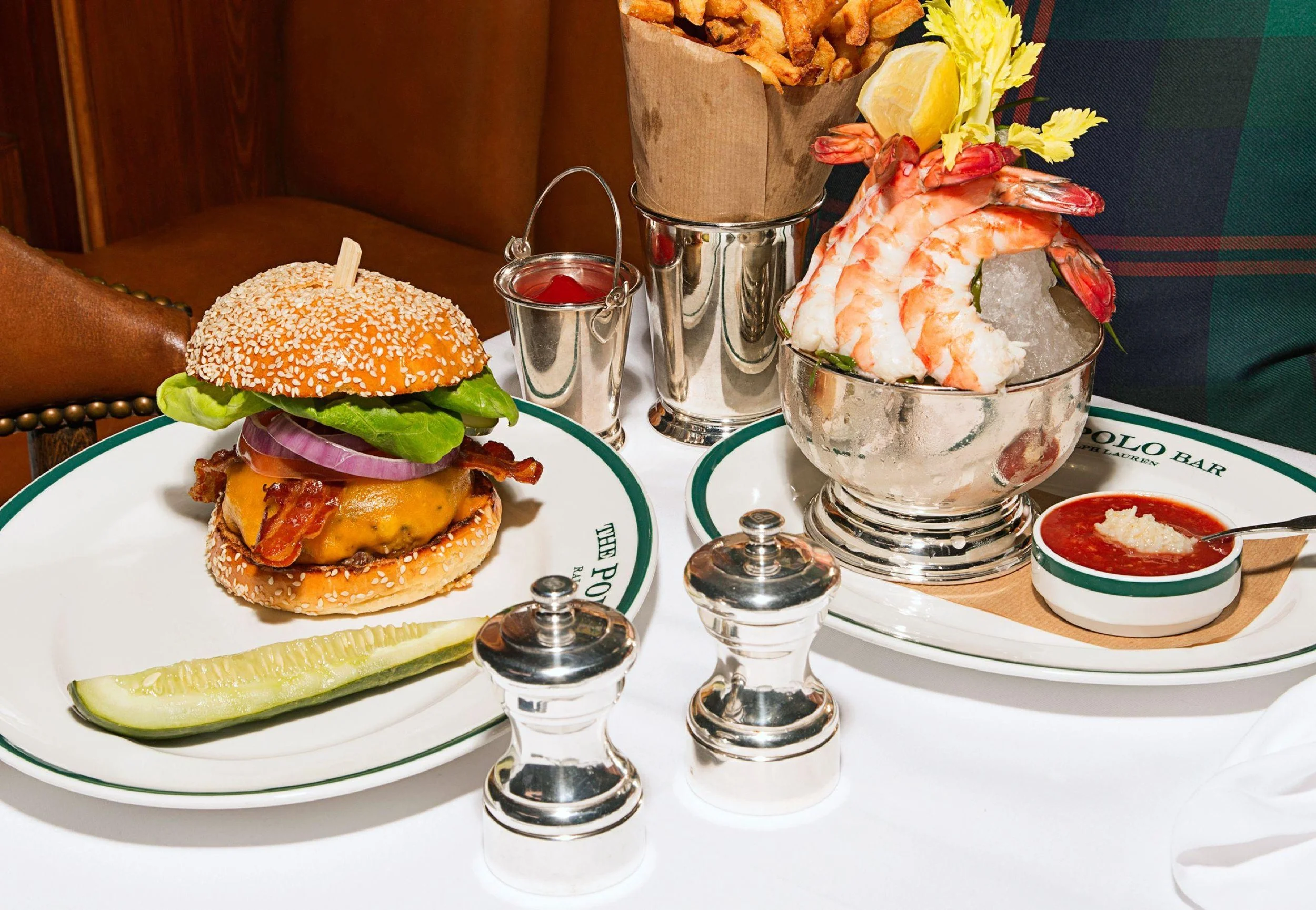
The signature Polo Bar Burger and classic shrimp cocktail — American culinary traditions served in decidedly luxurious surroundings.
The All-American Table
For all its aristocratic sporting imagery, The Polo Bar serves food that is distinctly American. The menu reflects Ralph Lauren's own culinary preferences rather than the elaborate techniques associated with contemporary Michelin-starred restaurants.
Ralph’s Corned Beef Sandwich is a particularly fitting tribute to the designer's New York upbringing, while shrimp cocktail, crab cakes, Dover sole and substantial cuts of steak recall the traditions of the great American supper clubs.
The restaurant's most celebrated dish, however, is a hamburger. The Polo Bar Burger arrives with cheddar, crisp bacon, lettuce, tomato, onion and pickles. There is something wonderfully American about the idea of dressing impeccably, securing one of Manhattan's most elusive reservations and descending an elegant brass-trimmed staircase to order a hamburger.
Desserts are equally nostalgic, including a five-layer chocolate cake and Ralph’s Coffee Ice Cream Sundae, accompanied by caramel corn, whipped cream and dark chocolate sauce.
The Luxury Beyond the Stars
Despite its formidable reputation and extraordinary popularity, The Polo Bar does not hold a Michelin star.
The distinction is particularly interesting because Ralph Lauren has created a dining experience in which culinary ambition is only one component of its desirability. The surroundings, the beautifully attired staff, the discretion afforded to its clientele and the sophisticated interpretation of familiar American cooking are equally integral to its appeal.
The Polo Bar demonstrates that a restaurant need not possess Michelin's celebrated endorsement to become one of the most prestigious addresses in Manhattan. Its distinction lies in the completeness of the experience rather than the complexity of the cuisine.
The Price of Elegance
Reported 2026 menu prices place the signature burger at $35 and Ralph’s Corned Beef Sandwich at $36. A filet mignon costs approximately $95, while a bone-in rib eye approaches $120.
Allow approximately $125 to $200 per person for a substantial dinner, depending upon the selection of courses and beverages, including tax and gratuity.
How to Secure a Table
Unlike Rao’s, The Polo Bar does accept reservations from the general public. The difficulty lies in actually obtaining one.
Curiously, despite belonging to a global fashion empire with considerable technological resources, The Polo Bar continues to accept its reservations by telephone rather than through an online booking system.
Reservations may be secured one calendar month in advance. For a dinner on December 27, for example, prospective diners should telephone the restaurant on November 27, precisely when the reservation office opens at 10 a.m., Eastern Time.
Flexibility is an advantage. Those willing to dine early in the evening or on a weekday may improve their prospects considerably. Should the desired date be unavailable, it is worth telephoning again to inquire about cancellations.
One should also dress for the occasion. Athletic apparel, T-shirts, hoodies, ripped jeans, beachwear and hats are prohibited. Gentlemen are encouraged, although not required, to wear jackets.
Ultimately, the allure of The Polo Bar lies in Ralph Lauren's extraordinary ability to make familiar things feel exceptional. A hamburger, a beautifully tailored jacket, an equestrian painting and a leather chair are hardly inaccessible luxuries in themselves. Yet assembled within his particular vision of American elegance, they have created one of the most coveted dining experiences in New York.
Address: 1 East 55th Street, New York, NY 10022
Neighborhood: Midtown Manhattan
Michelin distinction: No Michelin star.
Dinner: Daily, beginning at 5 p.m.
Dress code: Smart and elegant attire; jackets encouraged for gentlemen.
Reservations: By telephone, one calendar month in advance.
Reservation office: Daily, 10 a.m. to 10 p.m., Eastern Time.
Telephone: (212) 207-8562
Private dining: Events@PoloBarRalphLauren.com
Website: www.ralphlauren.com/global-polo-bar
03 — Carbone
Greenwich Village / Established 2013
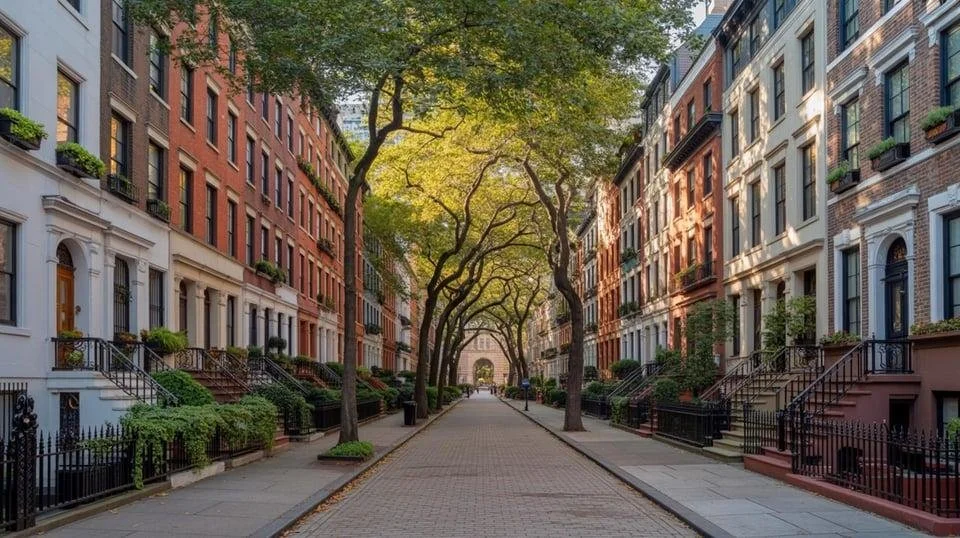
Greenwich Village, where historic townhouses, intimate restaurants and generations of Italian-American traditions contribute to one of Manhattan’s most distinctive neighborhoods.
Just south of Washington Square Park, along a relatively unassuming stretch of Thompson Street between Bleecker and West Houston Streets, stands one of the most celebrated Italian-American restaurants in the world. Its distinctive red neon sign illuminates a neighborhood whose culinary history stretches back generations.
Before Carbone, there was Rocco, an old-fashioned Italian restaurant that occupied 181 Thompson Street for much of the twentieth century. Its presence belonged to an era when Italian-American restaurants were neighborhood institutions, where families celebrated engagements, christenings and anniversaries, and where a familiar waiter might know three generations of the same family.
When restaurateur Jeff Zalaznick first inspected the premises, he was immediately captivated by the old neon sign. The address possessed precisely the architectural character and history that he and his partners were seeking. Rather than discard the physical remnants of Rocco, they incorporated its original signage into the identity of their new restaurant.
Carbone opened on March 8, 2013, the creation of chefs Mario Carbone and Rich Torrisi and their business partner, Jeff Zalaznick. Carbone and Torrisi had first met at culinary school in 1998 and subsequently worked together at the prestigious Café Boulud. Their classical culinary training would prove instrumental in their ambitious undertaking: restoring the grandeur of mid-century Italian-American fine dining.
In preparation, the chefs traveled throughout New York's five boroughs, studying the surviving restaurants of that earlier generation. They examined not only the food but also the peculiar rituals of service, the personalities of the waiters and the relationship between the dining room and its patrons. Historical menus preserved at the New York Public Library provided further inspiration.
What emerged was neither an ordinary Italian restaurant nor a museum dedicated to a vanished era. Carbone was a gloriously theatrical reinvention of Italian-American Manhattan, where the glamour of the late 1950s could be experienced by an entirely new generation.
The extraordinary irony is that culinary traditions born largely of immigrant ingenuity and modest means have become the foundation of one of the most fashionable and elusive dining experiences in contemporary America.
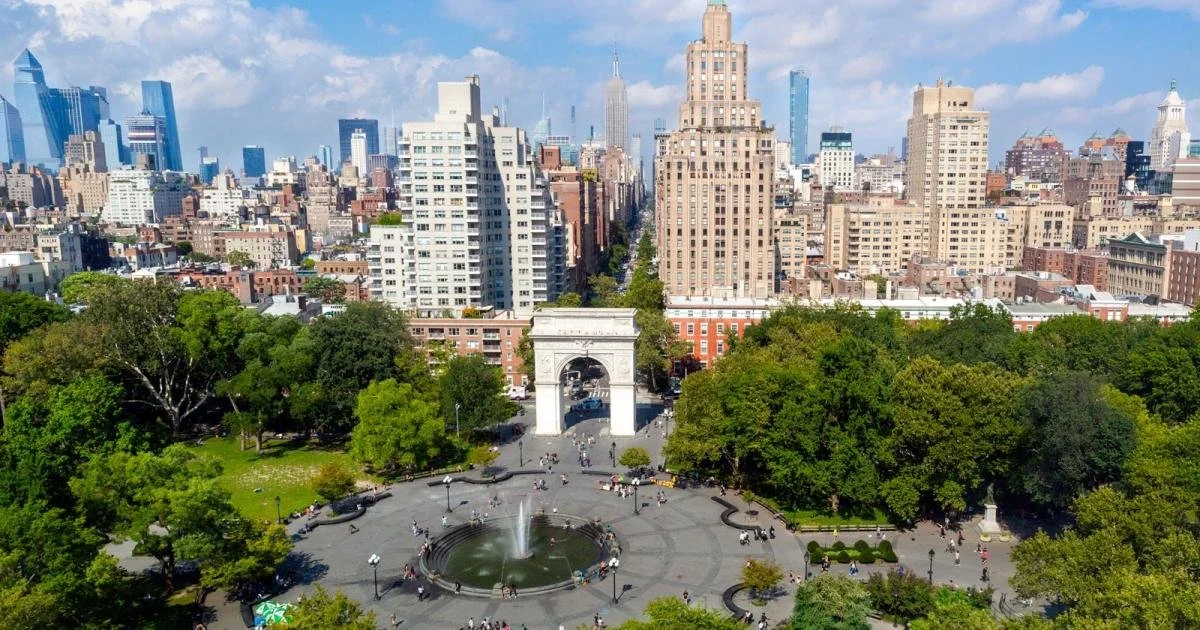
Washington Square Park, with its celebrated marble arch, remains the historic and cultural heart of Greenwich Village.
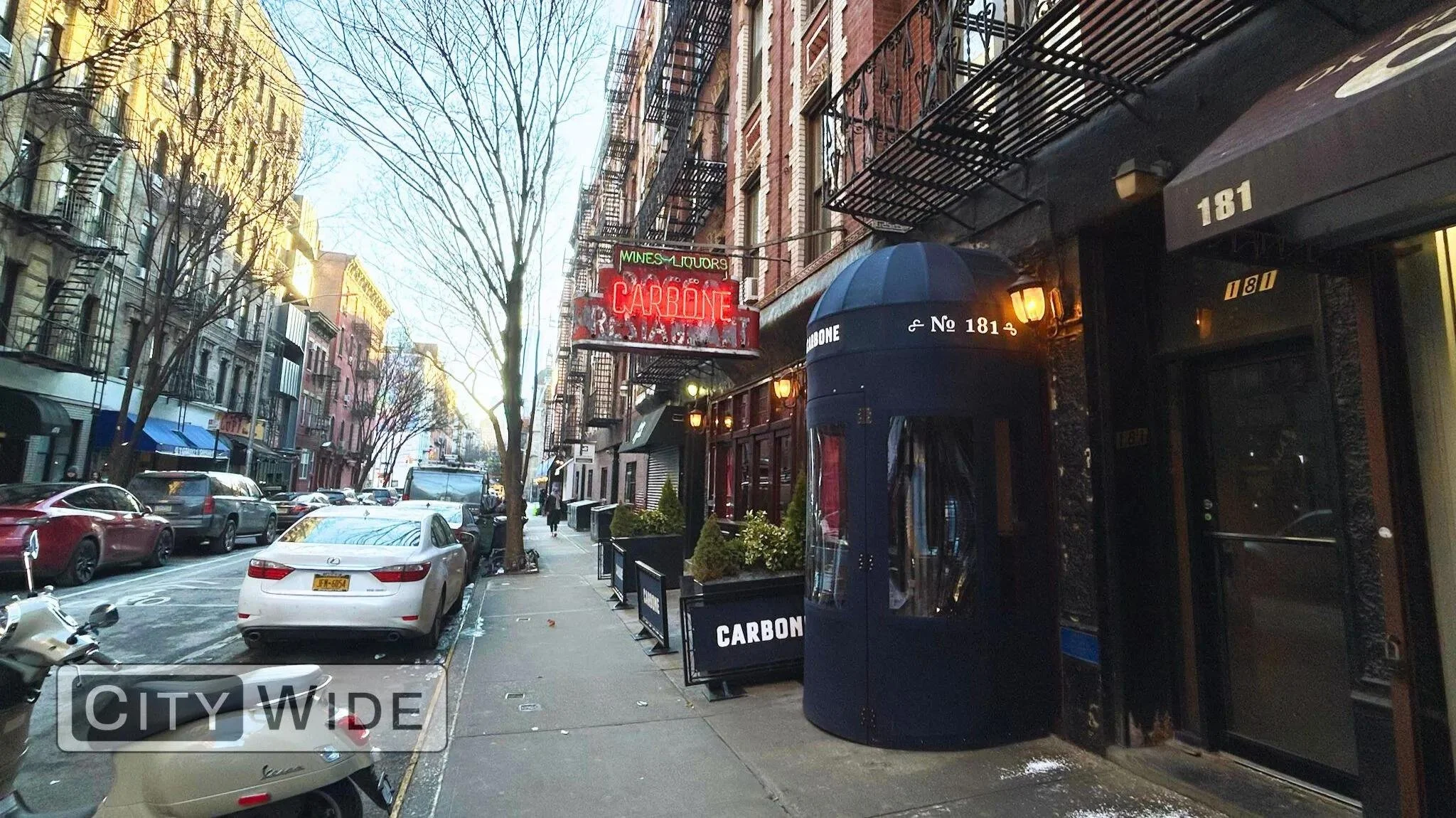
Thompson Street, where the architectural intimacy of historic Greenwich Village provides an unlikely setting for an internationally celebrated restaurant.
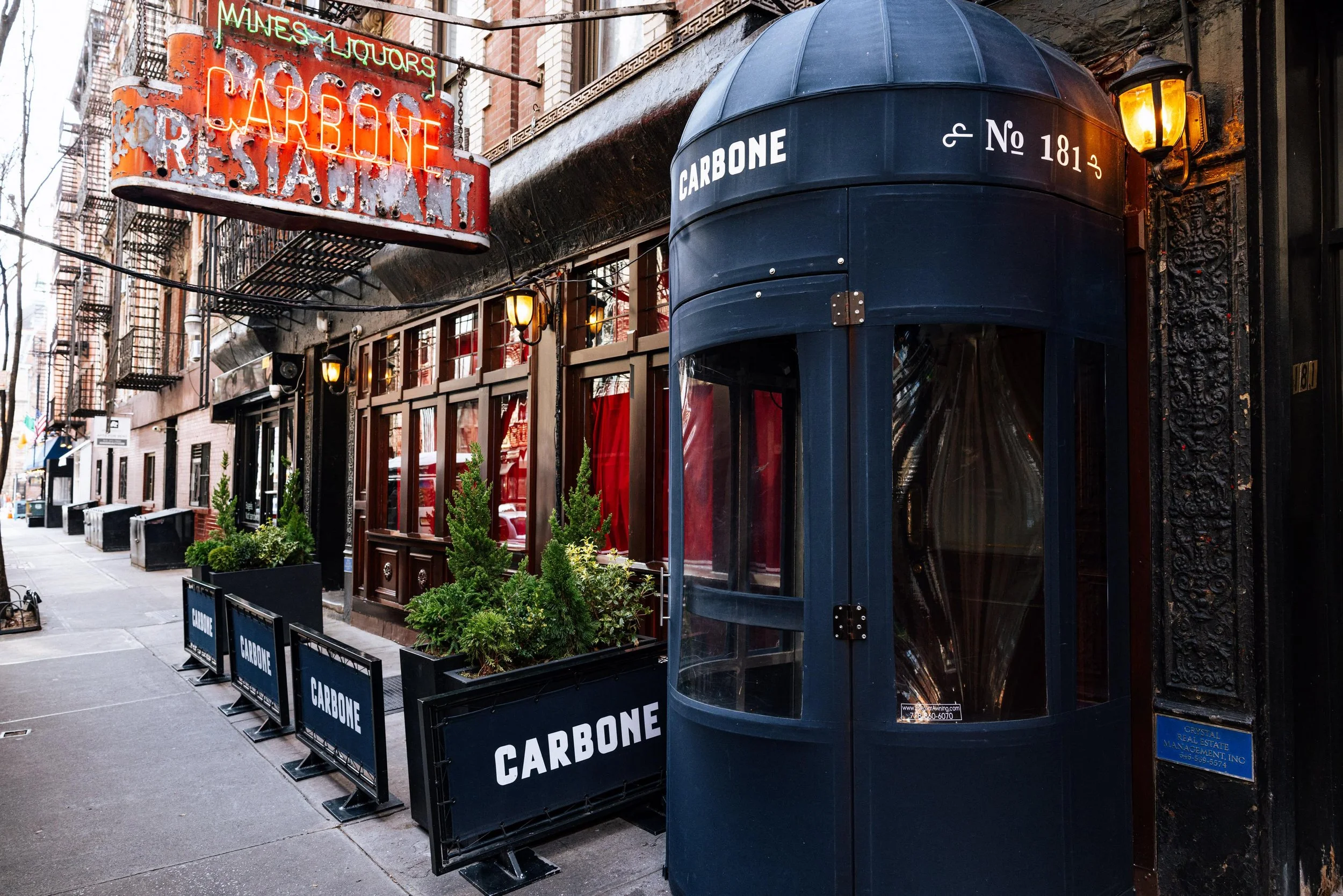
181 Thompson Street, the former home of Rocco and the birthplace of Carbone's international restaurant empire.
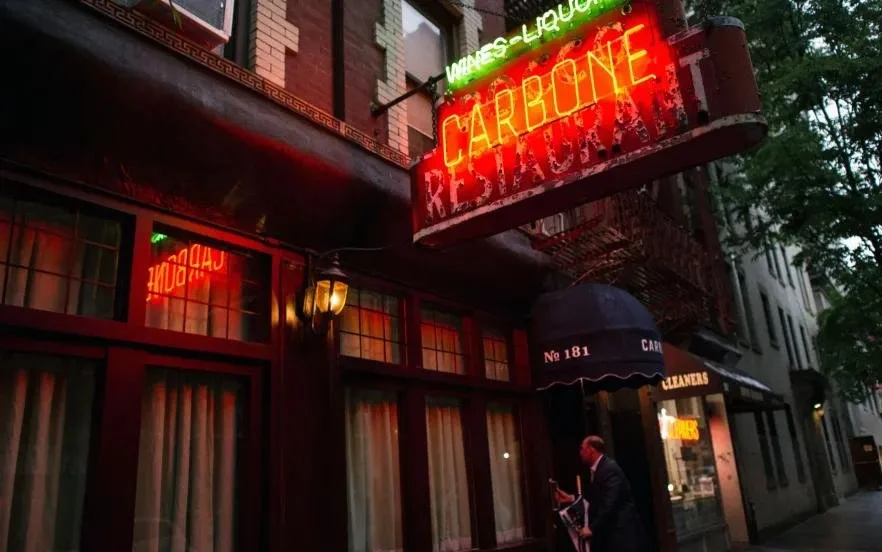
Carbone’s illuminated signage incorporates the original Rocco sign, preserving a tangible connection to the restaurant’s Italian-American heritage.
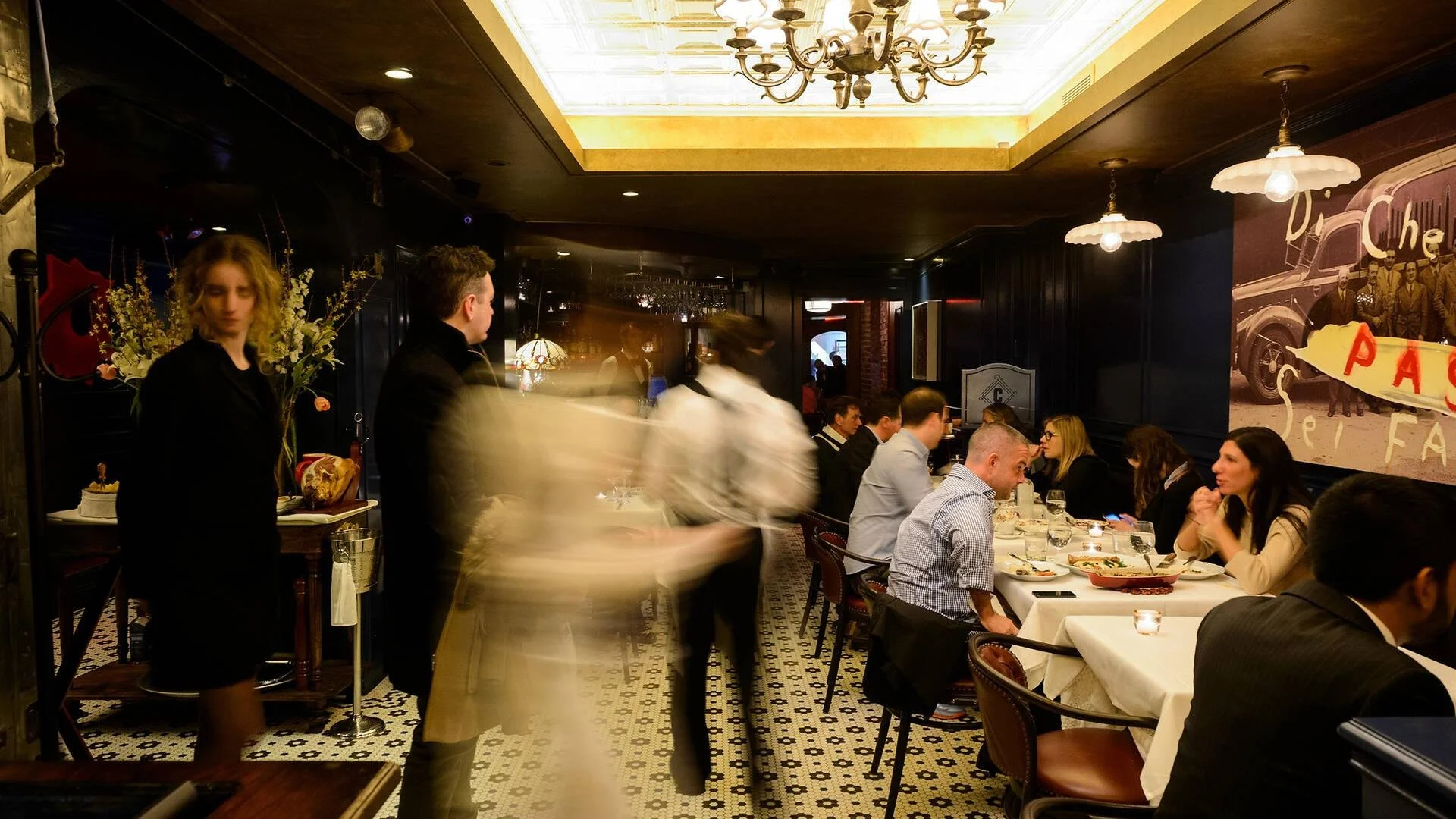
Beyond the neon sign, Carbone transports its guests into a richly imagined era of Italian-American dining.
A Dining Room Worthy of The Godfather
Among the most intriguing details of Carbone’s interior is something the casual visitor might scarcely notice: the floor.
While contemplating the design of the restaurant, Jeff Zalaznick happened to be watching Francis Ford Coppola’s 1972 masterpiece, The Godfather. The patterned tile flooring in the fictional Louis’ Italian-American Restaurant in the Bronx caught his attention. So captivated was he by the detail that he commissioned a specially manufactured floor inspired by the one in the film.
The walls, however, are considerably more contemporary than the flooring might suggest. The founders enlisted art dealer Vito Schnabel, son of the celebrated artist and filmmaker Julian Schnabel, to curate the restaurant’s artwork. The resulting collection introduces a sophisticated element of irreverence into the otherwise nostalgic surroundings.
The furnishings evoke the prosperous Italian-American establishments of an earlier generation, with burgundy leather, gleaming woodwork, brass chandeliers and immaculately dressed tables. Dean Martin and other familiar voices from the middle of the twentieth century contribute to the illusion that somewhere beyond the curtained windows, it might still be 1958.
When Carbone opened in 2013, its seventy-two seats represented a remarkably intimate stage upon which the founders could present their ambitious interpretation of Italian-American hospitality. The waiters, the music, the artwork and even the conversations between guests and staff were conceived as essential elements of the experience.
Whereas Ralph Lauren sought to immerse his guests in the cultivated elegance of the sporting aristocracy, Carbone's founders drew their inspiration from a considerably more exuberant culture, one in which dinner was an occasion for generosity, conversation and unapologetic abundance.
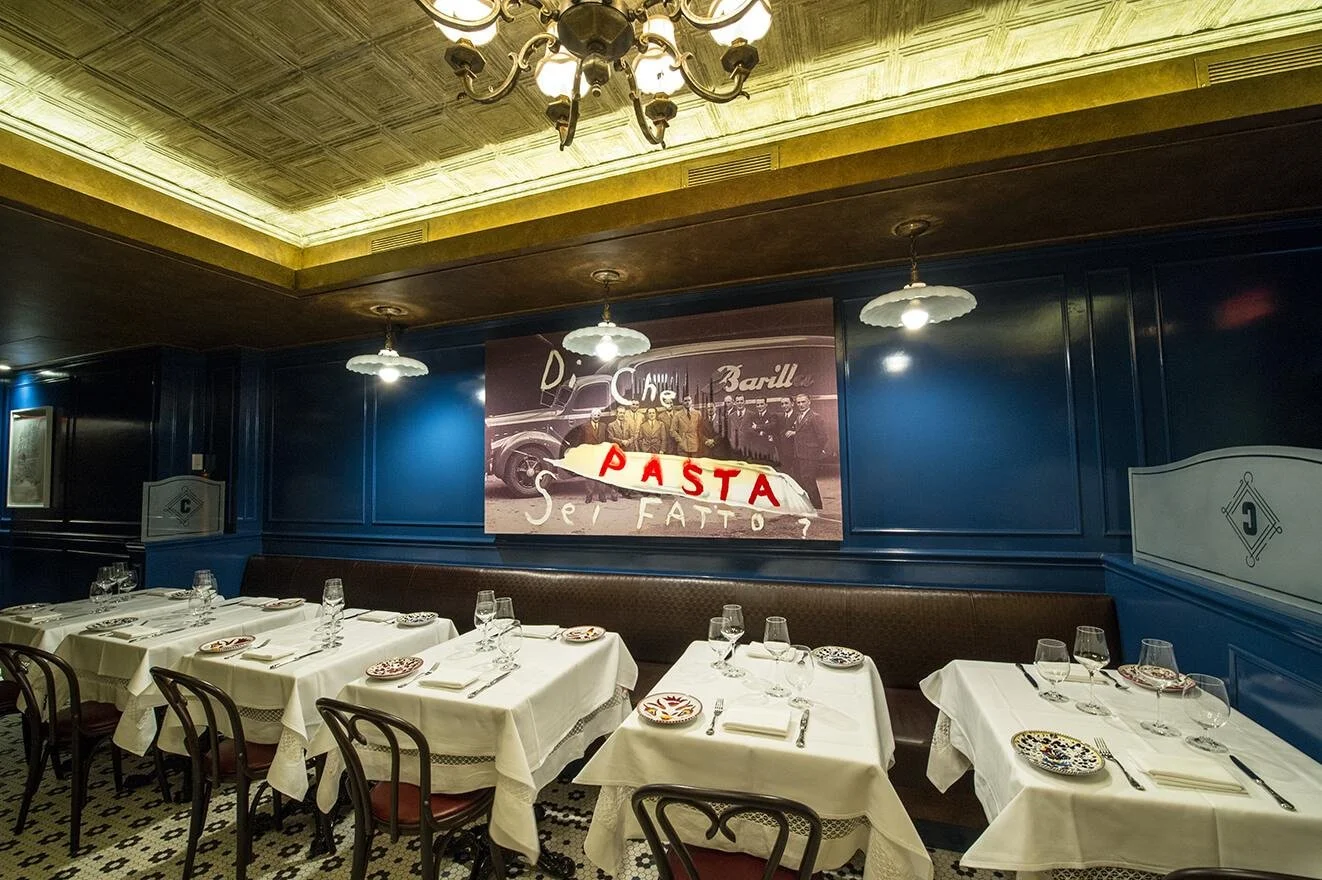
Carbone’s principal dining room, where vintage Italian-American glamour meets contemporary art and cinematic nostalgia.
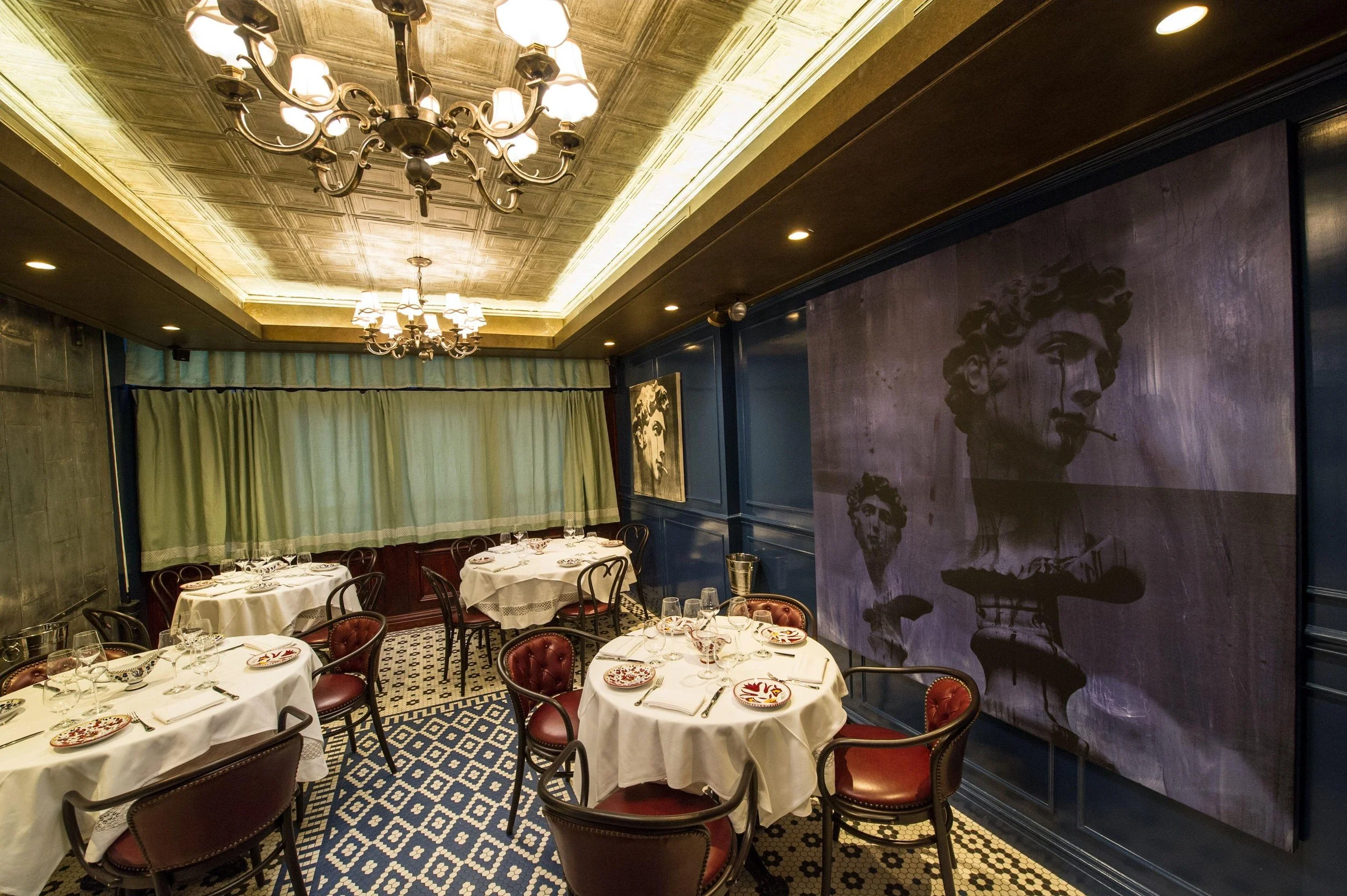
An intimate dining setting that continues the restaurant’s interpretation of mid-century Italian-American elegance.
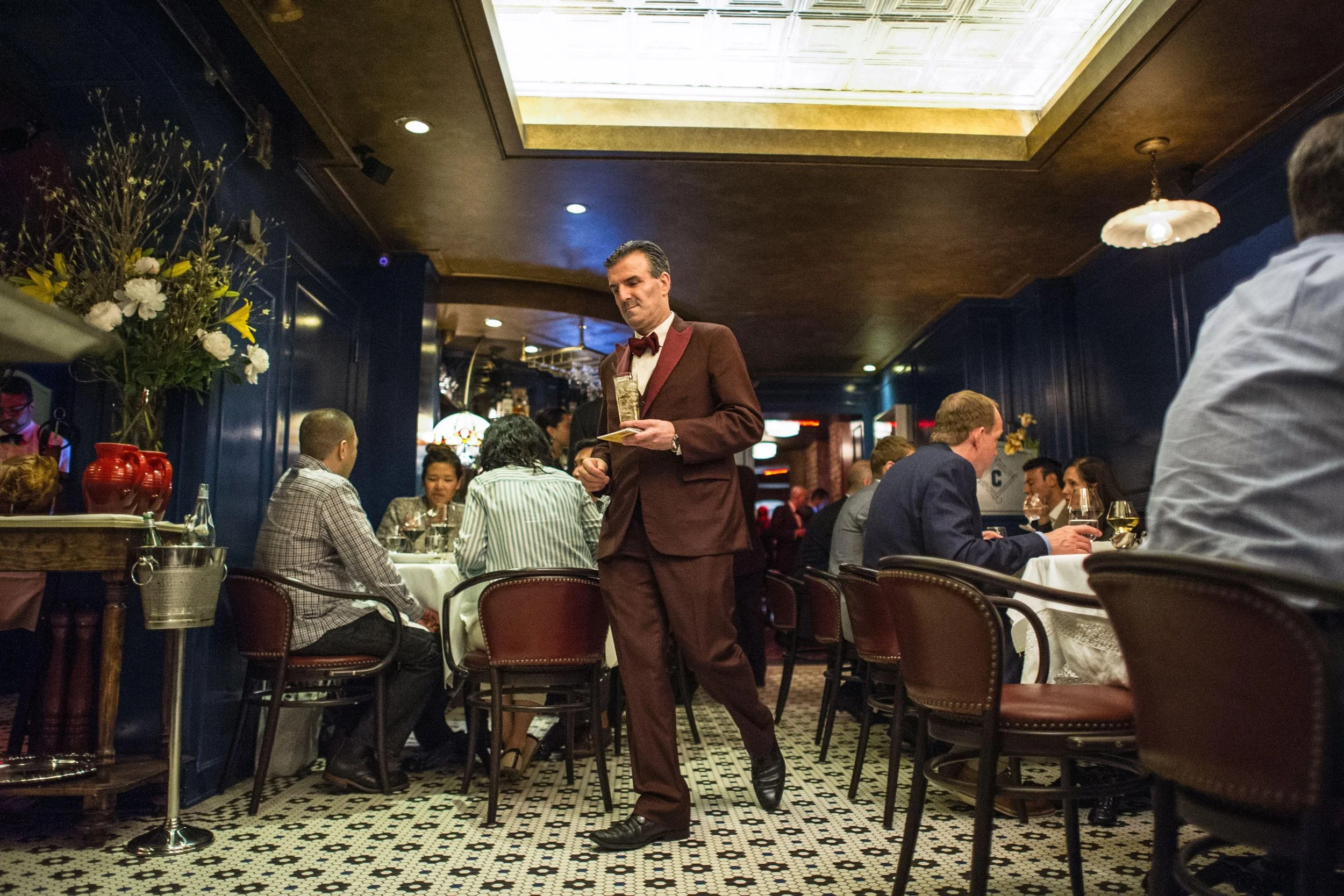
The elegantly attired Carbone captain — a tribute to the almost vanished tradition of the Italian-American headwaiter.
The Captains in Couture
In an age in which even some of the world's most expensive restaurants have abandoned formal attire, Carbone entrusted the appearance of its waitstaff to one of America's most celebrated fashion designers, Zac Posen.
Posen created distinctive burgundy tuxedos with broad satin peaked lapels, accompanied by pale pink shirts and matching burgundy bow ties. The bartenders were outfitted in equally distinctive double-breasted, eight-button waistcoats. The rich colors and generous proportions of the tailoring recalled the sartorial confidence of the late 1950s and early 1960s.
The men wearing these extraordinary uniforms are known as captains, and their responsibilities extend considerably beyond taking orders and delivering plates. They preside over their tables with a combination of authority, humor, familiarity and theatrical flair.
Before the restaurant opened in 2013, Jeff Zalaznick assembled his captains for intensive training intended to revive a style of hospitality that had largely disappeared from American dining rooms. The objective was to restore the personality of the great Italian-American headwaiter, a man who possessed the confidence to recommend dinner, the knowledge to explain its preparation and the social intelligence to recognize precisely how much attention his guests desired.
The preparation of the Caesar salad becomes a performance in its own right. The enormous veal parmigiana is divided at the table, and the preparation of flambéed desserts provides a suitably dramatic conclusion to the evening.
The Art of Being Seen
Carbone's dining room has attracted an extraordinary assortment of fashionable personalities, including Rihanna, Taylor Swift and members of the Kardashian family.
Yet celebrity does not necessarily guarantee admission. Justin and Hailey Bieber have reportedly been turned away when arriving without a reservation, an incident that rather neatly illustrates the peculiar hierarchy of Manhattan dining.
The social fascination of Carbone lies partly in the unpredictability of one's fellow diners. A table may be occupied by a celebrated musician, a fashion designer, a prominent financier or an entirely anonymous couple celebrating a wedding anniversary.
For the duration of the evening, they are participants in the same theatrical production, presided over by their impeccably dressed captains.
It is a particularly clever form of hospitality. Rather than merely feeding its guests, Carbone makes them feel as though they have been cast in a magnificent production of New York itself.
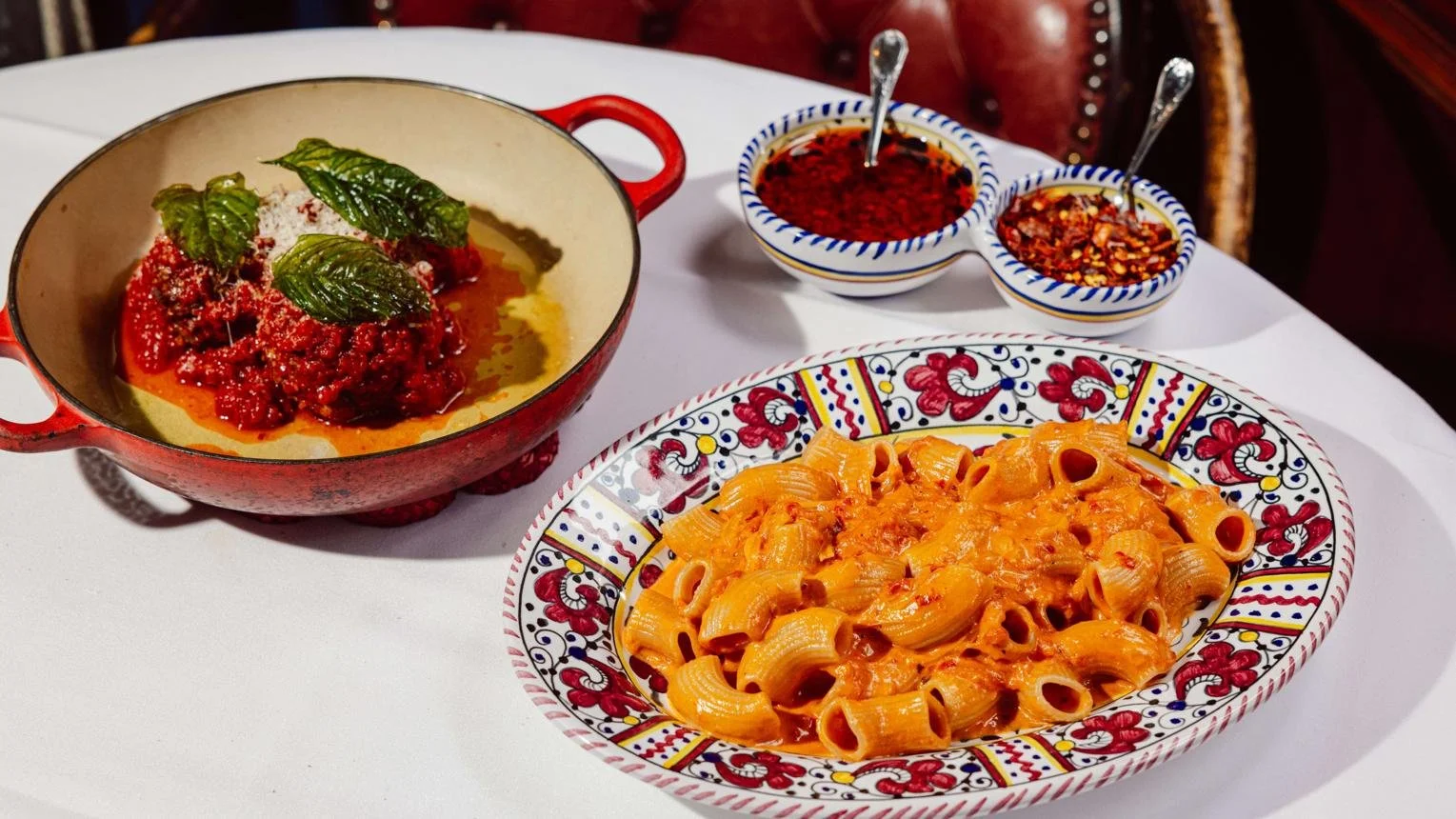
The generous traditions of Italian-American cooking, presented on colorful Italian dinnerware reminiscent of an earlier generation.
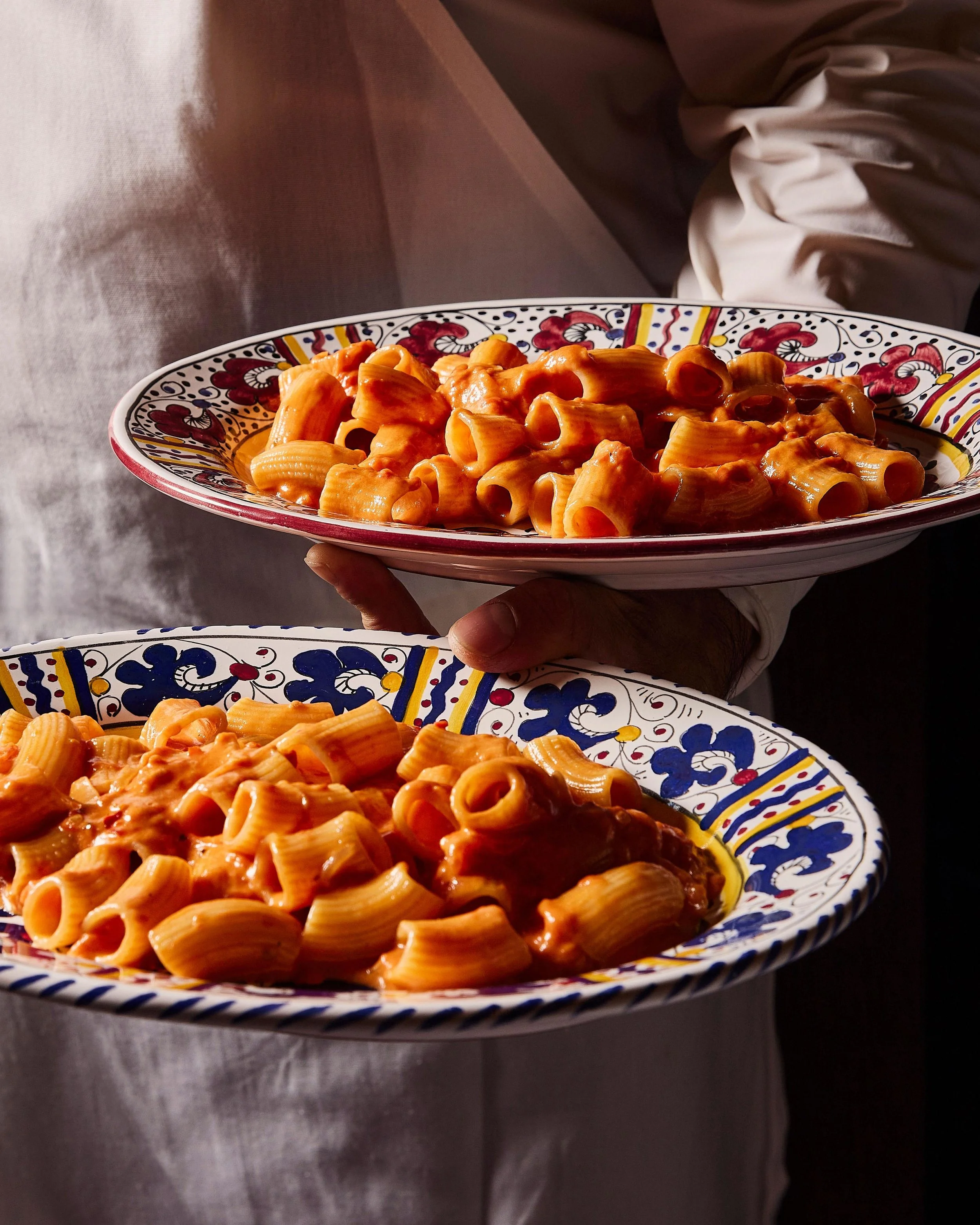
Carbone’s celebrated Spicy Rigatoni Vodka, a deceptively simple dish that has become an international culinary sensation.
The Most Coveted Plate of Pasta in Manhattan
Mario Carbone grew up in Queens, where his culinary education began long before he entered the prestigious Culinary Institute of America. His mother's family favored the more refined traditions of northern Italian cooking, while his father's Sicilian family embraced the magnificent Italian tradition of abbondanza, or abundance.
Both influences are evident in his restaurant. The sophistication of his classical training is married to the generosity and familiar flavors of the Italian-American family table.
The extraordinary success of his Spicy Rigatoni Vodka illustrates this philosophy particularly well. The dish combines the comforting richness of a creamy tomato sauce with the distinctive heat of Calabrian chili. Its appeal lies not in exotic ingredients or elaborate presentation but in the refinement of something familiar.
Other specialties include the flamboyantly presented Caesar alla ZZ, lobster ravioli, baked clams, lobster fra diavolo and an imposing veal parmigiana. The menu reads almost like a catalogue of the most beloved dishes of twentieth-century Italian-American dining.
For dessert, the chocolate hazelnut cake provides a suitably extravagant conclusion to the evening.
The Curious Case of the Vanishing Michelin Star
In October 2013, scarcely seven months after opening its doors, Carbone was awarded its first Michelin star for inclusion in the prestigious 2014 Michelin Guide. It was a remarkable achievement for a restaurant dedicated to resurrecting a style of Italian-American cooking that had frequently been dismissed by the culinary establishment as unsophisticated.
For nearly a decade, Carbone enjoyed the distinction. Then, in October 2022, Michelin withdrew its star. Carbone was not alone; two other celebrated New York institutions, Marea and Peter Luger, suffered the same fate.
In an intriguing twist, Carbone's sister restaurant, Torrisi, earned its own Michelin star the following year.
Yet the disappearance of Carbone's star did not diminish its extraordinary social cachet. Its reservations remained elusive, its celebrity clientele remained a source of fascination and its international expansion continued.
Perhaps this illustrates one of the most peculiar distinctions in the world of luxury dining. Michelin evaluates the culinary merits of a restaurant, whereas its patrons may covet something considerably more intangible: the atmosphere, the personalities, the history and the pleasure of belonging to a particular social world.
Carbone lost its Michelin star, but it certainly did not lose its glamour.
The Price of Nostalgia
According to Carbone's November 2026 menus, the celebrated Spicy Rigatoni Vodka costs $34. The Caesar alla ZZ is $35, lobster ravioli is $60, veal parmigiana is $98 and the Ribeye Diana is $115.
For a substantial dinner, including several shared dishes, beverages, tax and gratuity, a reasonable allowance is approximately $125 to $200 per person. Particularly extravagant selections can take the final bill considerably higher.
How to Secure a Table
Unlike Rao’s, where access depends primarily upon personal relationships, Carbone accepts reservations from the general public. Unlike The Polo Bar, where prospective diners compete for the attention of a telephone reservationist, Carbone's principal battleground is digital.
Reservations become available thirty days in advance at 10 a.m., Eastern Time, through Resy. Prospective diners should establish their accounts, enter their payment information and determine their preferred dates before reservations are released.
A deposit of $50 per person for dinner or $25 per person for lunch, plus applicable tax, is required and credited toward the final bill.
Those unsuccessful in their initial attempt should activate Resy's notification feature to receive alerts when tables become available. Lunch, particularly on a weekday, presents another possibility for experiencing the restaurant.
Reservations are nontransferable, and Carbone expressly cautions against acquiring them through unauthorized intermediaries.
The restaurant also maintains an appropriately elegant dress code. Shorts, open-toed shoes and tank tops are prohibited, and management reserves the right to refuse admission to guests whose attire it considers unsuitable.
The enduring fascination of Carbone is perhaps best understood through the extraordinary transformation of its celebrated neon sign. Beneath the illuminated letters spelling Carbone are the remnants of an earlier restaurant, a reminder of the generations of Italian immigrants who contributed so richly to the culinary identity of New York.
More than a decade after its opening, Carbone has accomplished something remarkable. It has made the traditions of yesterday some of the most desirable luxuries of today.
Address: 181 Thompson Street, New York, NY 10012
Neighborhood: Greenwich Village
Michelin distinction: Michelin Guide Selected.
Historic Michelin recognition: One Michelin star, 2014–2021 editions; star withdrawn in October 2022.
Lunch: Tuesday through Sunday, 11:30 a.m. to 2 p.m.
Dinner: Daily, 5 p.m. to 11:30 p.m.
Dress code: Elegant attire encouraged.
Reservations: Resy, thirty days in advance at 10 a.m., Eastern Time.
Telephone: (212) 254-3000
Email: reservations@carbonenewyork.com
Website: www.carbonenewyork.com
04 — 4 Charles Prime Rib
West Village / Established 2016
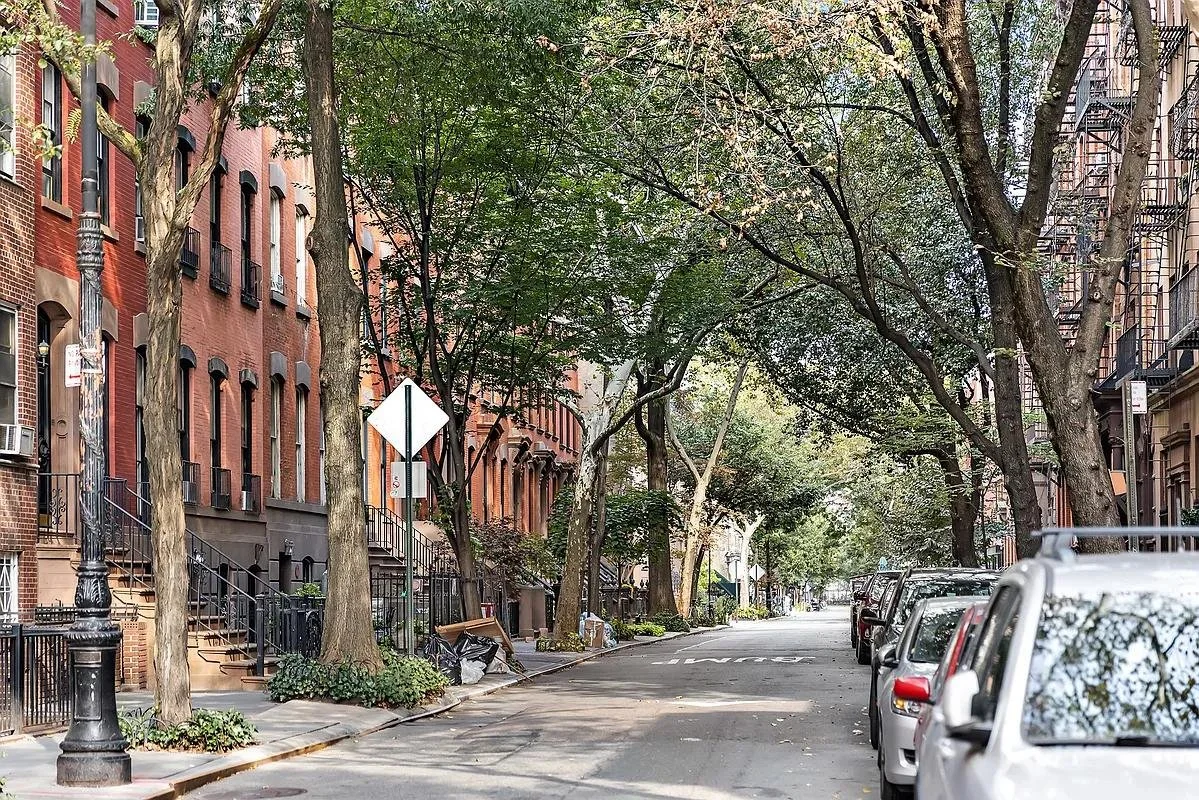
The West Village, where tree-lined streets and historic townhouses preserve an intimate, almost village-like atmosphere in the heart of Manhattan.
The residential streets of Manhattan’s West Village seem an unlikely setting for one of the most fiercely contested restaurant reservations in America. Here, historic townhouses stand shoulder to shoulder, and the architectural scale is considerably more intimate than that of Fifth Avenue.
At number 4 Charles Street, a restaurant occupies the lower level of a townhouse that for decades housed a neighborhood Spanish establishment known as El Charro Español. In December 2016, the address acquired an entirely new identity when Chicago restaurateur Brendan Sodikoff opened his first New York restaurant.
Unlike the founders of Carbone, Sodikoff looked toward the culinary traditions of the American Midwest for inspiration. Chicago, whose historic stockyards once supplied beef to much of the nation, had developed a particularly distinguished culture of steakhouses, chophouses and supper clubs.
Through his restaurant company, Hogsalt, Sodikoff had already demonstrated an extraordinary talent for making traditional American food fashionable again. His Chicago establishments included Bavette’s Bar & Boeuf, an atmospheric steakhouse, and Au Cheval, whose celebrated cheeseburger attracted nationwide attention and queues lasting several hours.
His New York restaurant, however, would be considerably more intimate. With just thirty-six seats at its opening, 4 Charles Prime Rib possessed the proportions of a private dining club rather than those of a conventional Manhattan steakhouse.
Curiously, during its initial opening period, the restaurant did not accept reservations at all. Contemporary reporting in December 2016 even described an evening when diners could enter without waiting during prime dining hours.
Such an opportunity would be almost unimaginable today.
Sodikoff had brought to Manhattan a romantic interpretation of the American supper club, an establishment devoted to exceptional beef, generous hospitality and the leisurely pleasures of an evening spent at the table. In doing so, he created a destination whose modest exterior conceals an extraordinary degree of desirability.
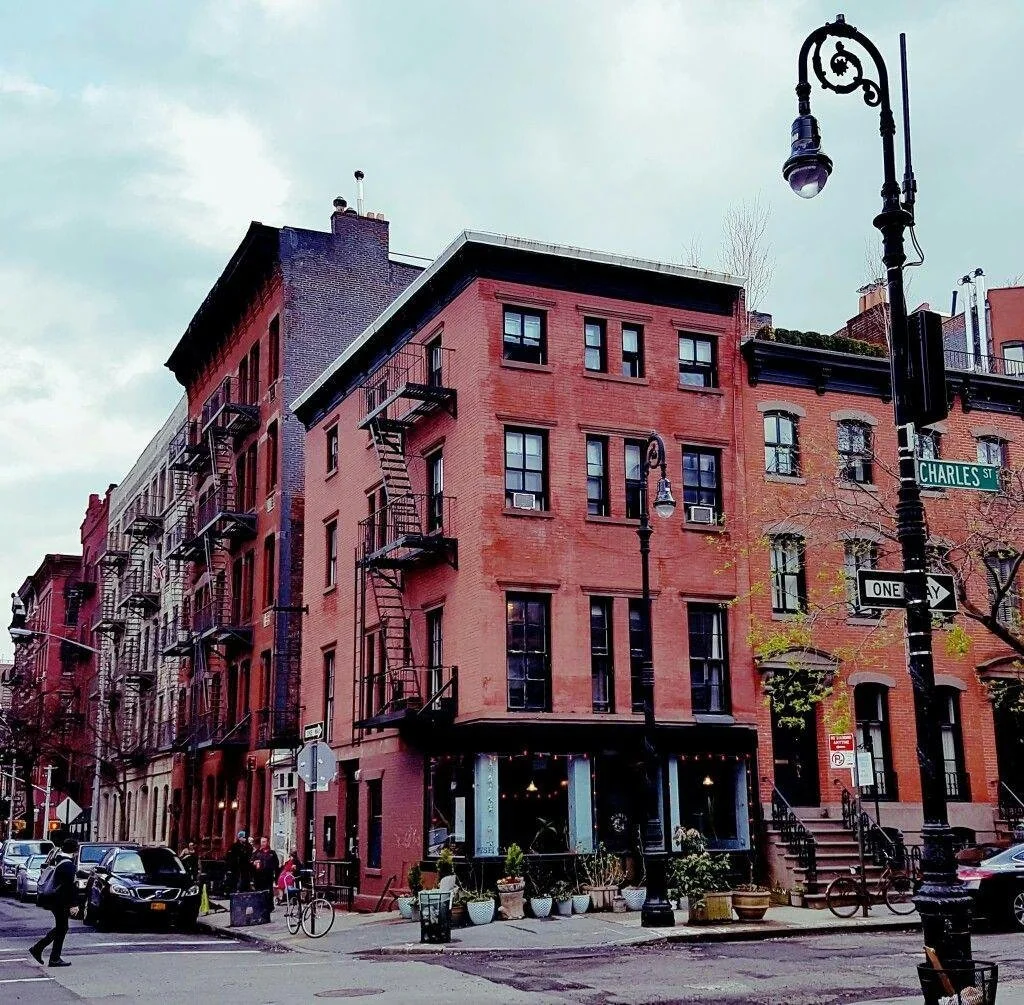
The residential character of Charles Street offers little indication that one of Manhattan’s most elusive dining reservations lies nearby.
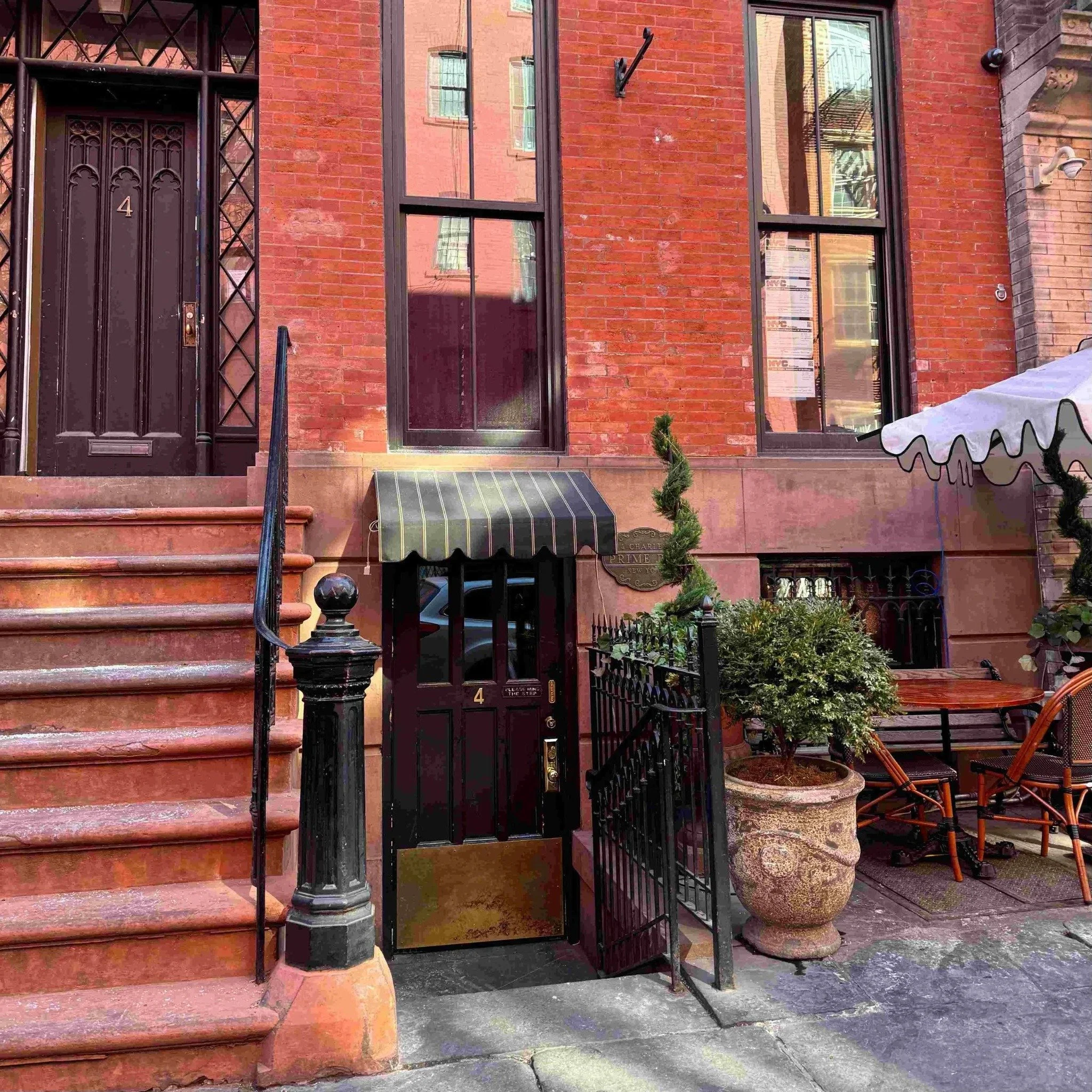
The historic townhouse at 4 Charles Street, where Chicago’s supper club traditions found a Manhattan home.
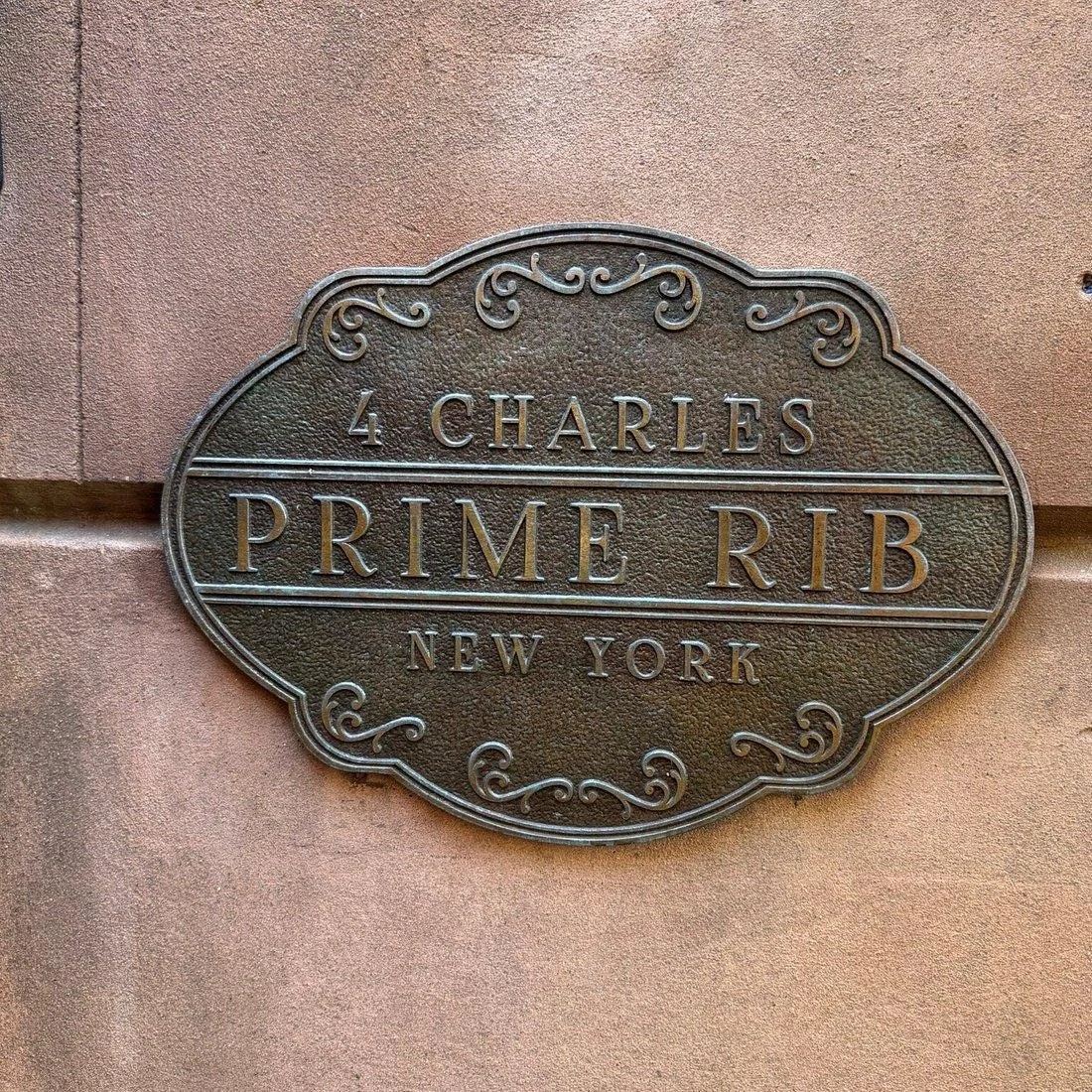
An understated entrance plaque announces one of New York’s most coveted dining destinations, without the fanfare ordinarily associated with such an establishment.
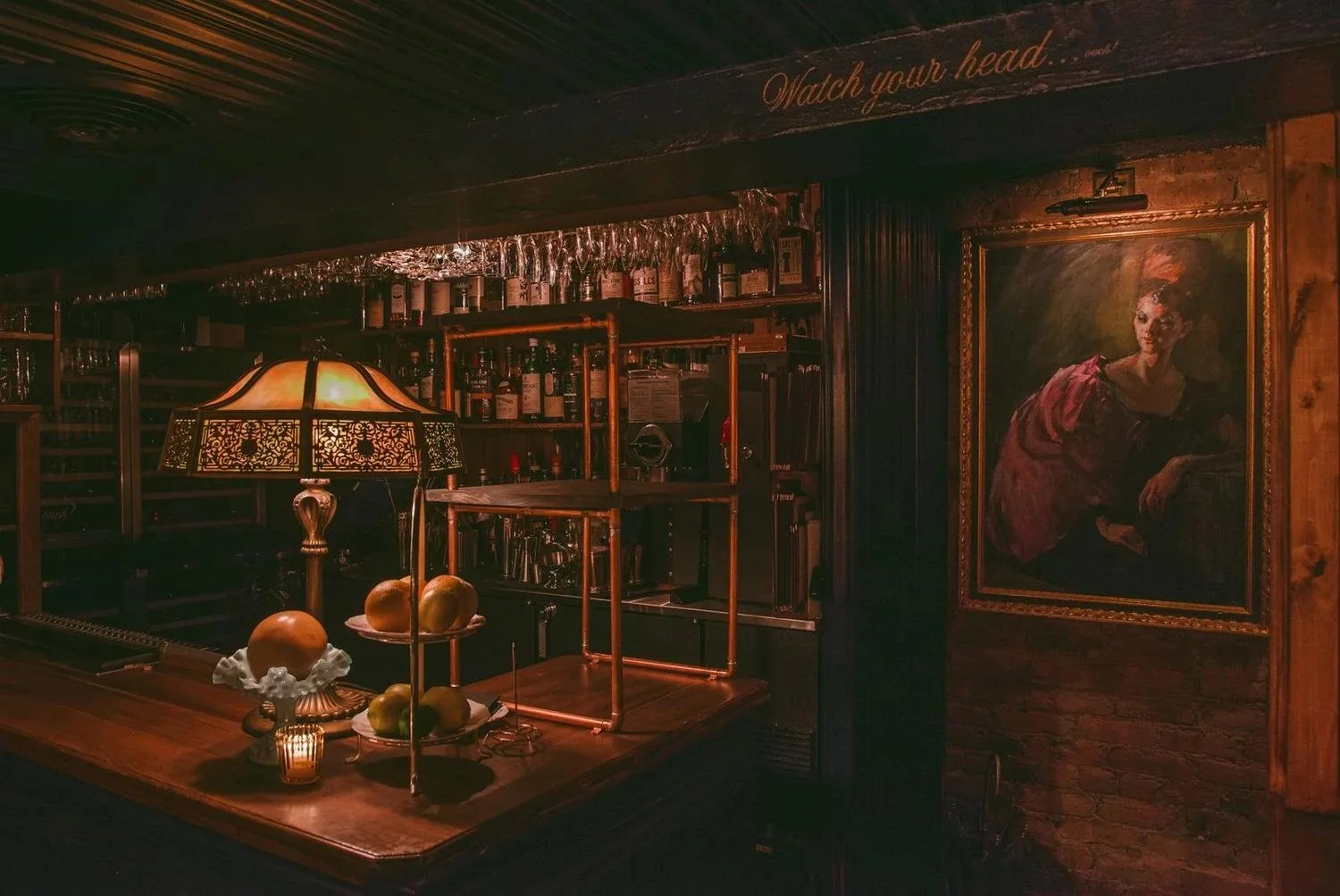
Beyond the discreet entrance, the atmosphere recalls a more intimate and leisurely era of American dining.
The Romance of the American Supper Club
In March 2017, scarcely three months after the restaurant opened, Vogue devoted an article to 4 Charles Prime Rib, recognizing in its intimate surroundings the vintage glamour of an Old Hollywood dinner club.
The American supper club occupies a distinctive place in the cultural history of the Midwest. Particularly popular throughout Wisconsin and neighboring states during the middle of the twentieth century, these establishments offered considerably more than dinner. An evening might encompass several leisurely hours of conversation, substantial portions of food and the pleasures of familiar company.
Brendan Sodikoff distilled the atmosphere of those establishments into a remarkably compact Manhattan dining room.
Crystal chandeliers illuminate dark wood paneling, richly upholstered leather banquettes and an eclectic assortment of paintings. The maritime pictures and portraits of elegantly attired women contribute to the impression that the furnishings have been accumulated over generations rather than assembled for a restaurant opening.
The absence of abundant natural light is an essential part of the atmosphere. Once seated, guests are comfortably removed from the activity of contemporary Manhattan, enveloped instead in the warmth of shaded lamps, polished wood and the familiar sounds of jazz.
The Intimacy of Ten Tables
Like Rao’s, 4 Charles Prime Rib owes a considerable proportion of its exclusivity to its diminutive size. In March 2017, restaurant critic Ryan Sutton reported that the establishment contained just ten tables.
Within such intimate surroundings, the personality of the waitstaff assumes particular importance. Formally attired servers cultivate a surprisingly informal relationship with their guests, dispensing recommendations with considerable humor and confidence.
The contrast is deliberate: the dignity of traditional steakhouse service without the stiffness sometimes associated with formal dining.
Even the humble cheeseburger receives a ceremonial presentation. In its 2017 review, Time Out New York described a server donning a glove before extracting the knife from the burger, dividing it into portions and presenting the interior for the diners’ admiration.
There is something delightfully extravagant about devoting such ceremony to one of America's most commonplace culinary inventions.
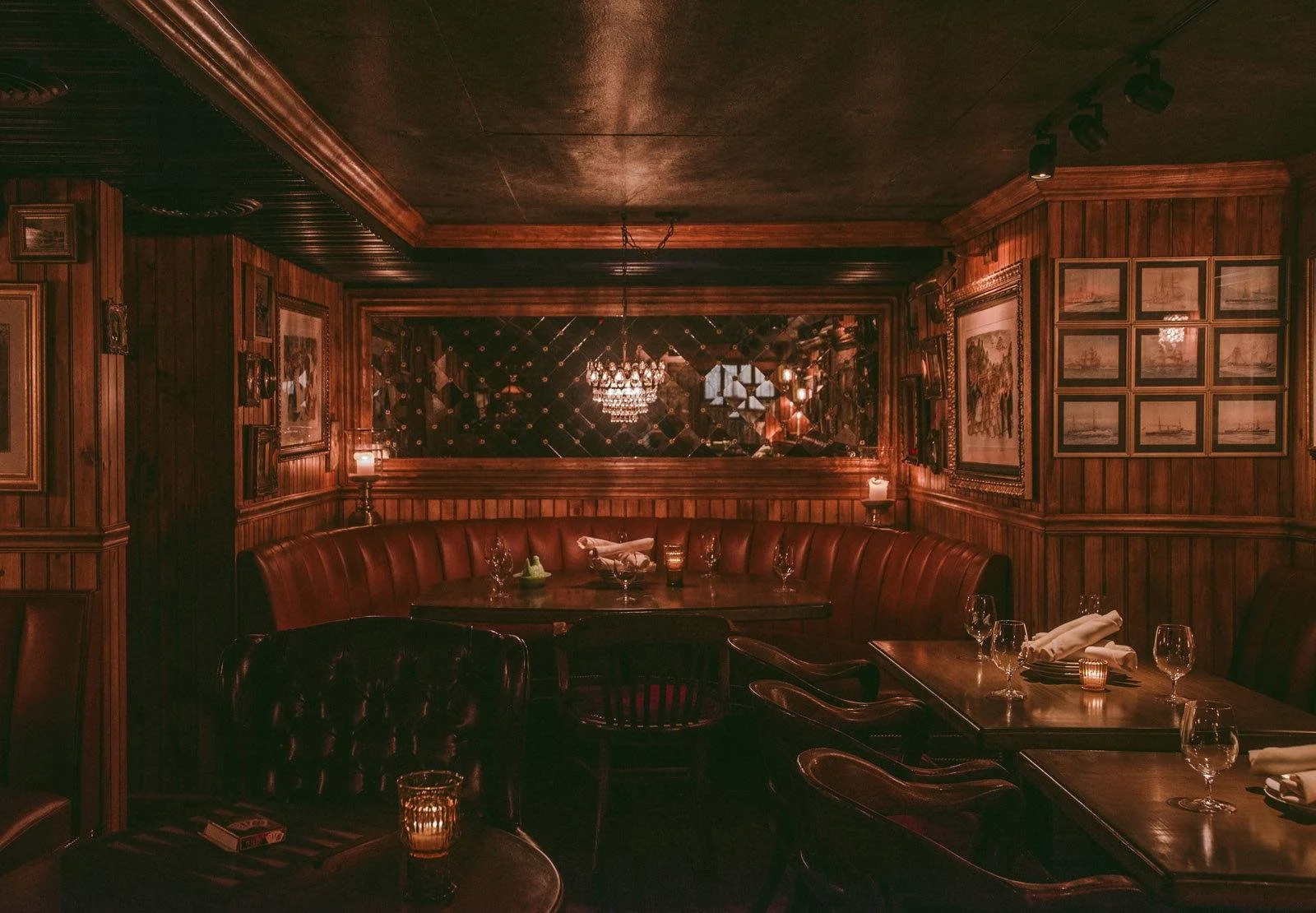
Crystal chandeliers, leather banquettes and dark wood paneling evoke the intimate glamour of a traditional American supper club.
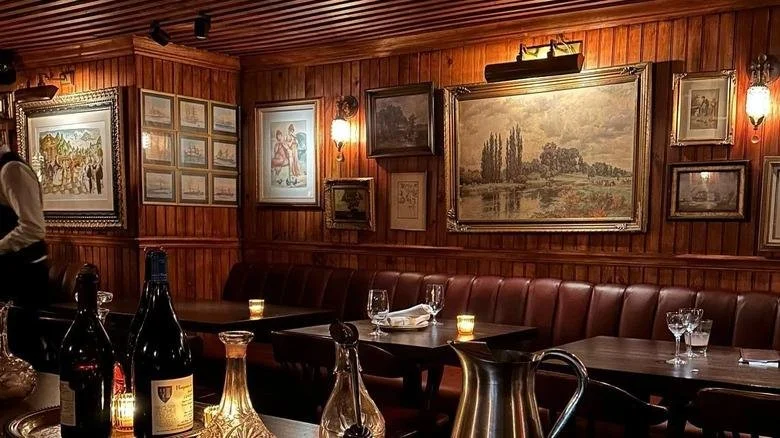
An eclectic collection of artwork lends the dining room the character of a private residence furnished over generations.
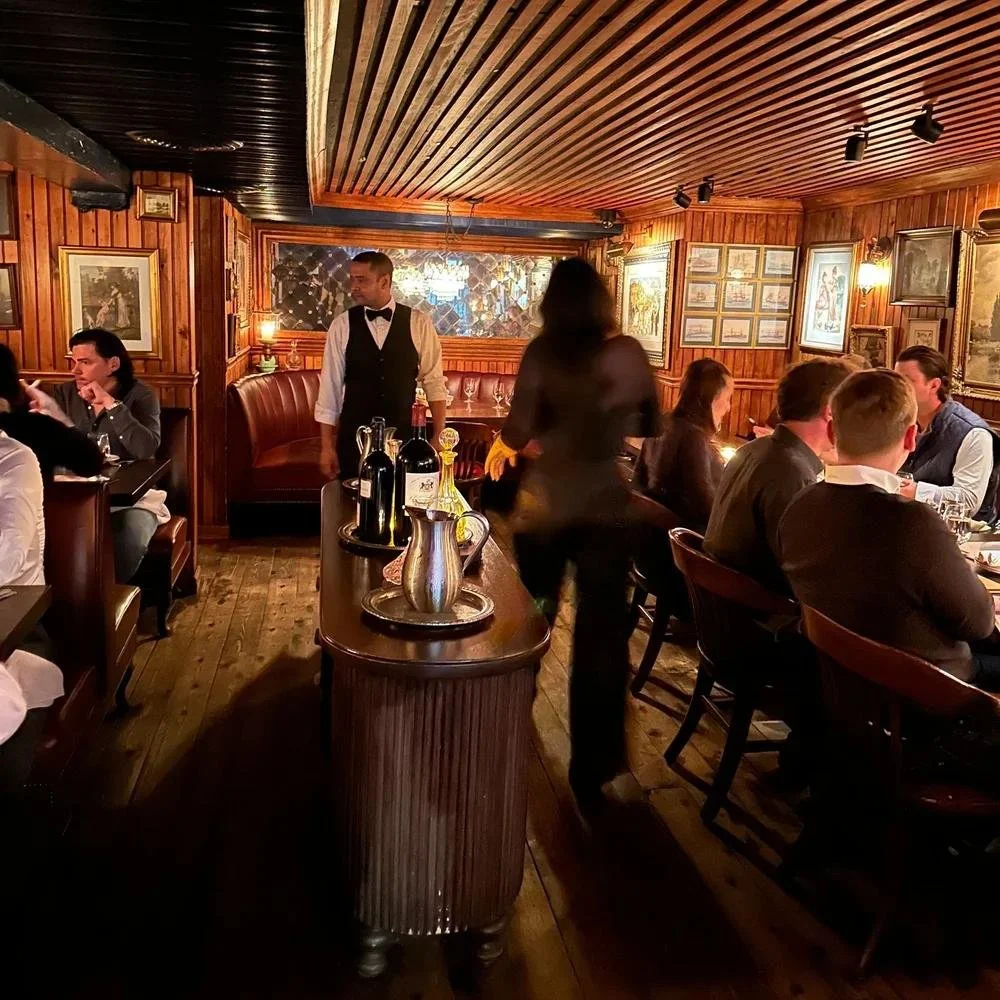
Traditional formal attire accompanies a distinctly American style of personable and theatrical service.
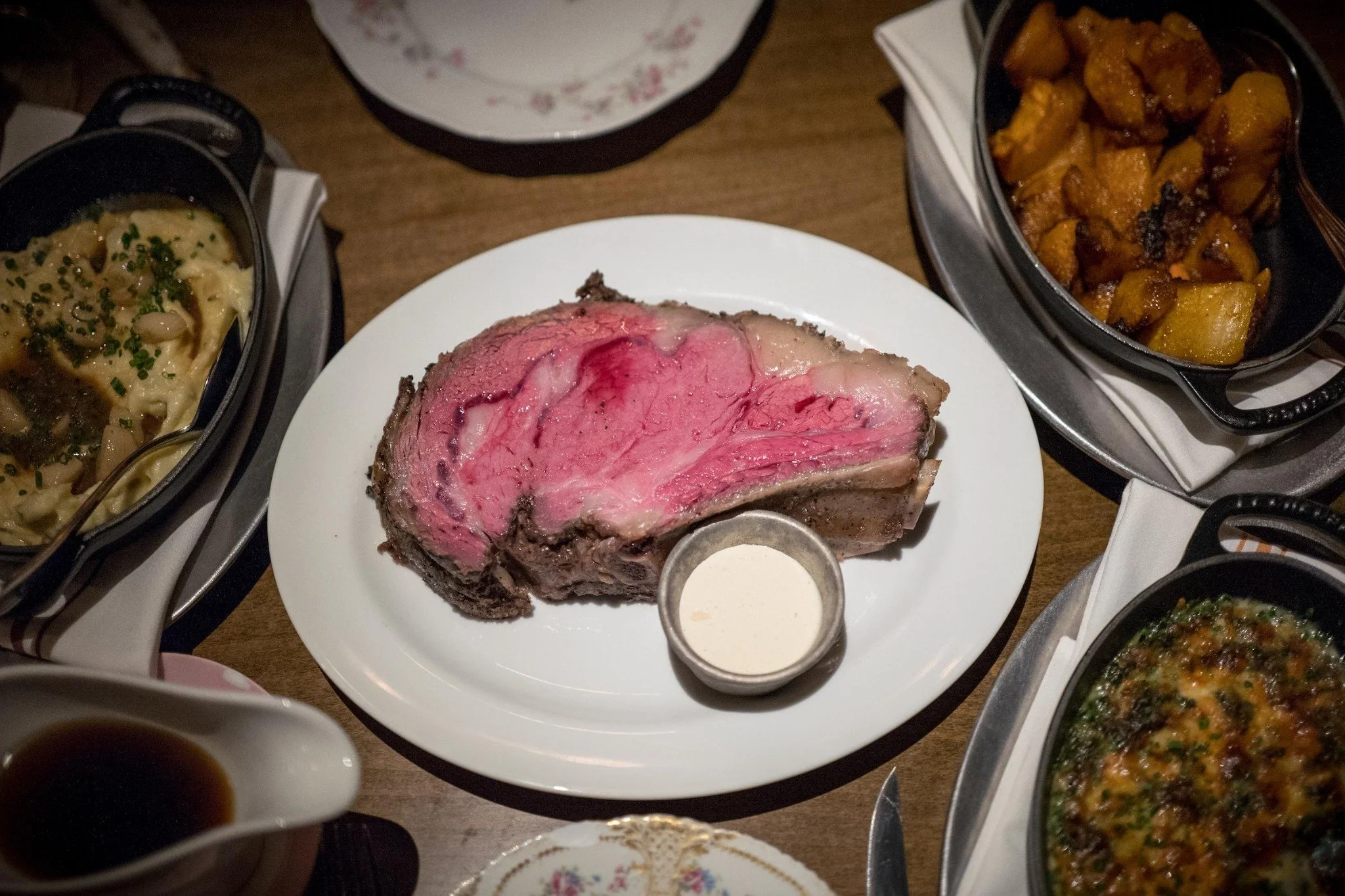
The restaurant’s namesake prime rib — a celebration of the great American steakhouse tradition.
An American Feast
At 4 Charles Prime Rib, the restaurant's namesake is traditionally roasted for twelve hours and presented in three different cuts: the thinly sliced English Cut, the more substantial Chicago Cut and the imposing 4 Charles Cut. Accompanied by beef jus and horseradish cream, the roast represents one of the enduring pleasures of the traditional American steakhouse.
The supporting dishes are equally indulgent. Creamed spinach, buttery mashed potatoes, truffle macaroni and cheese, baked crab cakes and thick-cut bacon reflect the generous culinary traditions of the Midwest.
Yet, rather remarkably, the dish responsible for much of the restaurant's contemporary mythology is not its prime rib but its cheeseburger.
The celebrated double Wagyu cheeseburger features American cheese, pickles, onions and the restaurant's distinctive sauce, with the optional additions of thick-cut bacon and a fried egg. Its origins lie in Brendan Sodikoff's Chicago restaurant Au Cheval, where the hamburger had already acquired something approaching a cult following.
The decision to employ ordinary American cheese rather than an imported artisanal variety is particularly interesting. Sodikoff understands that the pleasure of a great American cheeseburger lies partly in the familiar combination of flavors that generations of Americans have enjoyed since childhood.
The Critics, the Michelin Plate and the Making of a Legend
The extraordinary popularity of 4 Charles Prime Rib becomes considerably more fascinating when one examines its early critical reception.
In March 2017, restaurant critic Ryan Sutton of Eater questioned whether the famous cheeseburger justified the considerable difficulty of obtaining a reservation. Although he admired aspects of the preparation of the Chicago Cut prime rib, he found inconsistencies between visits and considered some of Manhattan's established steakhouses superior.
The following month, Christina Izzo of Time Out New York similarly questioned whether the restaurant's food warranted the extraordinary competition for its ten tables. She admired the cheeseburger and the thick-cut bacon but was considerably less enthusiastic about the namesake roast.
Michelin, however, subsequently recognized the restaurant with a Michelin Plate in its 2020 New York guide. Introduced as a distinction for establishments serving good food, the Plate acknowledged culinary merit without conferring either a Michelin star or a Bib Gourmand.
Today, 4 Charles remains recommended by the Michelin Guide, which has also included it in its selections of iconic New York restaurants and establishments particularly likely to inspire envy among one's friends.
By August 2025, The Infatuation awarded the restaurant an impressive 8.7 out of 10, recognizing the considerable appeal of its intimate surroundings, theatrical hospitality and celebrated food.
The evolution of its reputation is fascinating. A restaurant that experienced some decidedly mixed reviews during its first year has become a Manhattan institution, despite never having achieved the distinction of a Michelin star in the documented history of its awards.
Perhaps the most extraordinary accomplishment of Brendan Sodikoff is that he has persuaded New Yorkers to compete for the privilege of eating something that is quintessentially American, wonderfully familiar and widely available elsewhere.
The cheeseburger may be commonplace. The experience of eating it at 4 Charles is not.
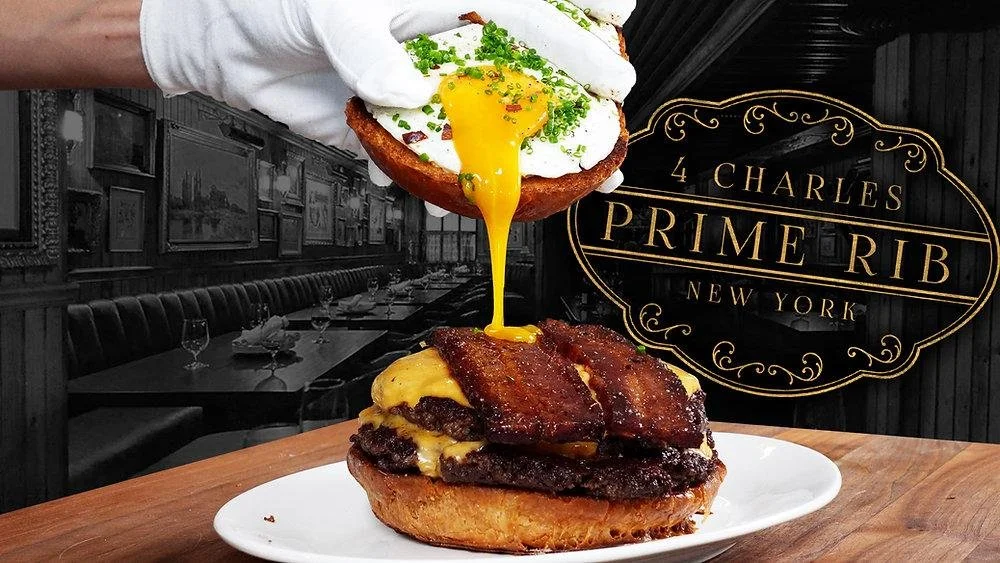
The celebrated double Wagyu cheeseburger, whose origins lie in Brendan Sodikoff’s enormously successful Chicago restaurant, Au Cheval.
The Price of American Indulgence
The prices at 4 Charles Prime Rib reflect its position among Manhattan's more luxurious steakhouses, although its celebrated cheeseburger remains relatively accessible to those fortunate enough to obtain a reservation.
Reported 2026 menu prices place the double Wagyu cheeseburger at $38.99, the English Cut prime rib at $79.99 and the limited 4 Charles Cut at $119.99. The substantial bone-in King Cut reaches $144.99.
The restaurant's desserts are equally indulgent, particularly its dark chocolate pie, prepared with Valrhona chocolate and an Oreo-cookie crust.
For a substantial dinner encompassing appetizers, prime rib, shared accompaniments, dessert and beverages, including tax and gratuity, allow approximately $150 to $250 per person.
How to Secure a Table
The pursuit of a reservation at 4 Charles Prime Rib requires considerably more preparation than its modest residential address might suggest.
Reservations are released through Resy at 9 a.m., Eastern Time, within a twenty-one-day booking window. Given the restaurant's remarkably limited seating, prospective diners would be well advised to establish their Resy accounts and enter their payment information well before the appointed hour.
Unlike Carbone, which requires a deposit credited toward the final bill, 4 Charles charges a reservation fee of $5 per person that is not applied toward the cost of dinner.
The restaurant accepts parties of no more than six guests. Those unable to secure a reservation upon its initial release should register for Resy's cancellation notifications. Weekend brunch presents another possibility, particularly since the restaurant also makes its dinner menu available during brunch service.
The extraordinary demand for these tables has contributed to the emergence of a secondary market in restaurant reservations. Management expressly prohibits the sale, exchange or unauthorized transfer of reservations and reserves the right to cancel such bookings without notice.
There is a rather intriguing contrast between 4 Charles and Rao’s. Both restaurants possess the intimacy of a private dining establishment, yet their methods of distributing that privilege are fundamentally different. At Rao’s, access is principally inherited through longstanding personal relationships. At 4 Charles, the prospective diner competes in a decidedly modern digital marketplace.
What makes 4 Charles particularly enchanting is the contrast between the frantic modern rituals necessary to obtain a reservation and the wonderfully unhurried atmosphere awaiting those who succeed.
Behind a discreet entrance on a quiet residential street, beneath the glow of crystal chandeliers, the pleasures of an earlier America have become some of the most elusive luxuries of contemporary Manhattan.
Address: 4 Charles Street, New York, NY 10014
Neighborhood: West Village
Michelin distinction: Michelin Guide Selected; no Michelin star.
Historic Michelin recognition: Michelin Plate, 2020.
Dinner: Daily.
Brunch: Weekends, with the full dinner menu also available.
Dress code: Smart casual or elegant evening attire recommended.
Reservations: Resy, twenty-one-day booking window, with new reservations released at 9 a.m., Eastern Time.
Reservation fee: $5 per person; not credited toward the final bill.
Maximum party size: Six guests.
Telephone: (212) 561-5992
Website: www.nycprimerib.com
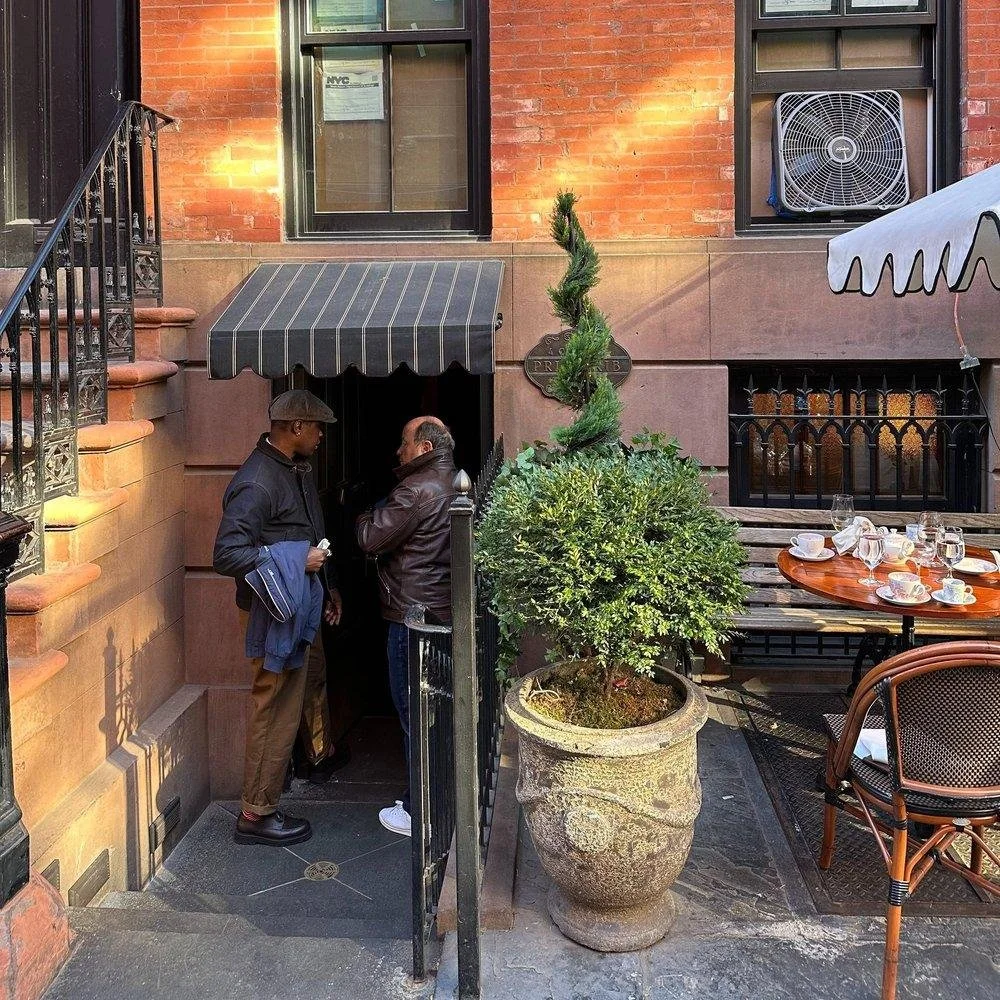
Outside the unassuming entrance to 4 Charles Prime Rib, where an ordinary West Village address has acquired extraordinary social significance.
05 — Torrisi
Nolita / Established 2022
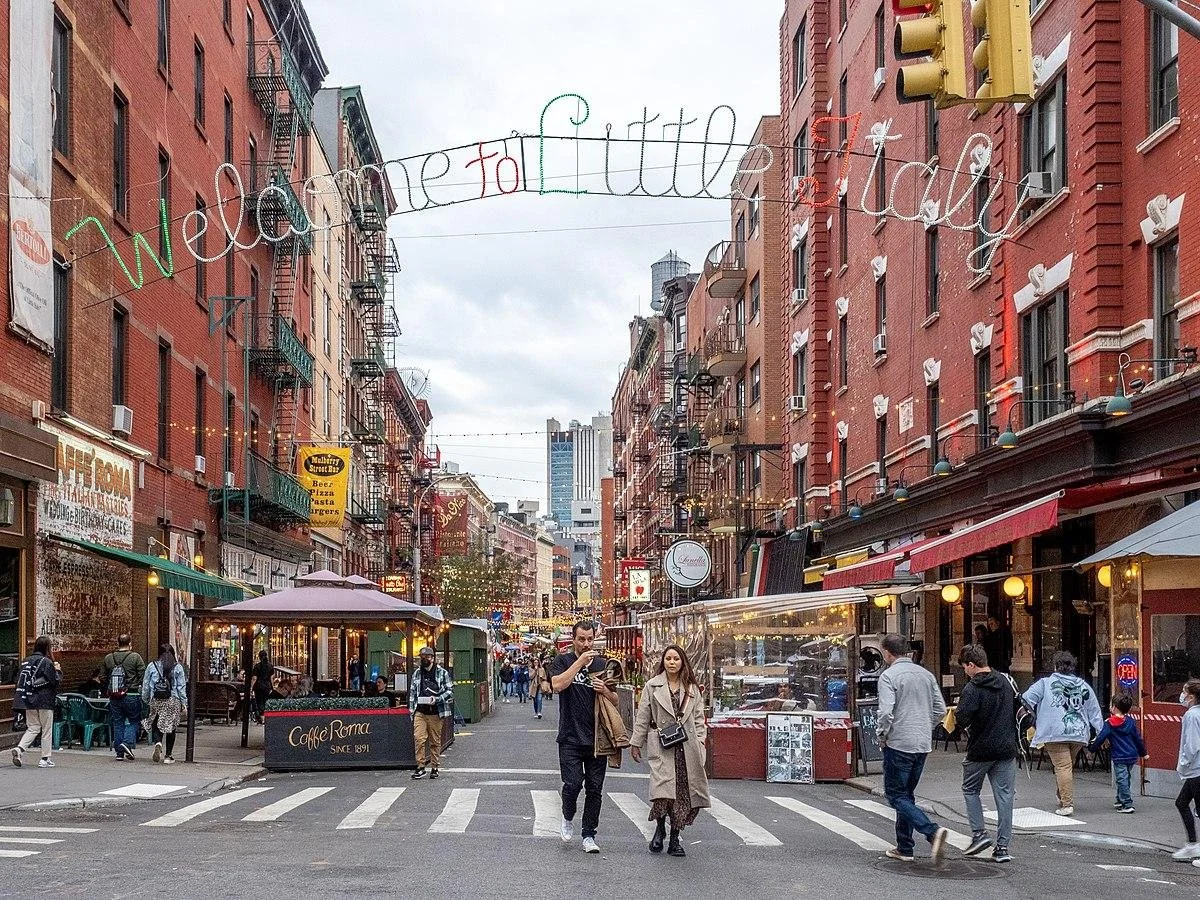
Manhattan’s historic Little Italy, where generations of immigrant families helped shape the culinary identity of New York.
Long before the celebrated dining room of Torrisi occupied the magnificent Puck Building, its story began in a tiny Italian delicatessen on Mulberry Street.
On December 30, 2009, two young chefs, Rich Torrisi and Mario Carbone, opened Torrisi Italian Specialties with financial assistance from friends and family. Both graduates of the Culinary Institute of America, they had worked together in the distinguished kitchens of Café Boulud, absorbing the techniques of classical fine dining before undertaking a considerably more personal culinary adventure.
Rich Torrisi, who grew up in Westchester County, New York, began working in professional kitchens at the remarkably young age of thirteen. His subsequent training included time at Aquavit under Marcus Samuelsson, Café Boulud under Andrew Carmellini and an exploration of the celebrated restaurant kitchens of France.
Yet his personal culinary ambition was rooted in the familiar flavors of his New York childhood.
The little Mulberry Street establishment initially served coffee and sandwiches. In March 2010, however, the two chefs introduced an evening menu priced at just $45 per person. There were eighteen seats and no reservations.
What made their approach particularly revolutionary was the recognition that Italian-American cooking possessed a culinary identity entirely deserving of serious attention. They were not attempting to reproduce the restaurants of Rome or Florence but to celebrate the food that Italian immigrants and their descendants had created in America.
Among the enthusiastic regulars was a young former investment banker named Jeff Zalaznick, who would become their business partner. From those modest beginnings emerged Major Food Group, the international hospitality empire responsible for Carbone and some of the most fashionable restaurants in the world.
The original Torrisi closed at the end of 2015. Seven years later, Rich Torrisi returned to Mulberry Street with a considerably grander interpretation of his original idea.
The new Torrisi opened on December 1, 2022, inside one of Manhattan’s most architecturally distinguished buildings. Its ambitions extended beyond Italian-American cooking to embrace the extraordinary diversity of New York itself.
If Carbone is a love letter to the Italian-American restaurants of an earlier generation, Torrisi is a love letter to the city that created them.

The historic storefronts and traditional restaurants of Little Italy recall the neighborhood’s enduring Italian-American culinary heritage.
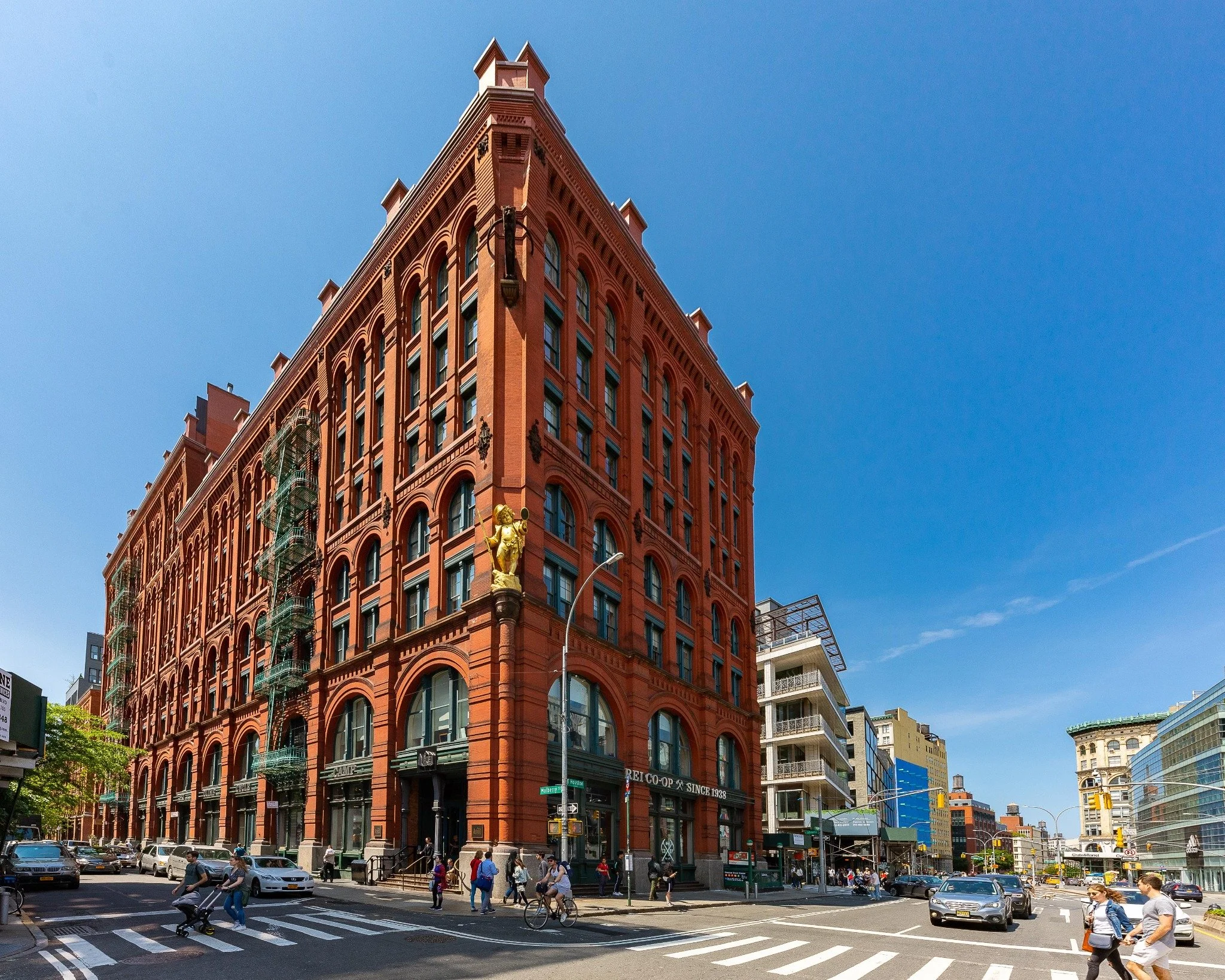
The magnificent Puck Building, a nineteenth-century Manhattan landmark and the architectural setting for Rich Torrisi’s ambitious culinary vision.
The Puck Building: A Monument to the Gilded Age
The magnificent red-brick building that houses Torrisi owes its existence not to the culinary arts but to the considerably more mischievous profession of political satire.
In 1885, Austrian-born cartoonist and publisher Joseph Keppler and his business associates commissioned the German-born architect Albert Wagner to design a permanent home for their enormously successful satirical magazine, Puck, and its associated printing enterprise.
The publication took its name from the mischievous supernatural character in William Shakespeare’s A Midsummer Night’s Dream. Its motto, derived from the same play, was particularly appropriate for a magazine devoted to exposing the absurdities of American political and social life: “What fools these mortals be!”
Through brilliantly colored illustrations, caricatures and political commentary, Puck entertained a readership that approached ninety thousand by the end of the 1880s. Its success necessitated a building of extraordinary proportions.
Constructed in stages between 1885 and 1893, the building represents a magnificent example of Romanesque Revival architecture, influenced by the German tradition known as Rundbogenstil, characterized by rounded arches. Its richly ornamented brickwork, imposing windows and substantial architectural proportions distinguish it even among the remarkable nineteenth-century buildings of Lower Manhattan.
Perhaps its most delightful architectural features are the two gilded figures of Puck himself. Rather than depicting Shakespeare's mischievous sprite in conventional theatrical costume, the magazine portrayed him as a rather impertinent little gentleman of the Gilded Age, equipped with a top hat, a pen and a mirror with which to expose the follies of society.
The building underwent a particularly dramatic alteration in the late 1890s, when the extension of Lafayette Street necessitated the removal of a substantial portion of its western side. An entirely new façade was constructed to harmonize with Wagner's original architectural design.
Although Puck ceased publication in 1918, the building continued to accommodate printing and publishing enterprises for much of the twentieth century. In 1983, its architectural and cultural significance was formally recognized through its designation as a New York City landmark and its inclusion in the National Register of Historic Places.
There is something particularly appropriate about Rich Torrisi establishing his restaurant within a building originally devoted to interpreting American society. The satirical magazine examined the peculiarities of American culture through illustration and humor; the restaurant explores its extraordinary diversity through food.
Separated by more than a century, both enterprises found their inspiration in the endlessly fascinating character of New York itself.
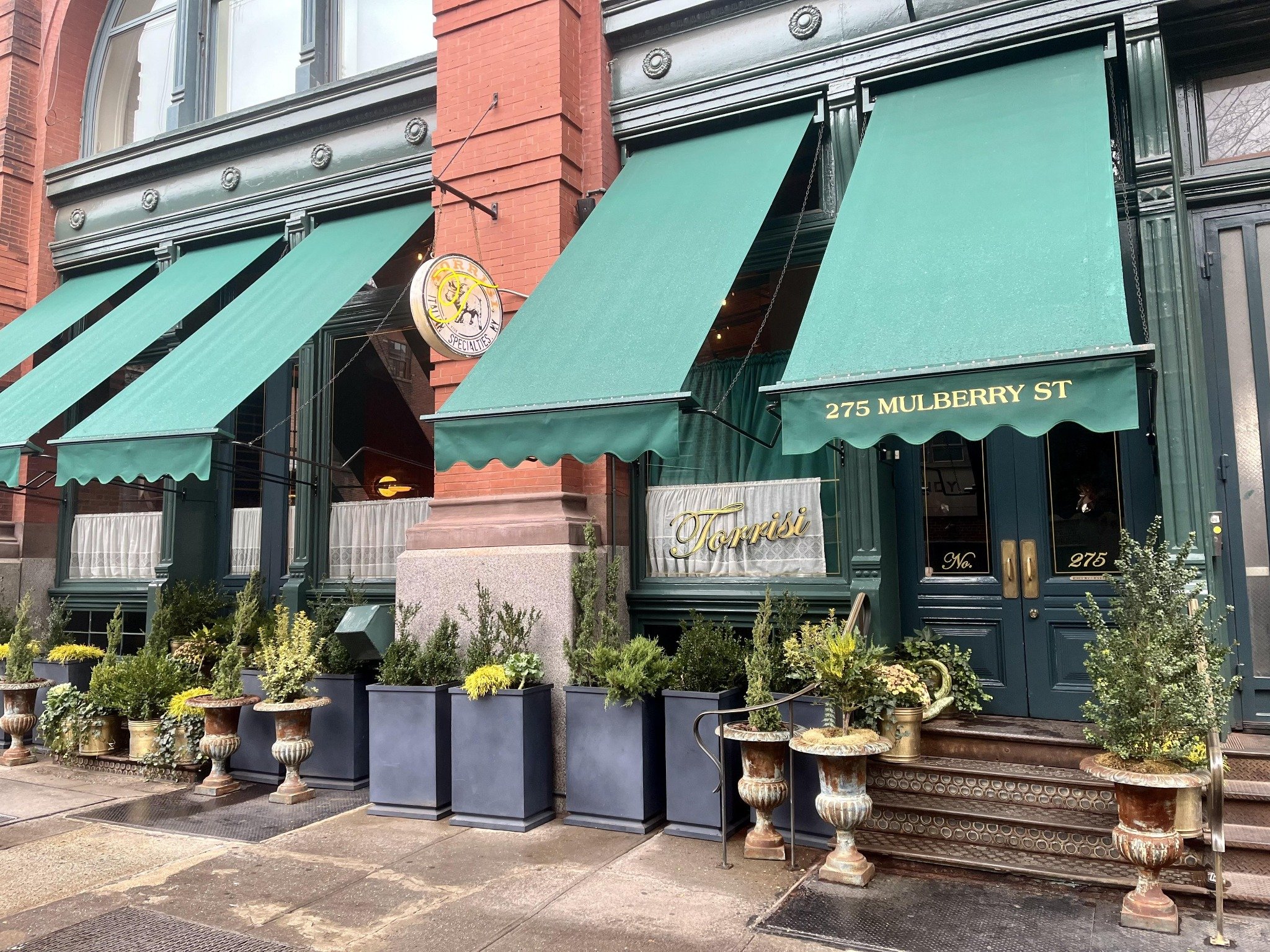
The distinctive green awnings along Mulberry Street introduce a contemporary culinary destination into the magnificent nineteenth-century architecture of the Puck Building.
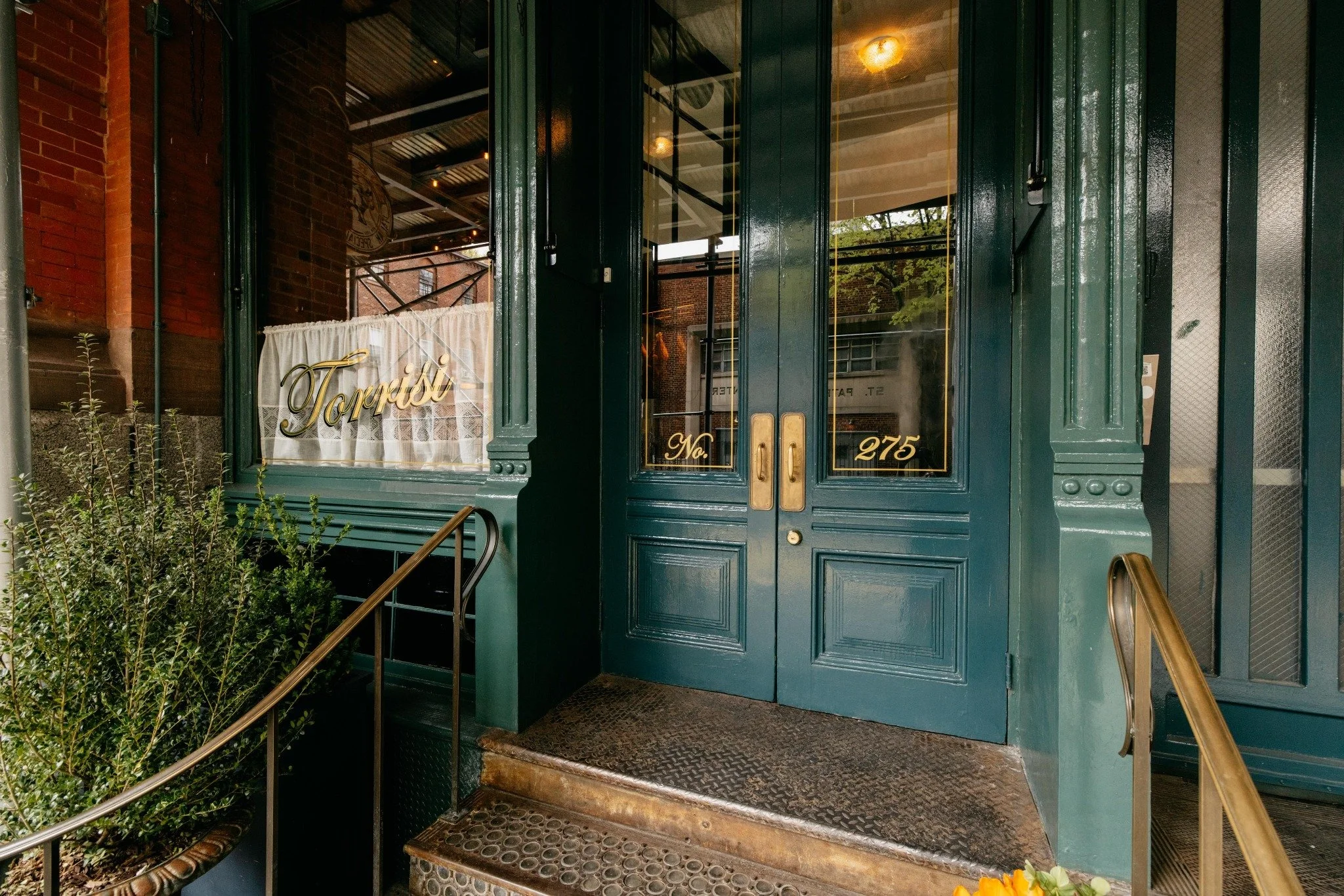
The entrance to Torrisi at 275 Mulberry Street, where the architectural grandeur of the Gilded Age meets contemporary New York dining.
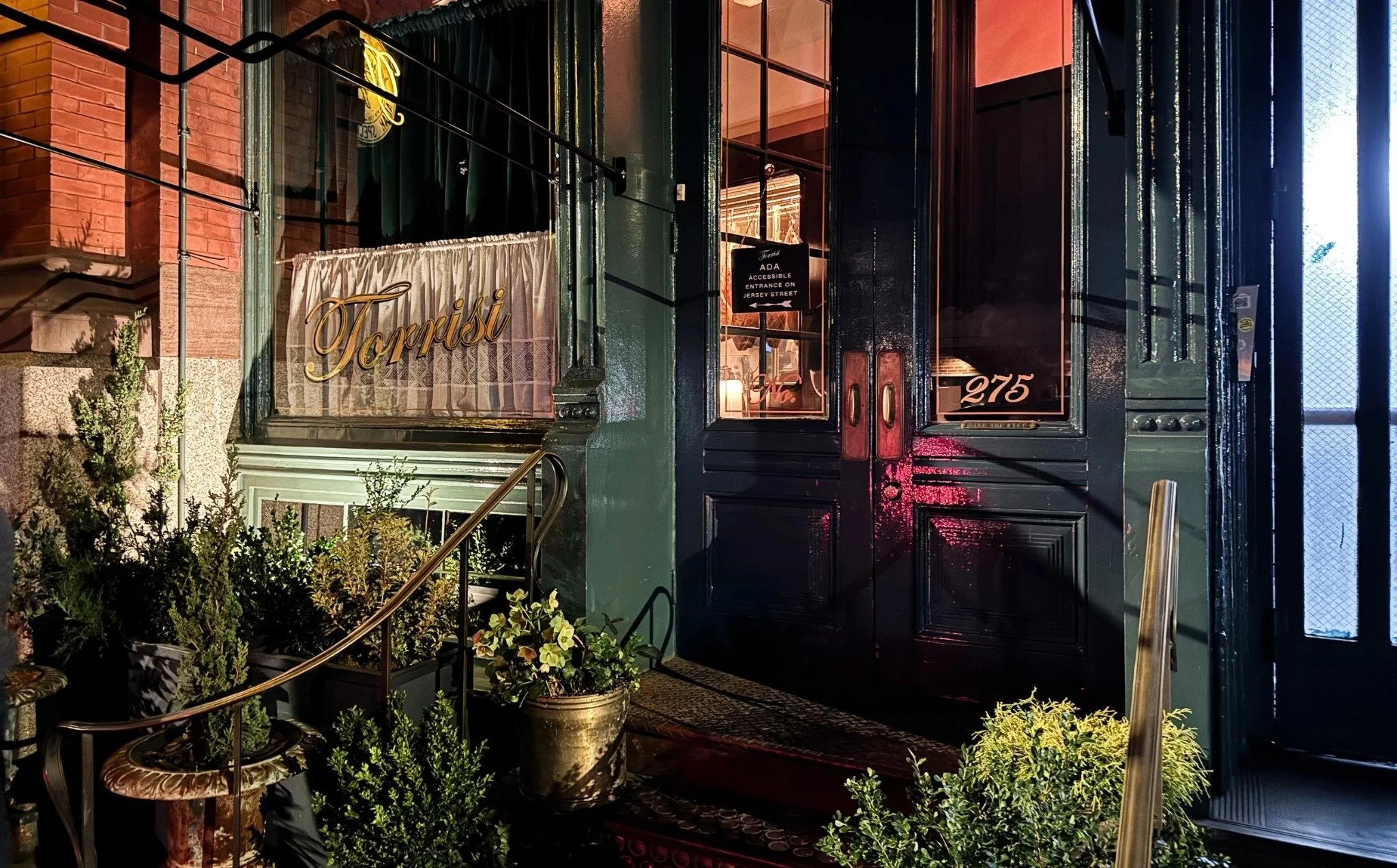
After nightfall, the illuminated entrance to Torrisi welcomes guests into one of Manhattan’s most coveted dining rooms.
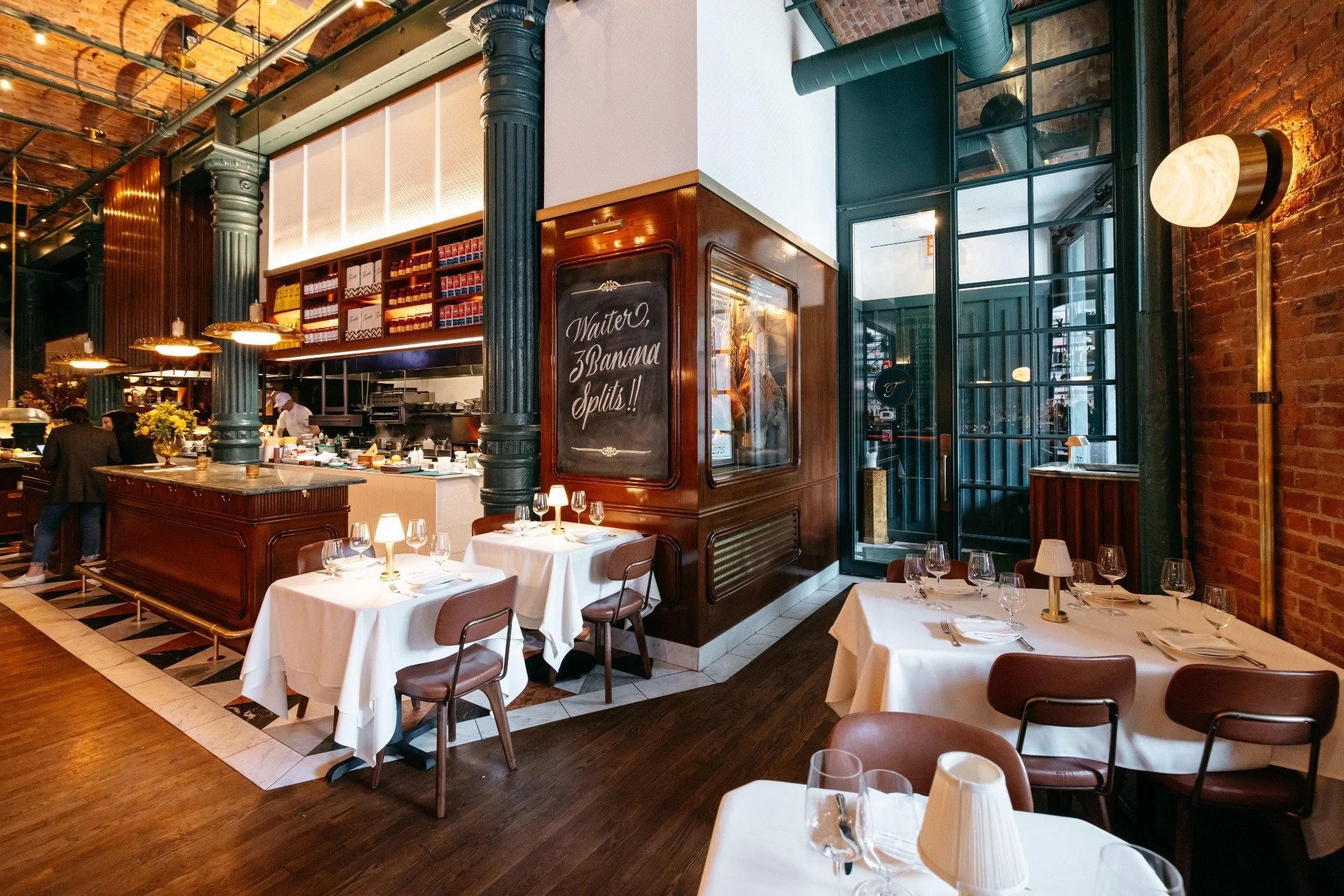
Inside Torrisi, the open kitchen introduces guests to the culinary activity at the heart of the restaurant.
The Grandeur of Old New York
Whereas Carbone deliberately recreates the atmosphere of a mid-century Italian-American restaurant, Torrisi draws much of its architectural character from the nineteenth-century building in which it resides.
The substantial columns, generous ceiling heights and magnificent windows of the Puck Building provide a setting that would be extraordinarily difficult to reproduce in a contemporary structure. Within these historic surroundings, rich woodwork, upholstered banquettes, decorative lighting and carefully arranged artwork establish an atmosphere of cultivated elegance.
There is something particularly appealing about the juxtaposition of the historic architecture and the visible activity of the kitchen. Rather than concealing the considerable labor involved in producing an exceptional dinner, Torrisi allows its guests to appreciate something of the discipline, coordination and craftsmanship behind the experience.
The kitchen is not merely a supporting element of the restaurant; it is central to its identity.
Two Restaurants, Two Visions
The differences between Torrisi and Carbone offer a fascinating insight into the creative ambitions of their founders.
At Carbone, the captain is a central figure in the evening's entertainment, and the culinary repertoire celebrates the familiar extravagances of Italian-American dining. At Torrisi, the imagination of the chef assumes a more prominent role.
Rich Torrisi's culinary interests extend far beyond the Italian neighborhoods of Manhattan. The Jewish delicatessens of the Lower East Side, the Chinese restaurants of Chinatown and the Caribbean culinary traditions found throughout New York all belong to the cultural landscape from which he draws inspiration.
It is an unusually ambitious undertaking: to create a restaurant that expresses the culinary identity of a city whose inhabitants have arrived from virtually every corner of the world.
The grandeur of the Puck Building provides a particularly fitting setting for such an enterprise. Within its nineteenth-century walls, Torrisi celebrates a New York that is continually reinventing itself without entirely relinquishing its past.
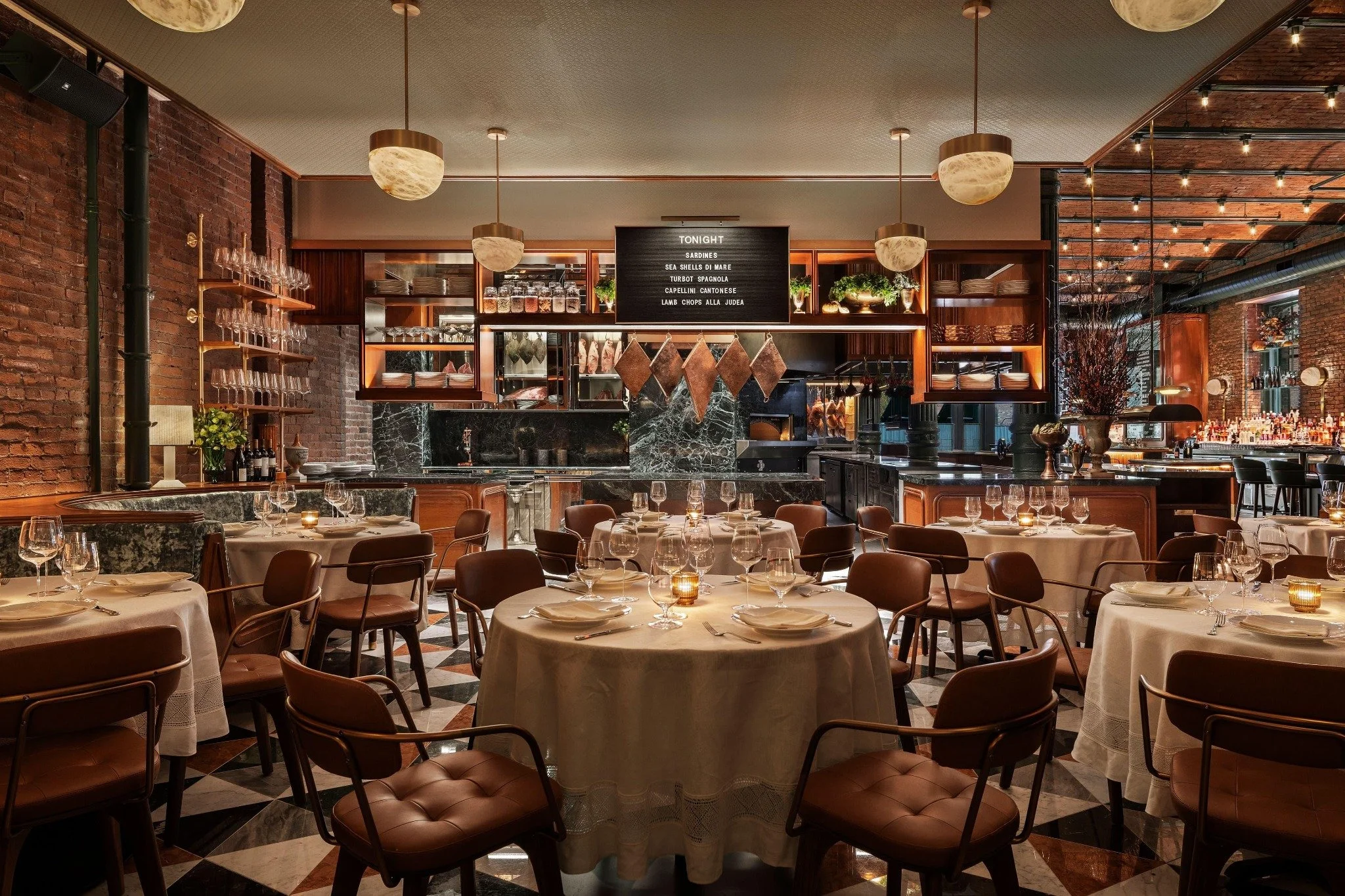
The principal dining room at Torrisi, where the architectural grandeur of the historic Puck Building meets contemporary Manhattan elegance.
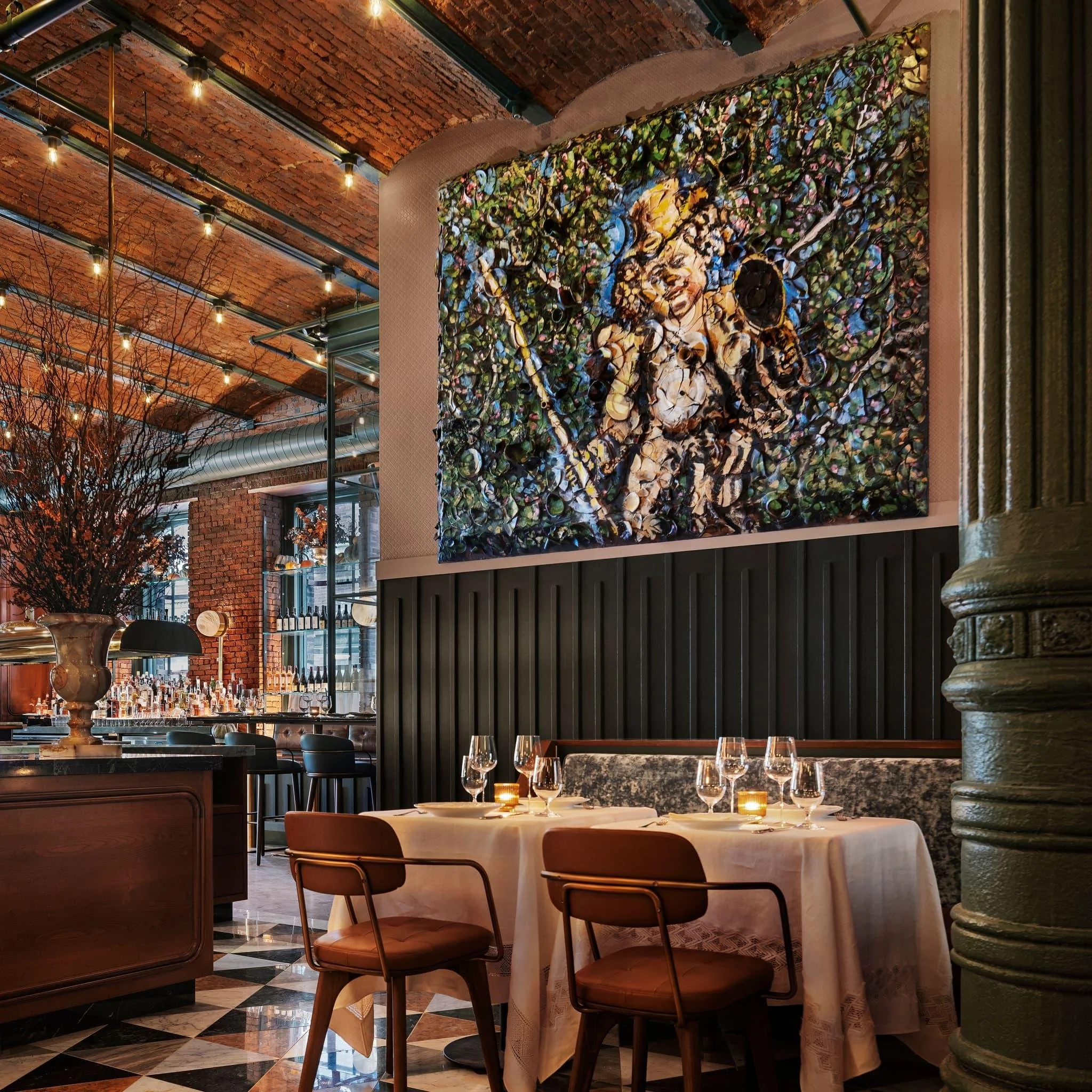
Historic architectural columns and carefully selected artwork contribute to the distinctive character of the dining room.
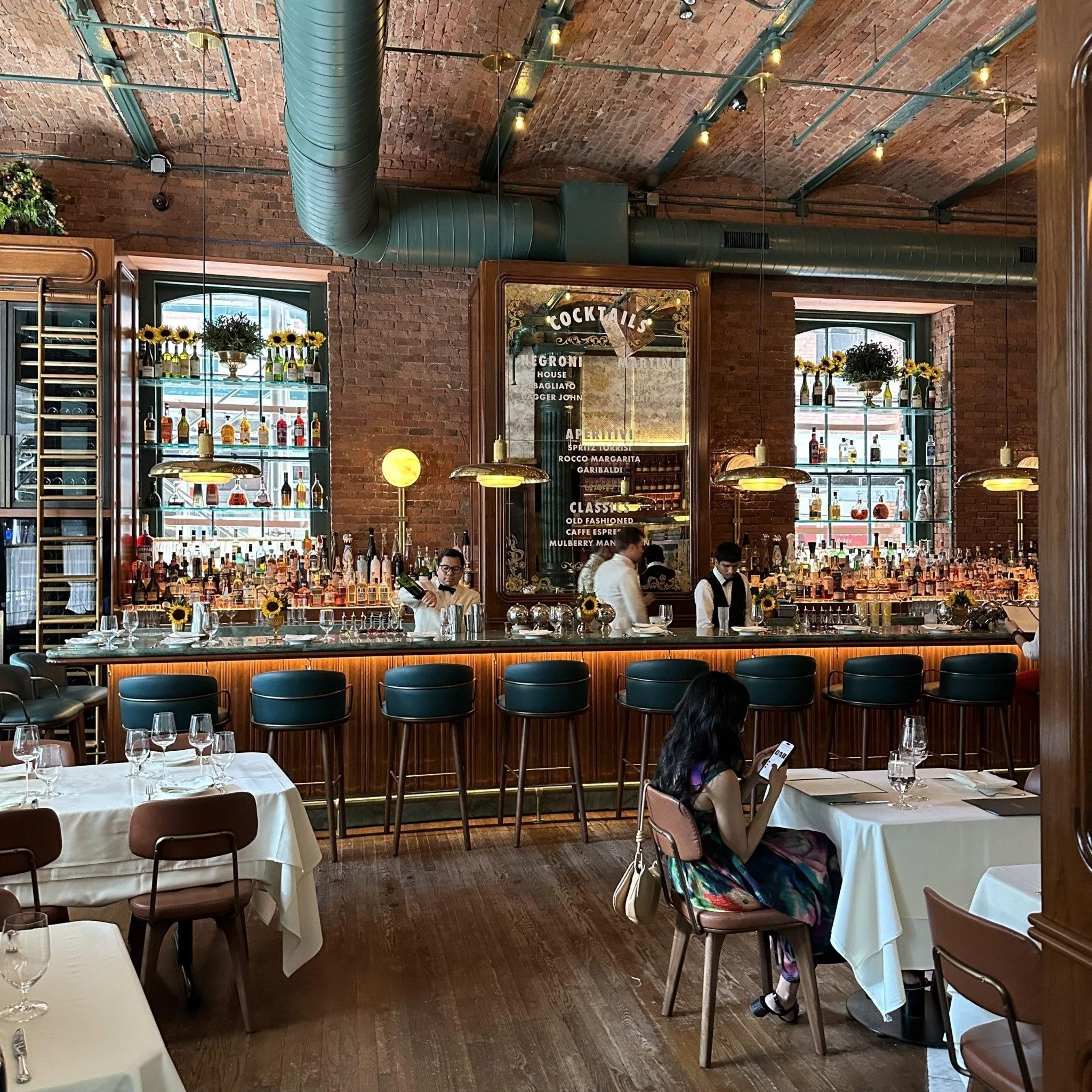
The bar at Torrisi, where the furnishings, service and attire of the staff contribute to the restaurant’s sophisticated atmosphere.
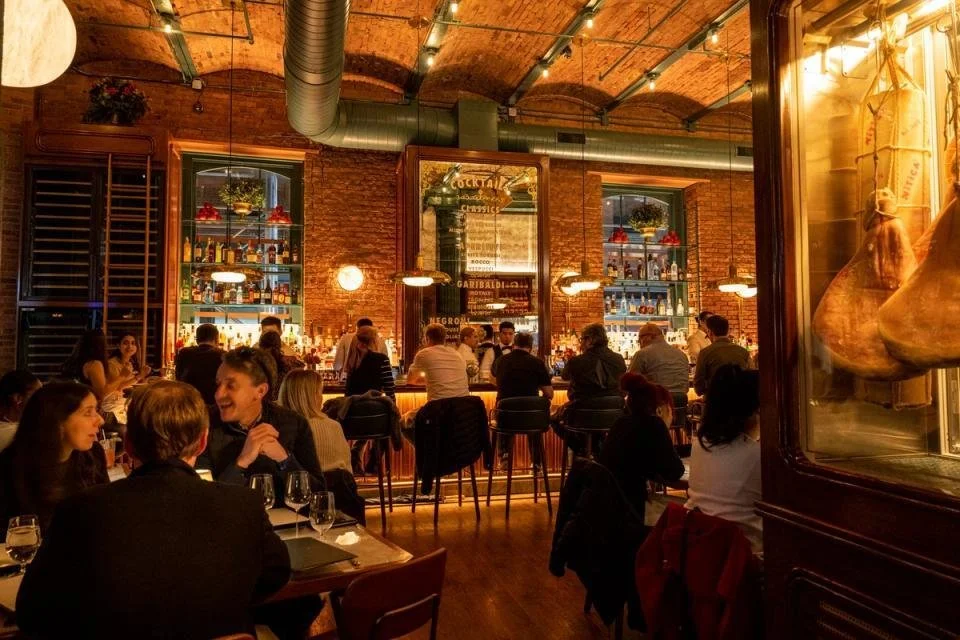
Torrisi after nightfall, when the historic surroundings come alive with the conversation and activity of Manhattan society.
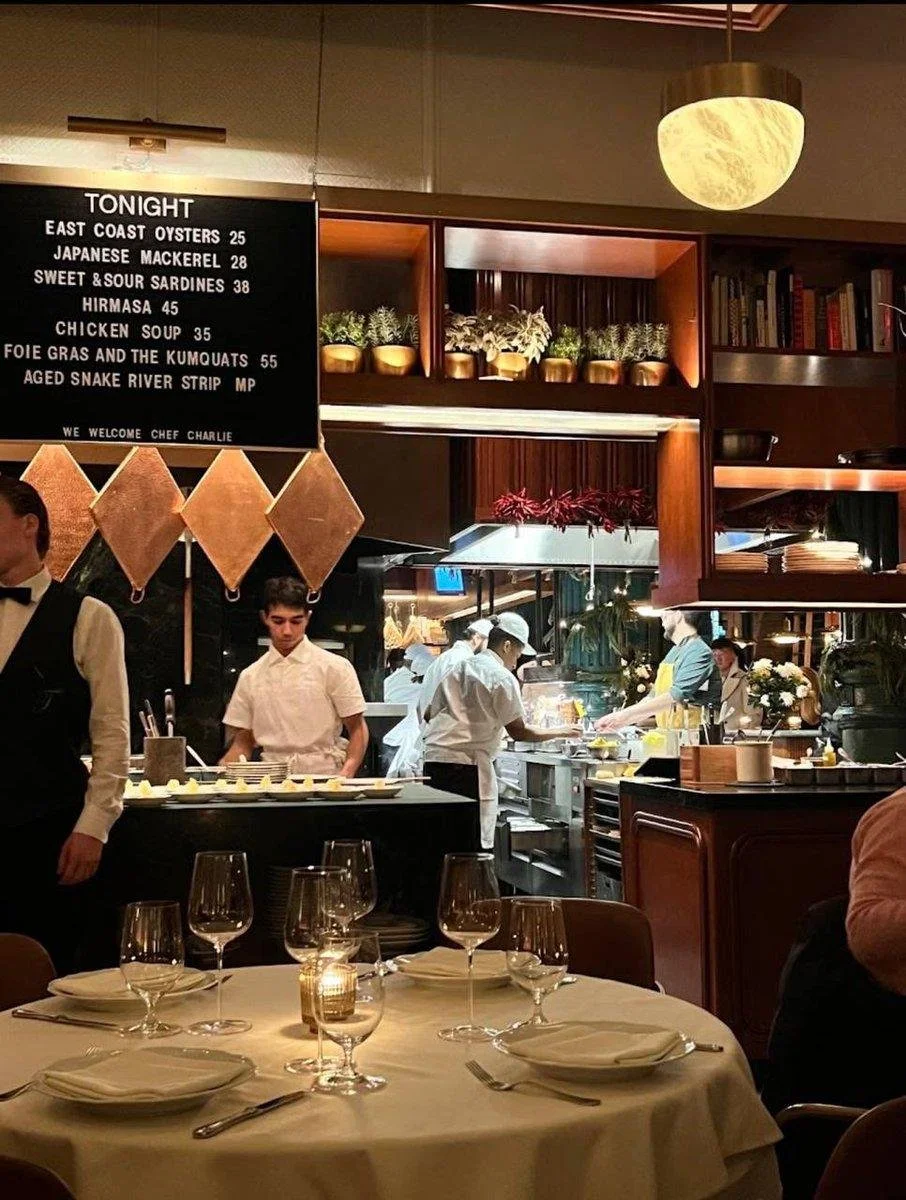
The kitchen brigade at Torrisi, where the diverse culinary traditions of New York are interpreted through the techniques of contemporary fine dining.
New York on a Dinner Plate
Perhaps the most revealing insight into Rich Torrisi’s culinary philosophy can be found not in the distinguished restaurants in which he trained, but in the decidedly unpretentious establishments he frequents in his own neighborhood.
In a March 2024 interview with the Michelin Guide, Torrisi described his affection for the cardamom coffee at Punjabi Deli, the lamb shawarma at Mamoun’s Falafel, the seafood and roast duck at Great N.Y. Noodletown and the traditional New York street hot dog.
These seemingly disparate culinary pleasures provide an illuminating explanation for the extraordinary diversity of his own menu.
Consider the Cavatelli with Jamaican Beef Ragu, in which a traditional Italian pasta becomes the companion to the richly spiced flavors of Caribbean cooking. His Capellini Cantonese draws upon the culinary traditions of Chinatown, while the San Gennaro Bao brings together the cultural identities of two neighboring Manhattan communities in a single dish.
Even the deceptively simple Cucumbers New Yorkese reflects the city's multicultural culinary inheritance.
What distinguishes Torrisi is the confidence with which the chef moves between these traditions without entirely abandoning his Italian-American culinary identity.
The menu is also intensely personal. Among its pasta offerings is Agnolotti Angelino, accompanied by a particularly touching dedication from the chef: “For my son.”
A Star Reborn
In 2022, the year in which Carbone lost its Michelin star, Rich Torrisi embarked upon the most ambitious reinterpretation of his original Mulberry Street restaurant.
On November 7, 2023, less than a year after opening in the Puck Building, the new Torrisi received its first Michelin star.
The Michelin inspectors particularly admired the restaurant’s ability to reinterpret familiar dishes with considerable imagination. Its recognition represented an important distinction between the two celebrated establishments belonging to Major Food Group.
Whereas Carbone had built an extraordinary reputation upon the revival of traditional Italian-American dining, Torrisi had undertaken the considerably more experimental endeavor of interpreting the culinary identity of New York itself.
In 2026, Torrisi achieved another significant distinction, ranking thirty-eighth among North America’s 50 Best Restaurants.
Perhaps most amusingly, Michelin itself included Torrisi in an October 2026 editorial selection of New York restaurants where securing a reservation was likely to provoke considerable envy among one's friends.
It is a particularly appropriate distinction for our exploration of Manhattan's impossible tables. Even the world's most prestigious culinary guide recognizes that the desirability of a restaurant encompasses considerably more than the food upon its plates.
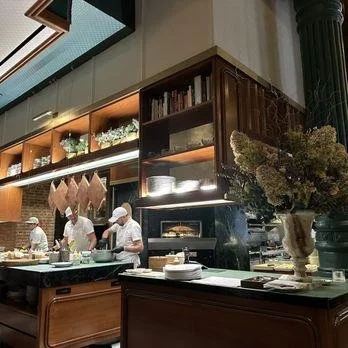
Behind the elegance of the dining room lies the considerable discipline and craftsmanship of the professional kitchen.
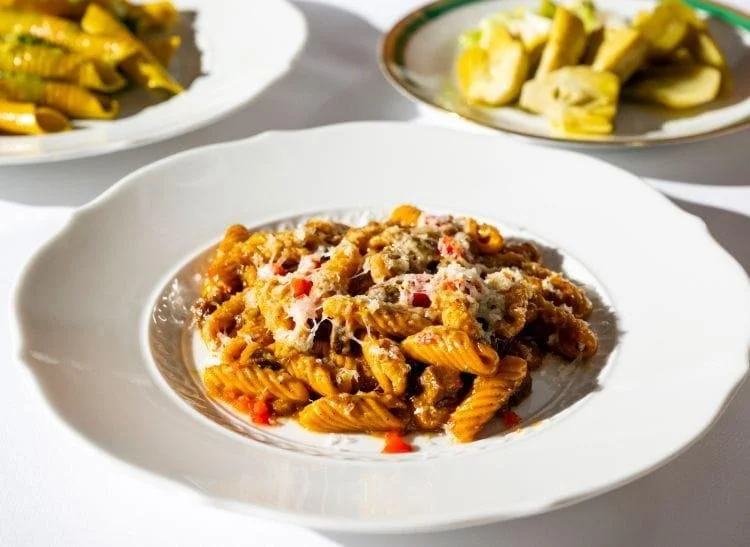
Pasta at Torrisi, where familiar Italian culinary traditions provide a canvas for the chef’s imagination.
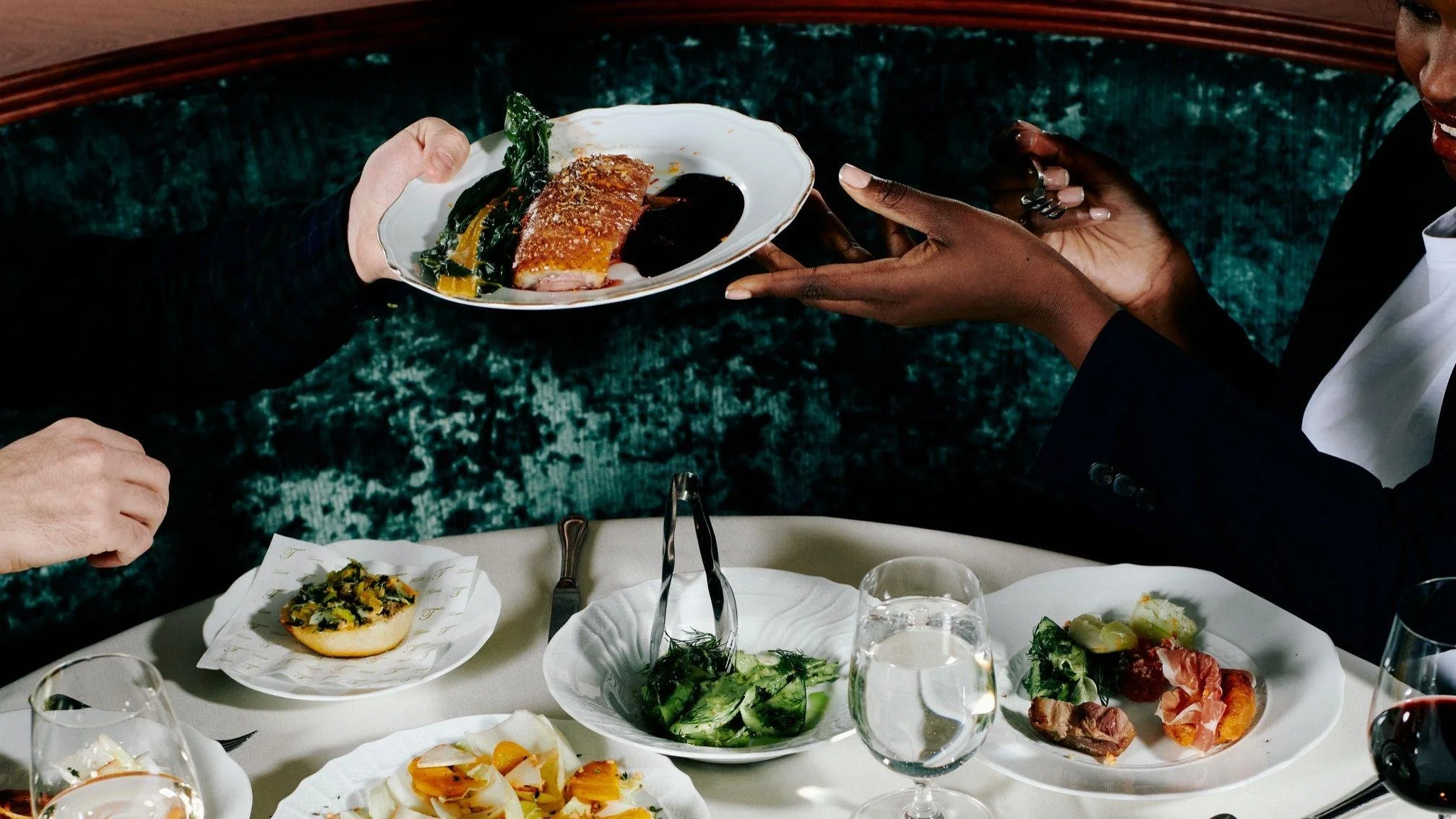
Contemporary culinary refinement presented within the historic grandeur of the Puck Building.
The Price of Culinary Imagination
Unlike many restaurants celebrated by the Michelin Guide, Torrisi does not require its guests to commit to an elaborate tasting menu. Its à la carte approach allows diners to explore Rich Torrisi's culinary imagination according to their individual appetites and interests.
The November 2026 lunch menu offers Cucumbers New Yorkese at $21, American Ham with Zeppole at $29, Cavatelli with Jamaican Beef Ragu at $32 and Raviolini with Blue Prawns and Saffron at $42. Dover Sole Francese is priced at $72, while certain specialties, including the Capellini Cantonese, are offered at market price.
For dessert, the restaurant's celebrated interpretation of affogato combines vanilla ice cream, chocolate fudge and espresso granita in an oversized stemmed glass.
For a leisurely dinner encompassing several courses, beverages, tax and gratuity, allow approximately $150 to $225 per person. The nightly specials and more extravagant selections can increase the final bill considerably.
How to Secure a Table
For those determined to experience Torrisi, perhaps the most encouraging advice comes from Rich Torrisi himself.
In November 2023, the Michelin Guide devoted an article to the extraordinary difficulty of obtaining a reservation at his restaurant. Among the chef's recommendations was a particularly refreshing alternative to the increasingly frantic competition for online reservations: simply visit the restaurant.
Torrisi maintains twelve seats at its bar counter that were specifically intended to accommodate guests without reservations. Most of the regular menu is available to these diners, although certain specialties are reserved for the principal dining room.
For a conventional dining-room reservation, tables are released through Resy thirty days in advance at 10 a.m., Eastern Time. Prospective diners should also consider lunch, when competition for reservations is generally less formidable.
Those attempting to secure one of the coveted bar seats would be well advised to arrive approximately forty-five minutes before dinner service begins. Arriving during the height of the evening can result in a wait of several hours.
There is another authorized avenue for securing a reservation. Torrisi partners with Dorsia, a members-only reservation service that generally operates through advance financial commitments toward dining expenditures.
The existence of such an arrangement offers another fascinating insight into the evolution of Manhattan dining. The difficulty of securing a restaurant reservation has become sufficiently extraordinary to support an entire industry devoted to obtaining access.
Yet there remains something particularly appealing about Rich Torrisi's own advice: visit the restaurant, experience its hospitality and cultivate a relationship with the people who work there.
More than sixteen years after the opening of his little Mulberry Street delicatessen, Torrisi remains profoundly connected to the city that inspired him. Within the magnificent nineteenth-century walls of the Puck Building, the culinary traditions of generations of New Yorkers have become something celebrated far beyond the boundaries of Manhattan.
Address: 275 Mulberry Street, New York, NY 10012
Neighborhood: Nolita
Historic Michelin recognition: Awarded one Michelin star in November 2023.
Additional distinction: Rated 8.9 out of 10 by The Infatuation in April 2026.
Lunch: Wednesday through Saturday, 11:30 a.m. to 2 p.m.
Dinner: Monday through Saturday, 5 p.m. to 11 p.m.
Dress code: Elegant attire encouraged; athletic wear prohibited.
Reservations: Resy, thirty days in advance at 10 a.m., Eastern Time.
Alternative reservation platform: Dorsia.
Walk-ins: Bar counter, subject to availability.
Maximum reserved party size: Six guests.
Telephone: (212) 254-3000
Email: reservations@torrisinyc.com
Website: www.torrisinyc.com
06 — Don Angie
West Village / Established 2017
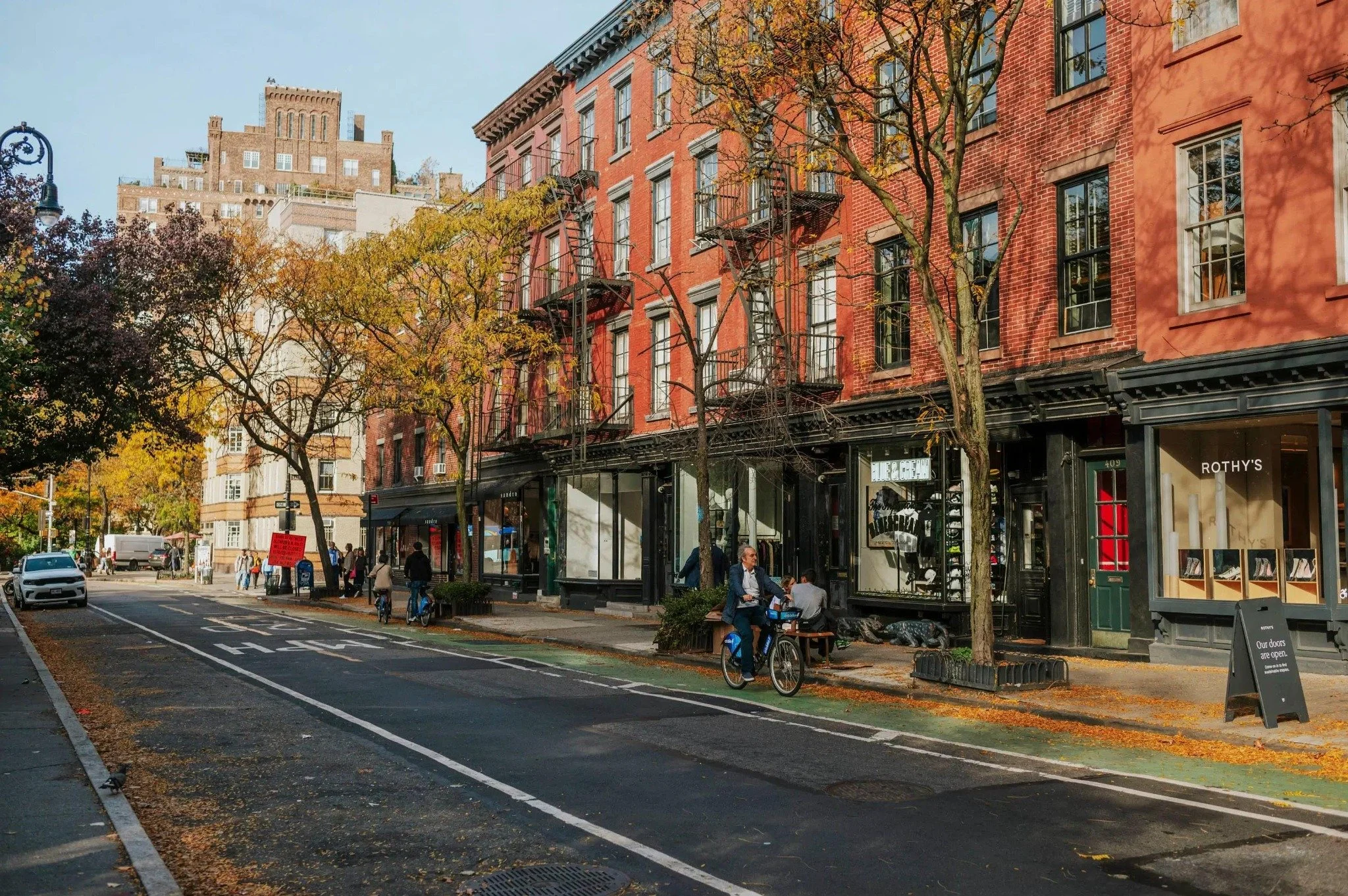
The historic West Village, where neighborhood restaurants and intimate dining rooms remain an essential part of Manhattan life.
An Italian-American Love Story
Unlike the international restaurant empires behind Carbone and The Polo Bar, Don Angie began with a considerably more intimate partnership: a husband and wife whose shared culinary ambitions were deeply rooted in their Italian-American childhoods.
Angie Rito grew up in Cleveland, Ohio, where her family operated an Italian bakery established by her grandfather in 1965. The bakery provided an early education in the traditions of Italian cooking, the importance of hospitality and the extraordinary capacity of food to preserve a family's cultural identity across generations.
Scott Tacinelli grew up in New Jersey, similarly surrounded by the culinary traditions of his Italian-American family.
The two met while working in the New York restaurant industry. Their professional experiences included some of the city's most distinguished kitchens, and Angie herself spent time at the original Torrisi Italian Specialties on Mulberry Street.
Together, they developed a culinary philosophy that celebrated the familiar flavors of their childhoods without being constrained by traditional recipes.
In October 2017, the couple opened Don Angie at 103 Greenwich Avenue. Their little West Village restaurant would become one of the most celebrated examples of a new generation of Italian-American cooking.
Whereas Carbone sought to resurrect the grandeur of an earlier era, Rito and Tacinelli approached their culinary inheritance with a considerably more playful imagination. The traditions of their grandparents provided the foundation, but the possibilities were entirely their own.

Don Angie occupies a distinctive corner of Greenwich Avenue, surrounded by the intimate streets and neighborhood establishments of the West Village.
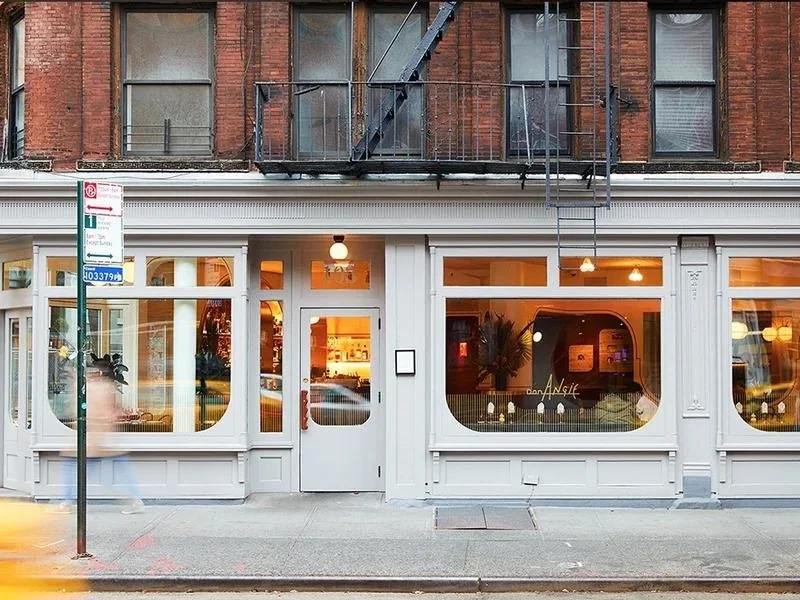
The understated façade of Don Angie at 103 Greenwich Avenue conceals one of Manhattan’s most sought-after dining rooms.
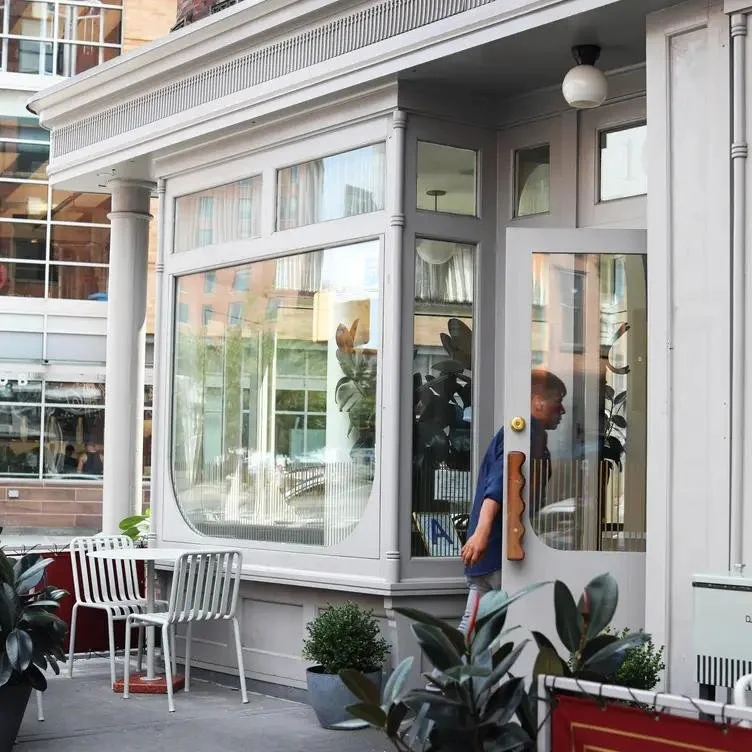
An inviting entrance to a restaurant whose reservations have become extraordinarily elusive.
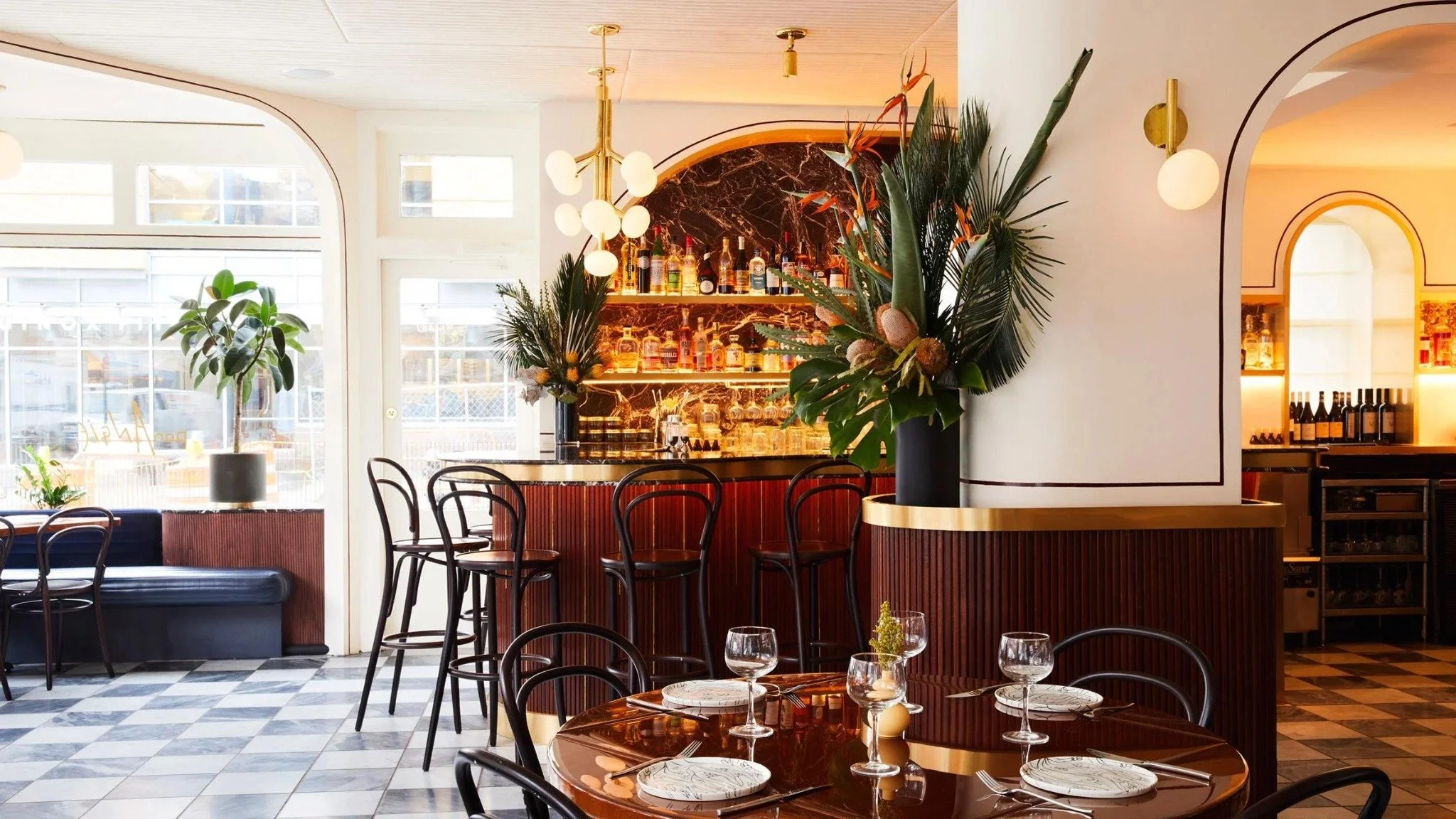
An intimate bar with traditional brass accents introduces the quietly sophisticated interior of Don Angie.
The Intimacy of a Neighborhood Restaurant
Don Angie possesses neither the architectural grandeur of Torrisi nor the elaborate theatricality of Carbone. Its appeal lies in the intimacy of its surroundings.
Blue-gray leather banquettes, traditional bentwood chairs, checkerboard flooring and brass accents establish an atmosphere that is simultaneously nostalgic and contemporary.
In a 2018 interview, the restaurant's front-of-house management revealed that the principal dining room contained just fifteen tables, accommodating approximately fifty guests, in addition to seating at the bar.
Such modest proportions help explain the extraordinary difficulty of securing a reservation. Don Angie has acquired a national reputation without sacrificing the physical intimacy of a neighborhood restaurant.
The furnishings and atmosphere provide an appropriately understated setting for the considerable creativity occurring in the kitchen.
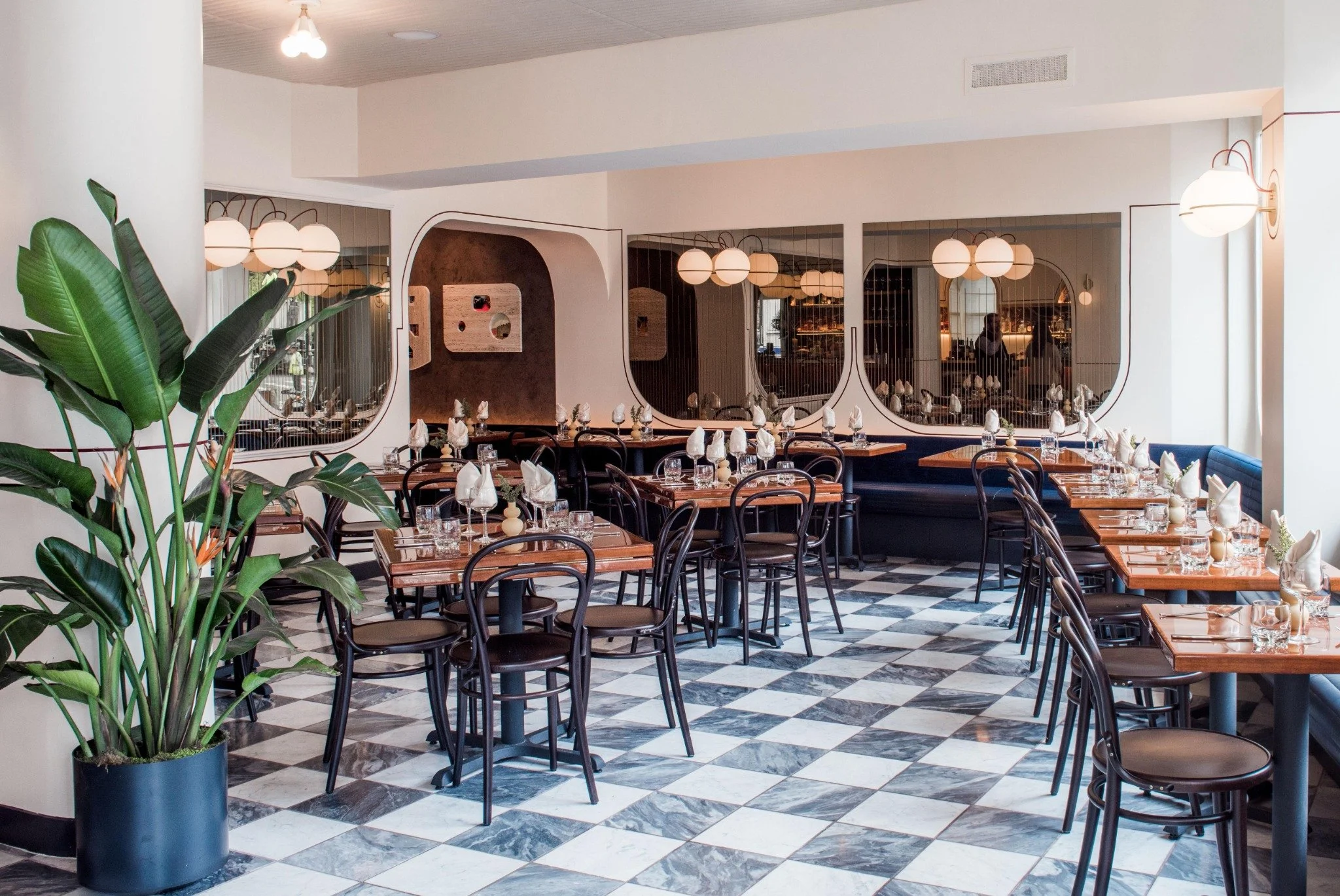
The principal dining room, where restrained elegance preserves the intimacy of a traditional neighborhood restaurant.
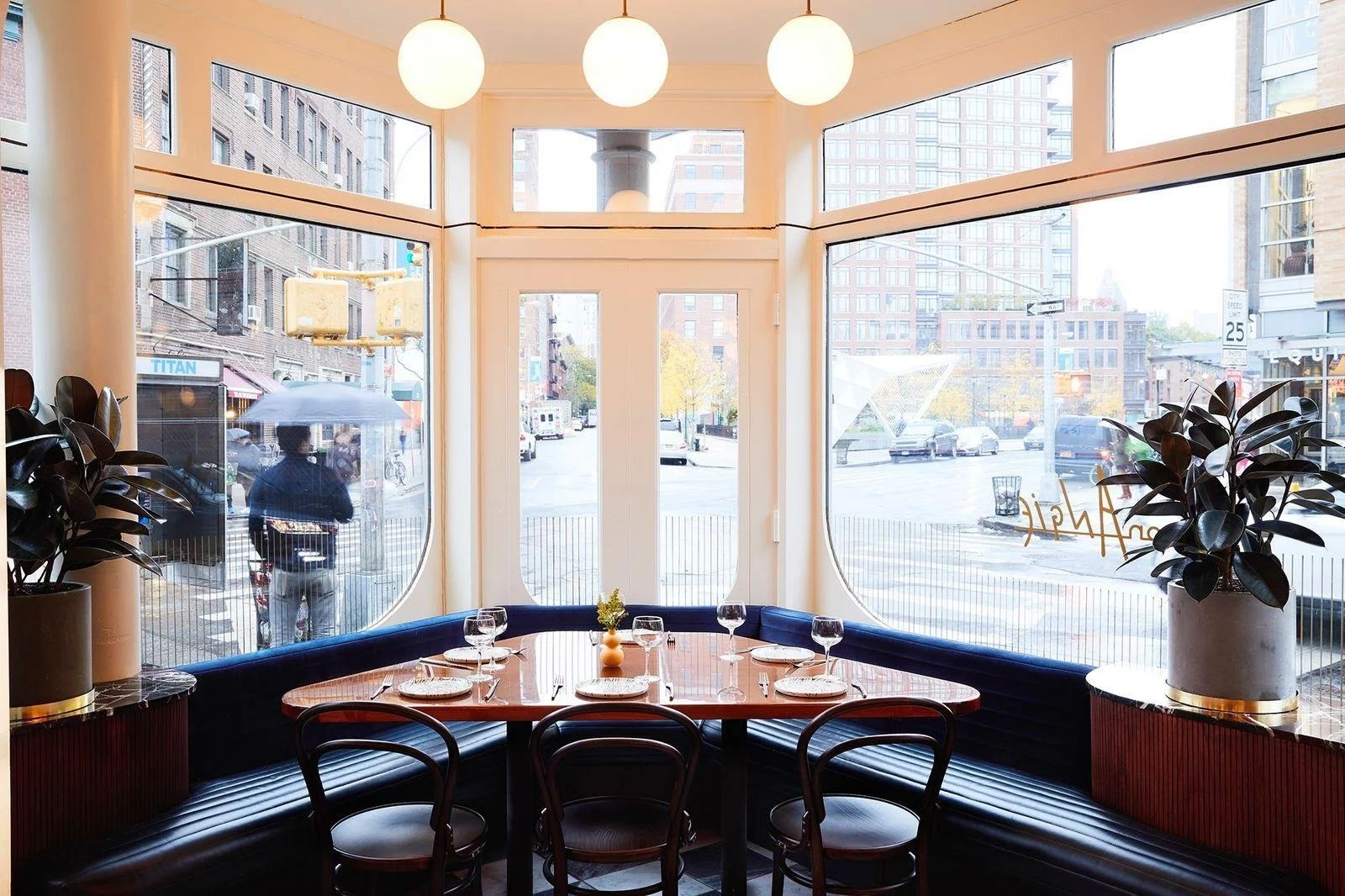
A particularly inviting corner table overlooking the streets of the West Village.
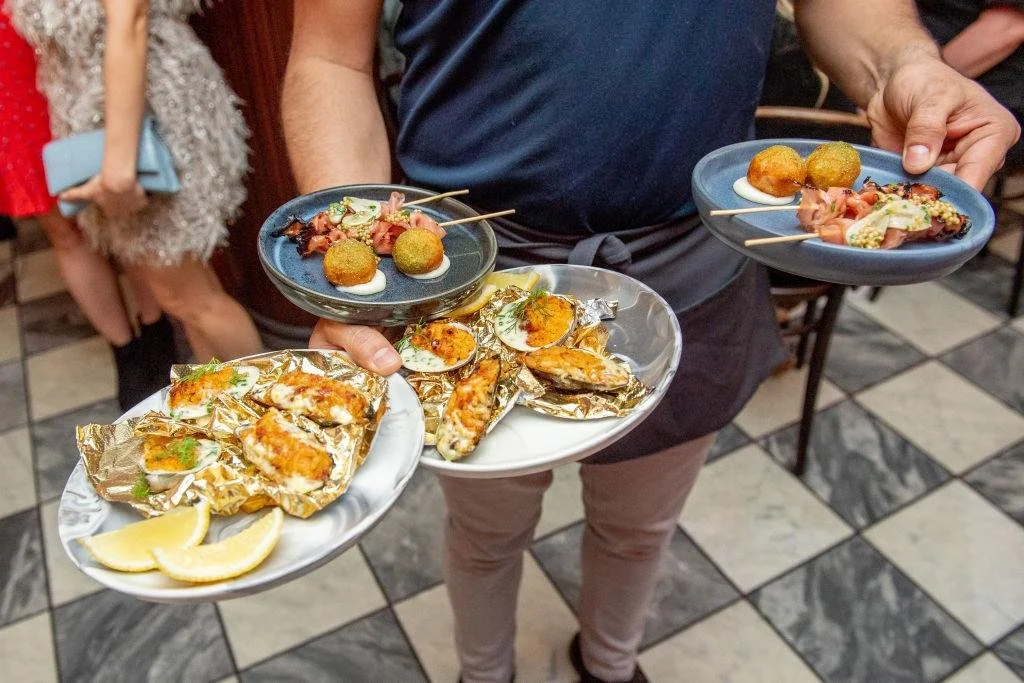
The personal traditions of Italian-American hospitality interpreted through contemporary restaurant service.
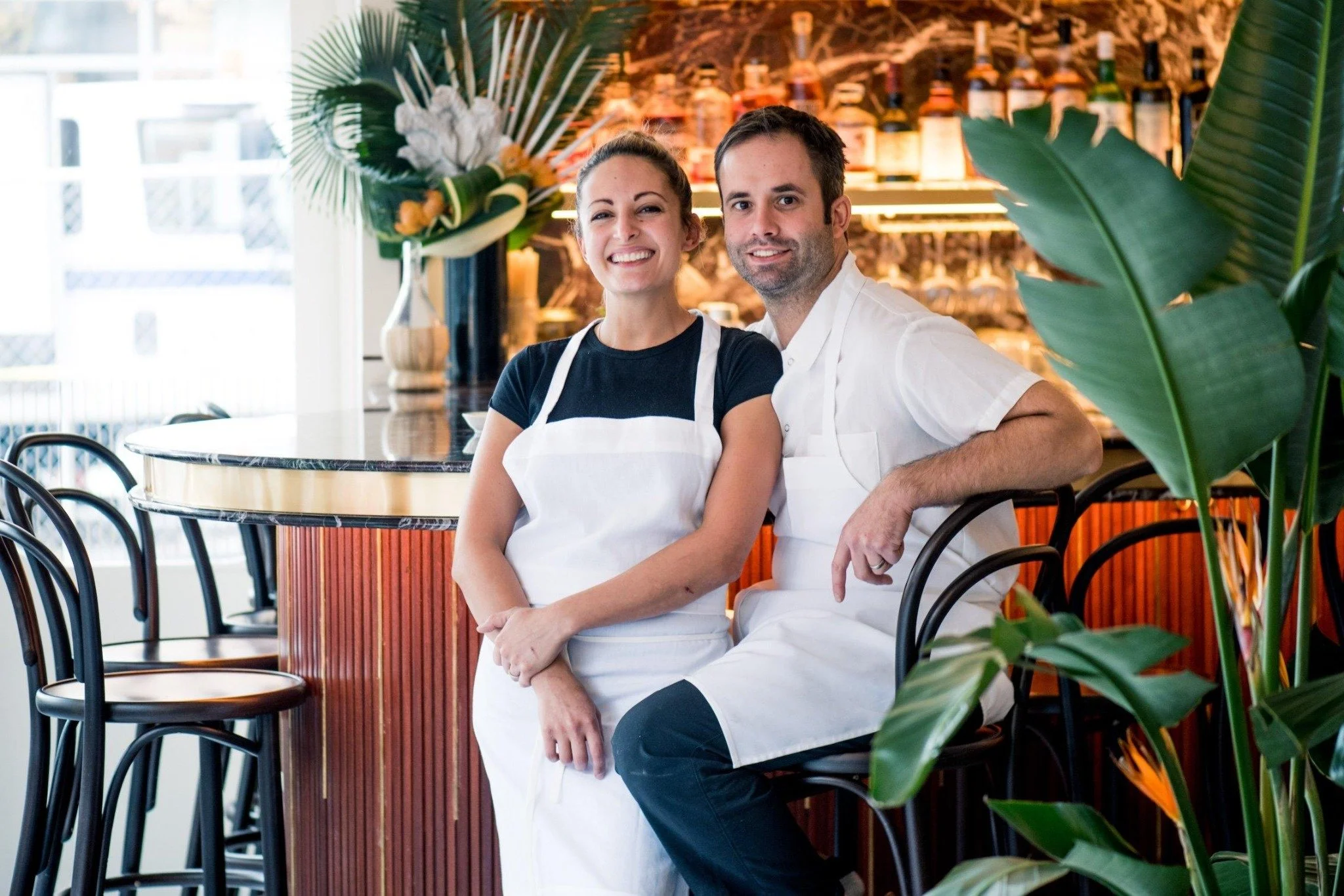
The culinary team behind Don Angie’s imaginative interpretation of Italian-American cooking.
The Lasagna That Captivated Manhattan
Perhaps no dish better illustrates the extraordinary imagination of Angie Rito and Scott Tacinelli than their celebrated lasagna for two.
Rather than assembling the ingredients in conventional horizontal layers, the chefs roll sheets of pasta with Italian sausage Bolognese, arranging the individual pinwheels upright in a baking dish. The exposed edges acquire a particularly appealing crispness, while the interior preserves the comforting richness of traditional lasagna.
Finished with tomato sauce and delicate portions of whipped robiolina cheese, the dish possesses the visual character of an elaborate floral arrangement.
Other creations reveal an equally inventive approach to familiar flavors. The chrysanthemum salad arrives beneath a generous covering of finely grated Parmesan, while pepperoni fried rice incorporates elements of Asian cooking into an unmistakably Italian-American culinary vocabulary.
The candy-striped buffalo milk caramelle, stuffed garlic flatbread and imaginative interpretation of chicken scarpariello similarly reflect the couple's willingness to depart from convention.
In 2021, Rito and Tacinelli published their cookbook, Italian American: Red Sauce Classics and New Essentials, bringing their distinctive culinary philosophy into American homes.
The Star That Disappeared
Don Angie's history of critical recognition is particularly fascinating.
In 2018, The New York Times awarded the restaurant two stars and designated it a critic's pick. Esquire included it among America's best new restaurants that same year.
Recognition from the James Beard Foundation followed, with nominations for the couple in 2019, 2020, 2022 and 2025.
In May 2021, Don Angie achieved one of the most coveted distinctions in the culinary profession: a Michelin star.
Yet in 2023, the restaurant lost that star.
As we have already observed with Carbone, the withdrawal of Michelin recognition did not necessarily diminish the public's enthusiasm. Don Angie remained one of Manhattan's most difficult reservations, and its celebrated lasagna continued to attract extraordinary attention.
Perhaps most interestingly, Michelin did not abandon the restaurant altogether. Don Angie remains recommended by the Guide, whose inspectors continue to acknowledge the creativity of its cooking and the appeal of its intimate dining room.
In June 2024, Michelin even published a feature devoted to Angie Rito and her culinary accomplishments.
The relationship between critical recognition and public enthusiasm is evidently more complicated than a simple arrangement of stars. Don Angie may have lost one of the culinary world's most prestigious distinctions, but it retained the enthusiastic devotion of its patrons.
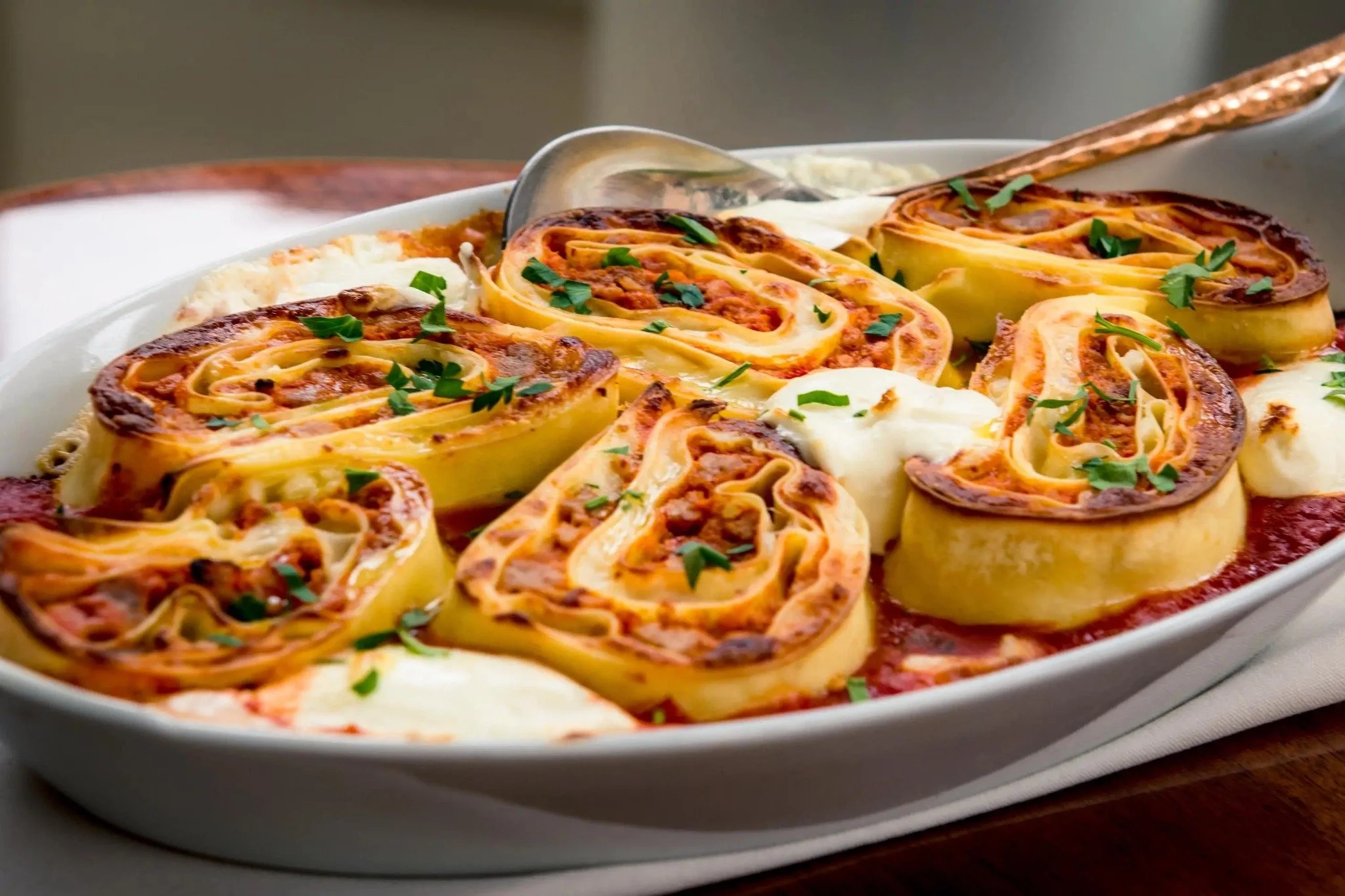
Don Angie’s celebrated pinwheel lasagna for two, in which the comforting traditions of Italian-American cooking acquire an entirely new architectural form.
The Price of Culinary Romance
Compared with several of the establishments featured in our exploration of Manhattan's impossible tables, Don Angie offers a relatively modest price of admission once a reservation has been secured.
Reported July 2026 menu prices place the celebrated lasagna for two at $72, with most individual pasta dishes ranging from $27 to $29 and many main courses between $34 and $46.
For a substantial dinner encompassing shared appetizers, pasta, main courses, dessert and beverages, including tax and gratuity, allow approximately $100 to $150 per person.
The generous portions and emphasis upon sharing make the restaurant particularly appealing for an intimate dinner for two.
How to Secure a Table
Don Angie differs from several of Manhattan's other coveted restaurants in its choice of reservation platform. Reservations are available through OpenTable rather than Resy.
Published reservation guides report that tables are released seven days in advance at 9 a.m., Eastern Time. Prospective diners should establish their OpenTable accounts beforehand and be prepared to select a suitable reservation as soon as availability appears.
Those unsuccessful in their initial attempt should monitor cancellations and consider the restaurant's Friday, Saturday and Sunday lunch service.
The bar provides another possible avenue for admission. Diners willing to arrive early and wait for an available seat may discover that persistence offers advantages over the frantic competition for advance reservations.
For those seeking a more secluded occasion, the restaurant also operates Don's Next Door, a private dining space around the corner on West 12th Street, accommodating up to eighteen guests with its own kitchen and bar.
Ultimately, the extraordinary appeal of Don Angie lies in the marriage of nostalgia and invention. Two chefs, drawing upon the culinary traditions of their respective families, have transformed the familiar pleasures of Italian-American cooking into one of the most desirable dining experiences in contemporary Manhattan.
It is a particularly charming reminder that even within the fiercely competitive world of New York restaurants, a love story can provide the foundation for something extraordinary.
Address: 103 Greenwich Avenue, New York, NY 10014
Neighborhood: West Village
Michelin distinction: Michelin Guide Selected; no current star.
Historic Michelin recognition: One Michelin star, awarded in 2021 and withdrawn in 2023.
Additional distinctions: Two stars from The New York Times in 2018; James Beard Award nominations in 2019, 2020, 2022 and 2025.
Dinner: Daily.
Lunch: Friday through Sunday, 11:30 a.m. to 2 p.m.
Dress code: Business casual.
Reservations: OpenTable; reported release time of 9 a.m., Eastern Time, seven days in advance.
Private dining: Don's Next Door, accommodating up to eighteen guests.
Telephone: (212) 889-8884
Email: info@donangie.com
Website: www.donangie.com
07 — Tatiana
Lincoln Center / Established 2022
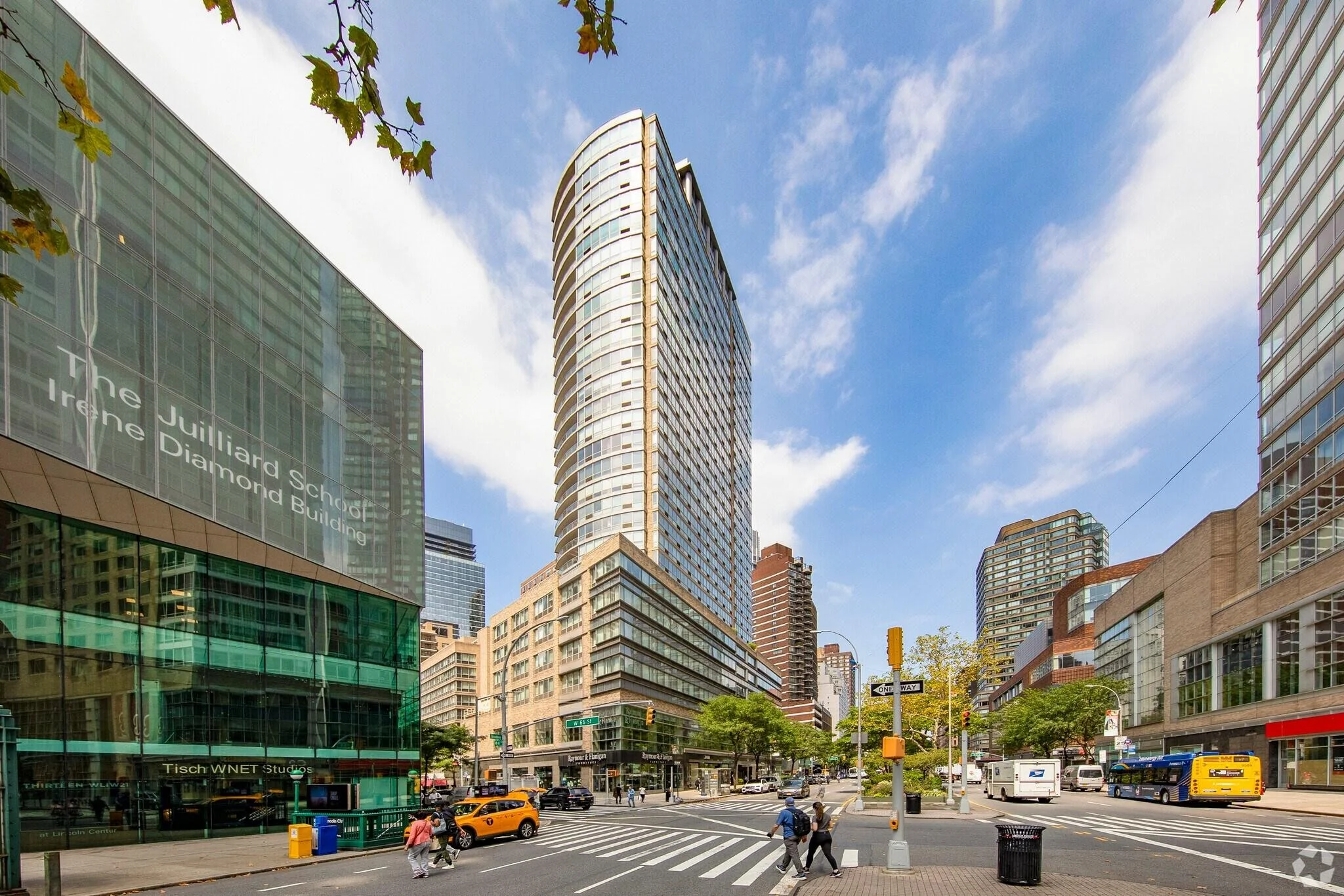
Lincoln Square, Manhattan, where the performing arts, architectural grandeur and contemporary urban life converge.
From the Bronx to Lincoln Center
Of all the restaurants featured in our exploration of Manhattan's most coveted tables, perhaps none possesses a more personal relationship with the city than Tatiana.
Located within David Geffen Hall at Lincoln Center, the restaurant opened in November 2022 under the direction of chef Kwame Onwuachi, whose extraordinary culinary journey began in the Bronx.
Born in 1989, Onwuachi spent part of his childhood in Nigeria, where he developed an appreciation for the West African culinary traditions of his family. His mother operated a catering business, and the flavors of her kitchen would provide an enduring foundation for his professional ambitions.
Before entering the Culinary Institute of America, Onwuachi worked as a cook aboard a vessel involved in the response to the Deepwater Horizon oil spill. He subsequently trained in distinguished American restaurant kitchens, competed on Top Chef and established himself in Washington, D.C.
In 2019, the James Beard Foundation named him Rising Star Chef of the Year. That same year, he published his memoir, Notes from a Young Black Chef.
Yet it was his return to New York that would produce his most celebrated restaurant.
Named after his older sister, Tatiana represents an intensely personal interpretation of the culinary traditions that surrounded Onwuachi during his childhood. Nigerian cooking, Caribbean flavors, neighborhood delicatessens, Chinese takeout restaurants and the familiar pleasures of the New York bodega all contribute to its extraordinary identity.
There is a particularly charming symmetry in the establishment of such a restaurant at Lincoln Center. Surrounded by institutions devoted to the interpretation of music, dance and drama, Onwuachi has created a dining room devoted to interpreting the culinary culture of his native city.
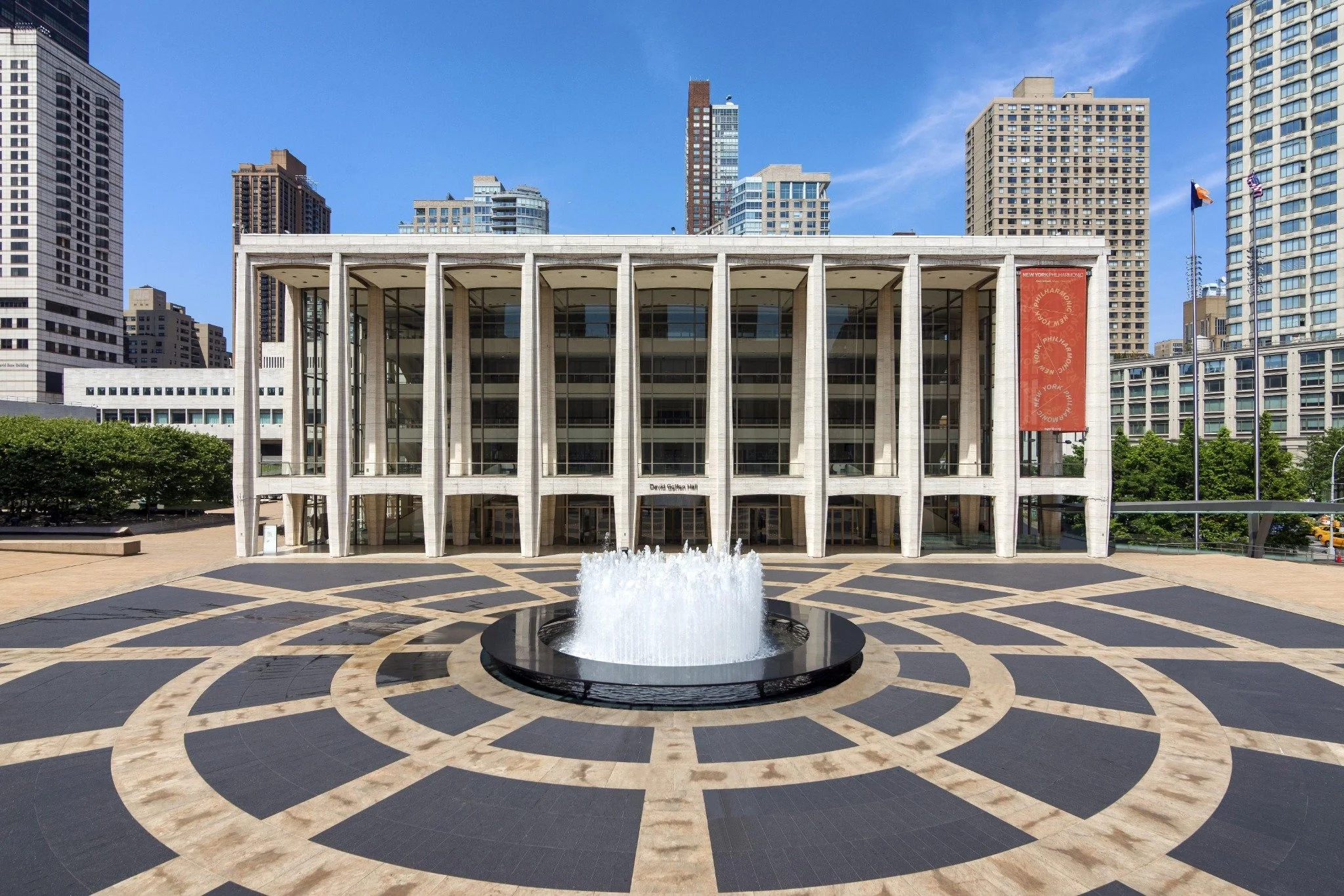
Lincoln Center Plaza, the monumental architectural setting for some of America's most celebrated performing arts institutions.
A Restaurant Among the Performing Arts
Lincoln Center emerged from one of the most ambitious urban development projects in twentieth-century Manhattan. President Dwight D. Eisenhower participated in its ceremonial groundbreaking in May 1959, and the complex would eventually become an internationally recognized center for music, opera, ballet and theatrical performance.
The concert hall that houses Tatiana opened in 1962 as Philharmonic Hall, designed by architect Max Abramovitz. It subsequently became Avery Fisher Hall and, in 2015, was renamed David Geffen Hall following the entertainment executive's extraordinary $100 million gift.
After undergoing a comprehensive $550 million transformation, the hall reopened in October 2022, introducing a redesigned auditorium, contemporary public spaces and a renewed relationship with the surrounding neighborhood.
The architectural setting also possesses a deeper historical connection to Onwuachi's culinary vision. Before the construction of Lincoln Center, the surrounding area included San Juan Hill, a neighborhood with a rich African-American and Caribbean cultural history.
Among its former residents was the celebrated jazz pianist Thelonious Monk.
Tatiana's establishment within the renovated concert hall therefore carries a significance beyond its prestigious address. Through the culinary traditions that inspired his restaurant, Onwuachi has established a connection between the contemporary cultural institution and the earlier history of its neighborhood.
An evening at Tatiana might precede a performance by the New York Philharmonic, an opera at the Metropolitan Opera House or a ballet across the plaza. The restaurant, however, has become a destination sufficiently compelling to constitute the evening's principal attraction.
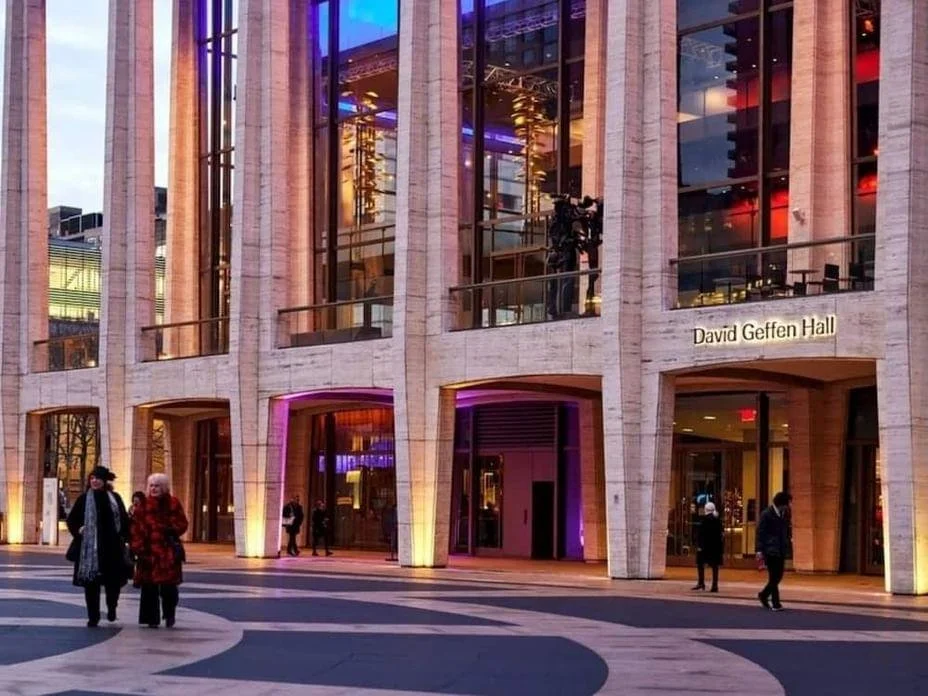
David Geffen Hall illuminated at dusk, as Lincoln Center prepares for an evening of music, performance and dining.
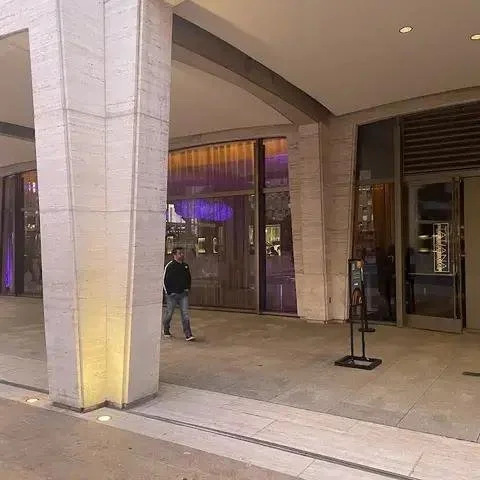
The approach to Tatiana beneath the monumental architecture of Lincoln Center.
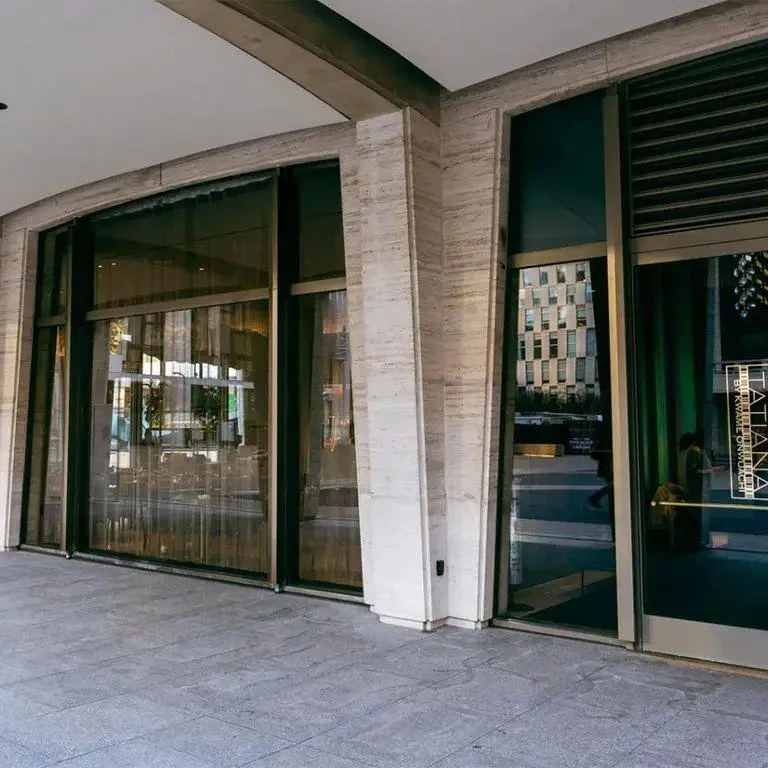
Tatiana’s contemporary glass frontage at 10 Lincoln Center Plaza.
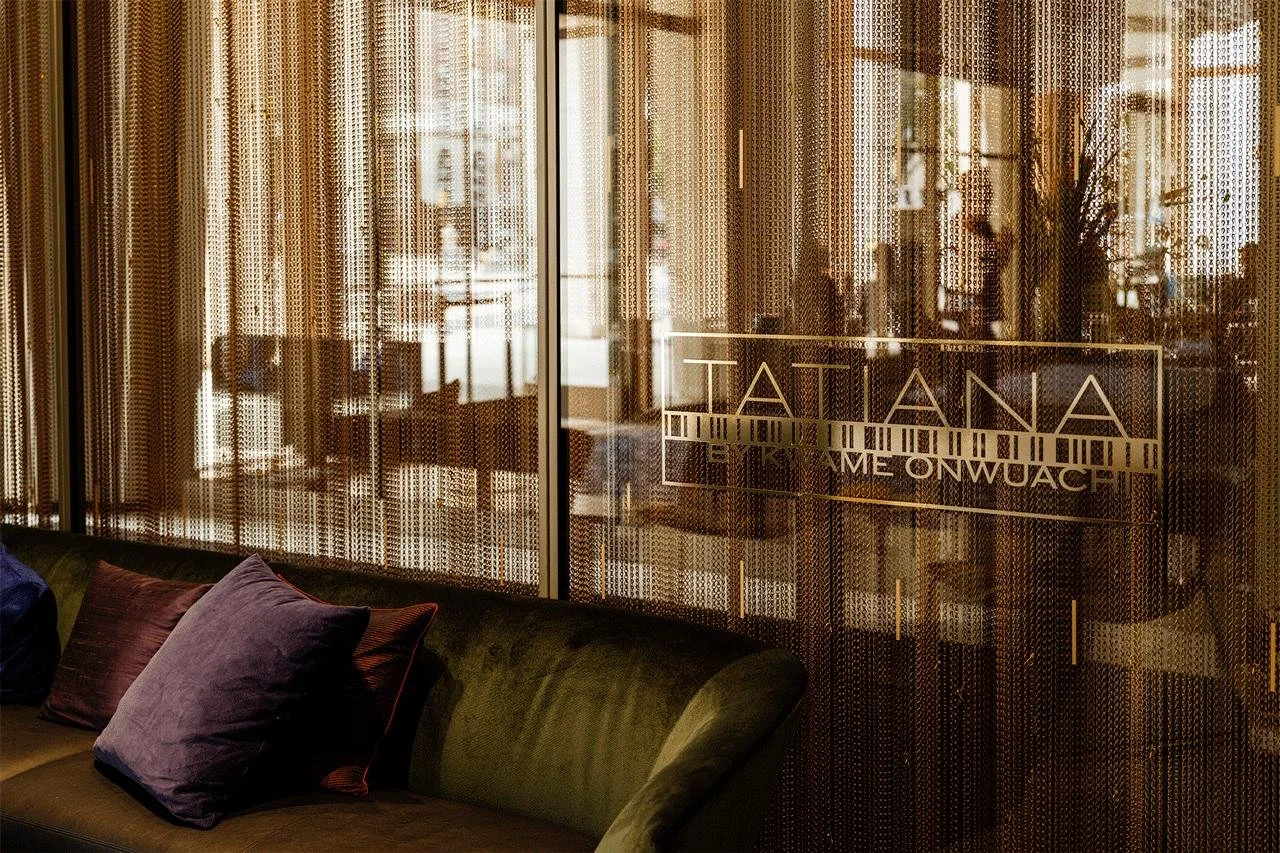
The entrance to Tatiana introduces a contemporary interpretation of Manhattan dining glamour.
A Different Kind of Manhattan Glamour
Designed by the architectural firm Modellus Novus, Tatiana departs considerably from the nostalgic interiors of Carbone, The Polo Bar and 4 Charles Prime Rib.
Its aesthetic belongs unmistakably to contemporary New York. Expansive windows, sculptural lighting, polished surfaces and richly colored furnishings create an atmosphere that changes considerably between daylight and evening.
Among its most distinctive decorative features are the illuminated cloud-like forms suspended from the ceiling, whose changing colors contribute to the theatrical character of the dining room.
Music is equally important to the experience. Rather than adopting the restrained atmosphere traditionally associated with restaurants attached to concert halls, Tatiana embraces a more energetic and contemporary soundtrack.
The dimensions of the restaurant remain surprisingly intimate. In a 2023 interview with Resy, its management described a principal dining room accommodating fifty guests, a private dining room with fourteen seats and a bar with just six.
An additional thirty-two outdoor seats provide further opportunities during favorable weather.
The contrast between the monumental architecture of Lincoln Center and the modest seating capacity of its celebrated restaurant helps explain why a table at Tatiana has become so extraordinarily difficult to obtain.
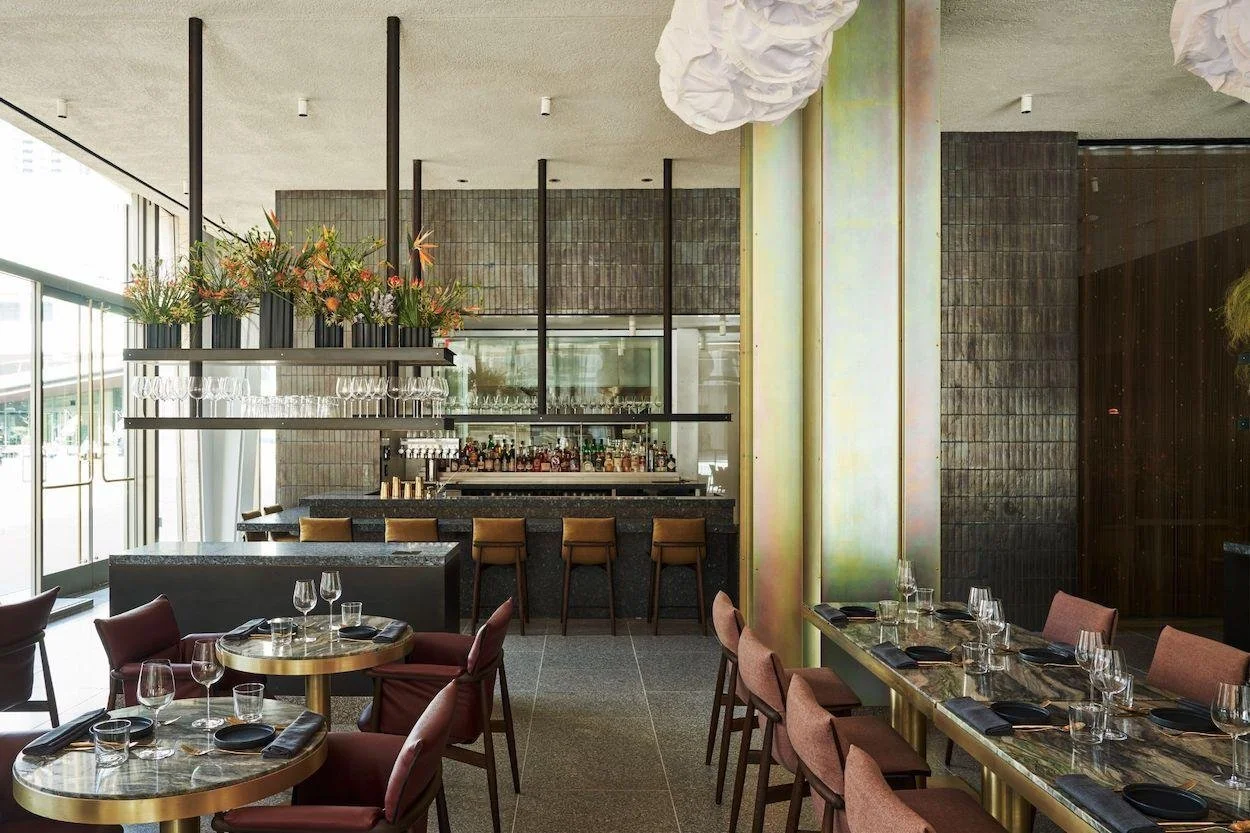
Contemporary materials and sculptural architectural details distinguish Tatiana from Manhattan’s more traditionally appointed dining rooms.
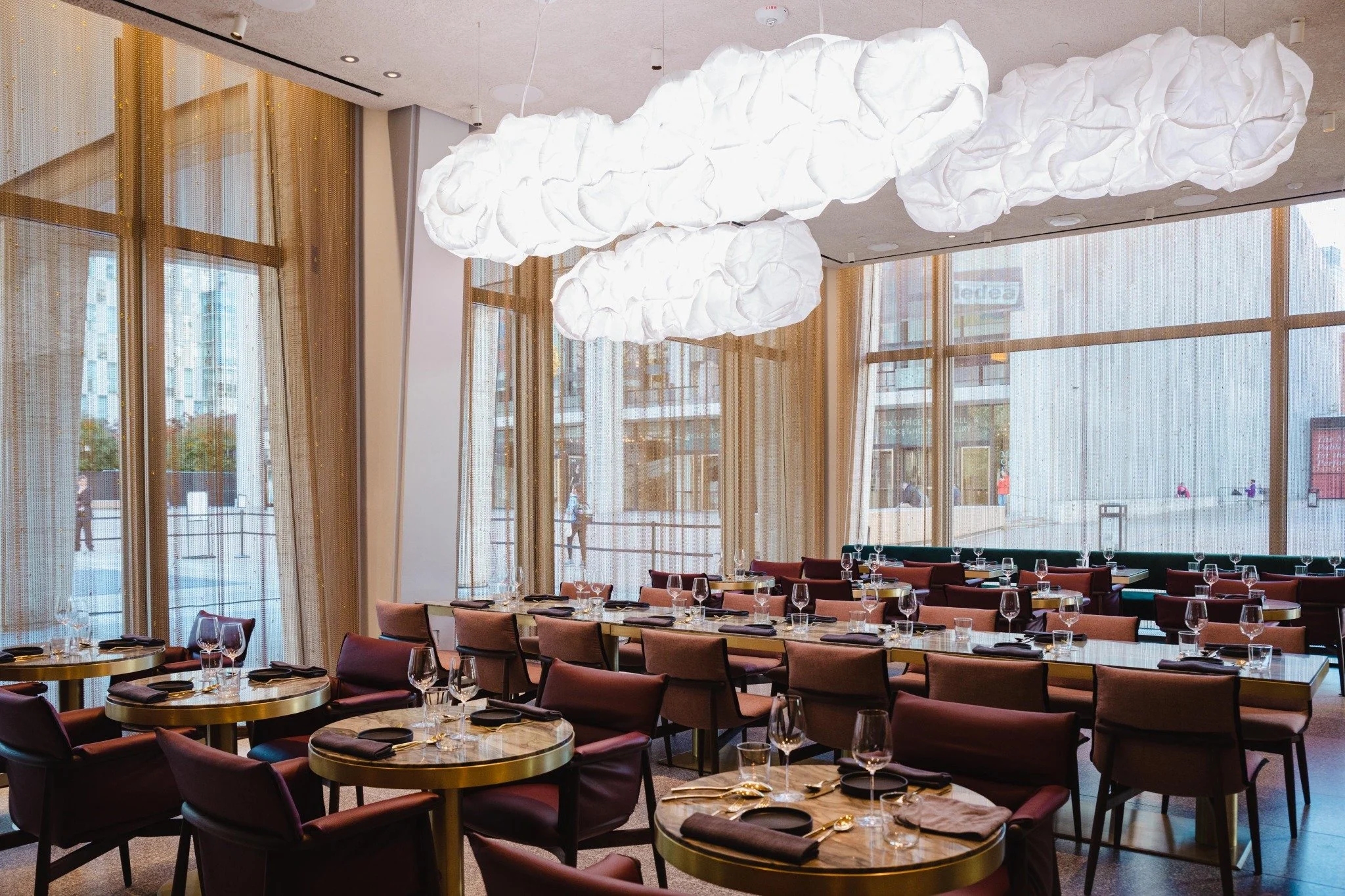
Natural light from the expansive windows reveals the architectural character of Tatiana’s dining room.
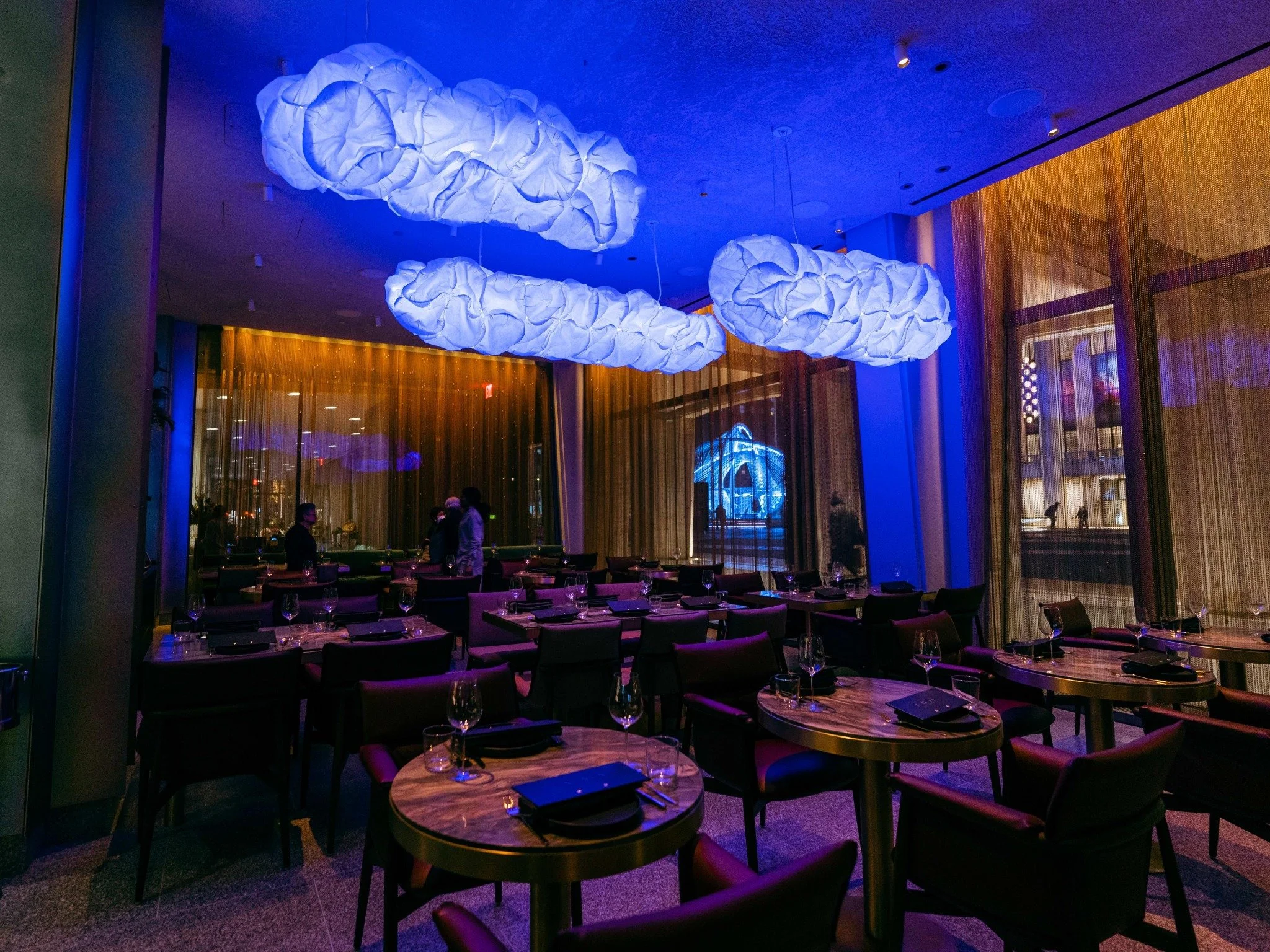
After dark, dramatic lighting transforms the dining room into one of Manhattan’s most fashionable evening destinations.
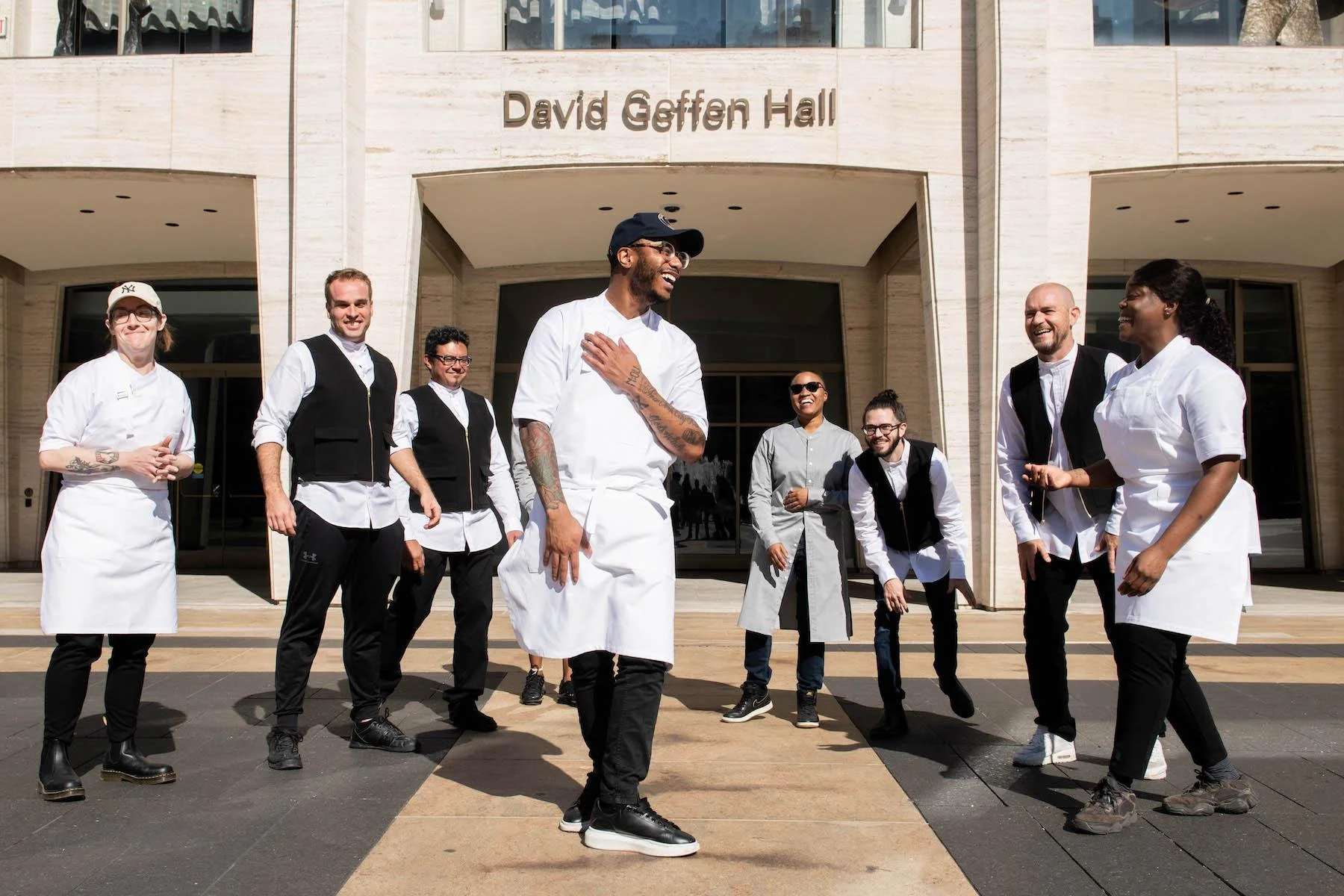
Members of the Tatiana team outside David Geffen Hall, representing the contemporary hospitality of Lincoln Center.
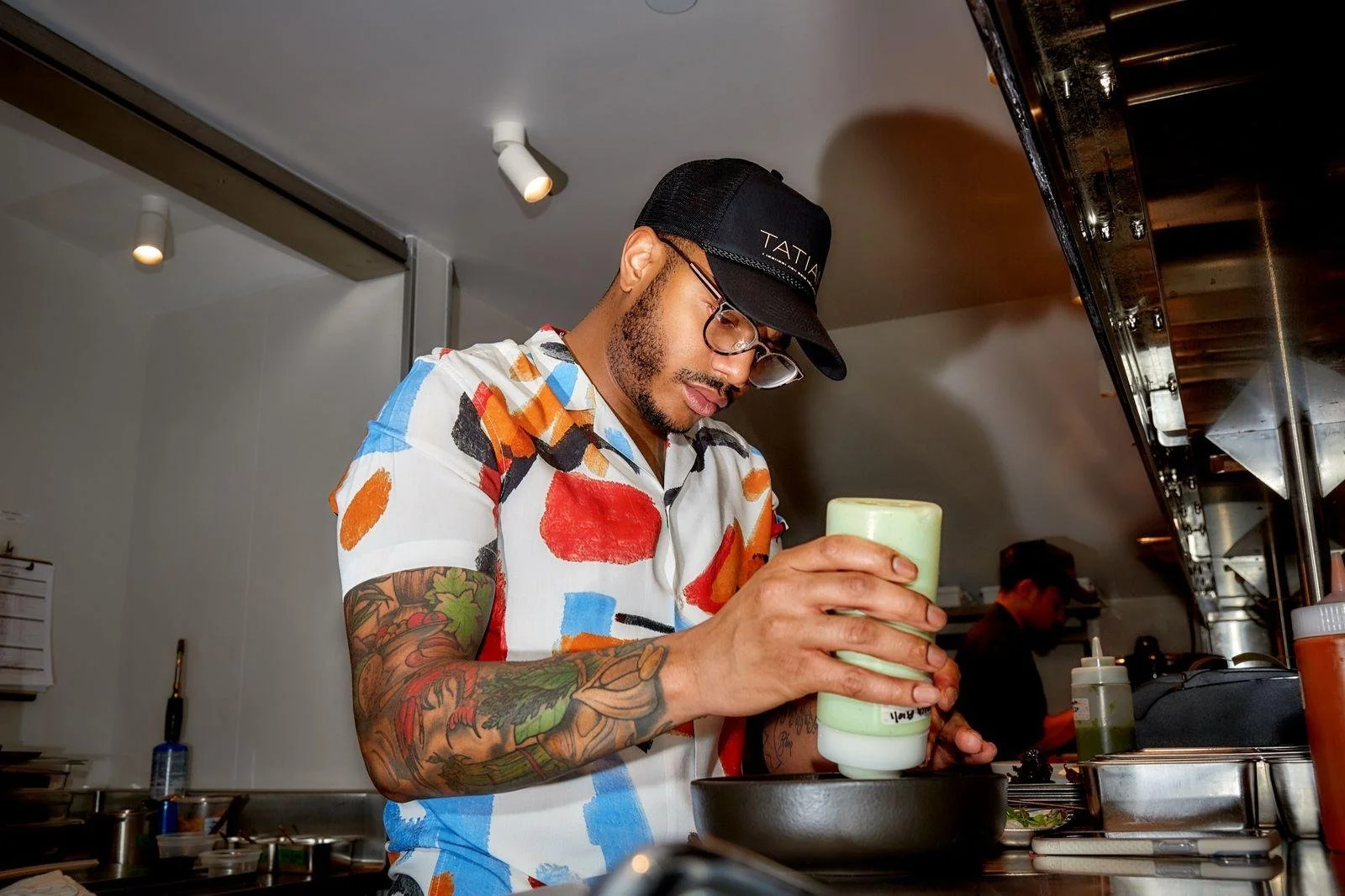
The craftsmanship behind Kwame Onwuachi’s imaginative interpretation of New York’s diverse culinary traditions.
The Culinary Geography of New York
The extraordinary appeal of Onwuachi's cooking lies partly in his ability to bring together culinary traditions that might otherwise appear entirely unrelated.
His Short Rib Pastrami Suya, for example, combines the familiar traditions of the New York Jewish delicatessen with the distinctive spices of West African suya. Accompanied by Caribbean-style bread and red cabbage, the dish encompasses several generations of immigrant culinary history.
His egusi dumplings bring together the traditions of Nigerian cooking and filled pasta, while curried goat patties celebrate the familiar savory pastries of Caribbean bakeries.
The celebrated braised oxtails, accompanied by rice and peas, represent another particularly indulgent interpretation of traditional Caribbean cooking.
Even dessert provides an opportunity for culinary nostalgia. The Bodega Special transforms the familiar packaged sweets of a New York corner shop into a composed restaurant dessert.
The ingenuity of these dishes lies not simply in the combination of ingredients but in the deeply personal memories that provide their inspiration.
The Most Celebrated Restaurant Without a Michelin Star
Tatiana presents perhaps the most extraordinary distinction in our entire exploration of Manhattan's impossible tables.
In 2023, restaurant critic Pete Wells awarded Tatiana three stars in The New York Times. The restaurant subsequently occupied the coveted first position in his ranking of New York City's one hundred best restaurants.
Tatiana retained that distinction in 2024.
International recognition followed. In 2023, The World's 50 Best Restaurants organization presented Tatiana with its One to Watch Award, acknowledging the remarkable promise of Onwuachi's culinary enterprise.
In 2026, Tatiana ranked thirty-ninth among North America's 50 Best Restaurants.
Yet despite these extraordinary distinctions, Tatiana does not currently possess a Michelin star.
The restaurant remains recommended by the Michelin Guide, whose inspectors have recognized its imaginative cuisine, distinctive atmosphere and sophisticated interpretation of Onwuachi's culinary heritage.
The contrast between its position in the Michelin Guide and its extraordinary recognition by other culinary authorities is particularly fascinating.
Unlike Carbone and Don Angie, whose histories include the withdrawal of Michelin stars, Tatiana has accumulated remarkable critical prestige without that particular distinction.
It is a compelling reminder that even the world's most influential culinary authorities do not necessarily arrive at identical conclusions about the merits of a restaurant.
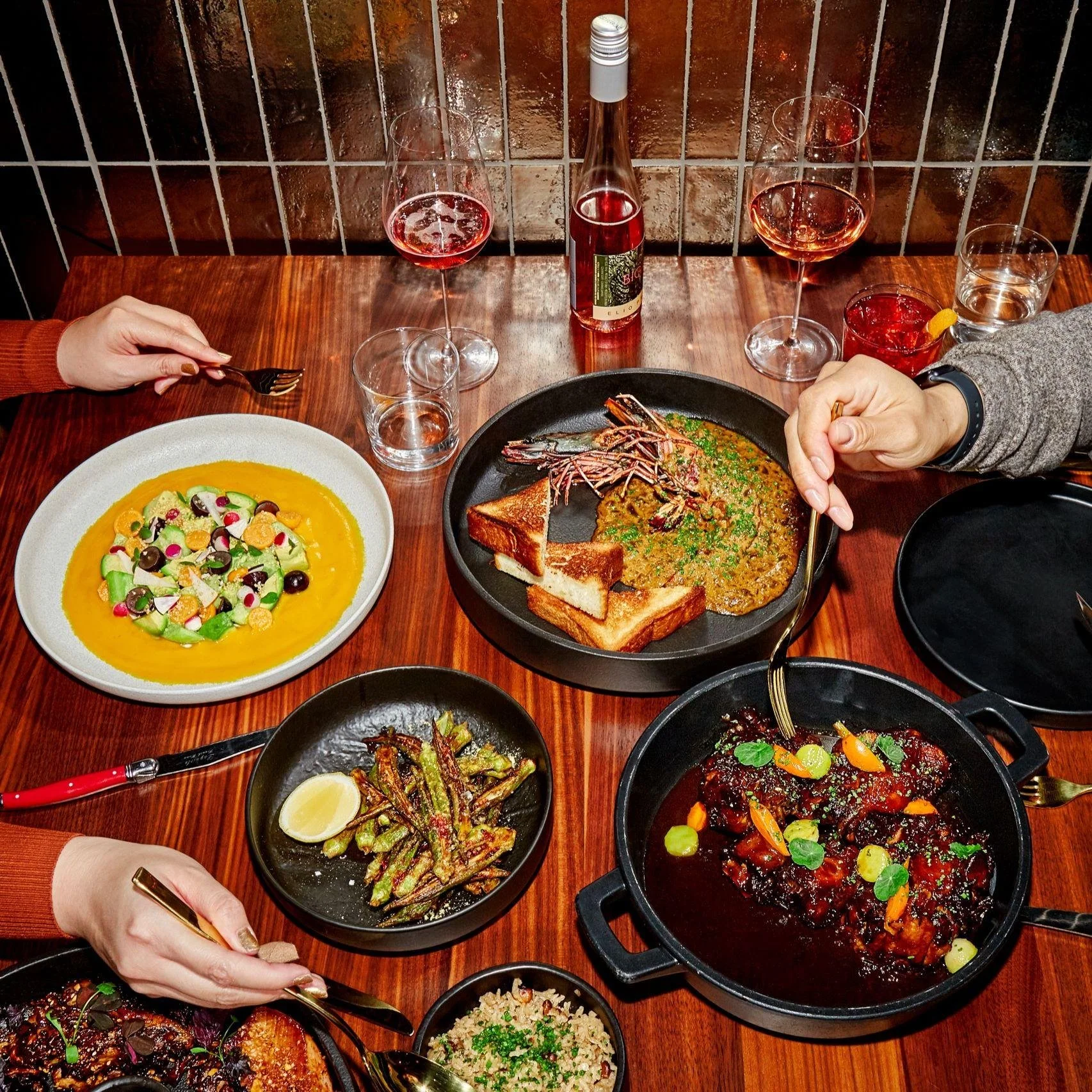
The diverse culinary traditions of New York, West Africa and the Caribbean find elegant expression at Tatiana.
The Price of Culinary Discovery
Tatiana's cuisine is particularly suited to sharing, allowing diners to explore several distinct culinary traditions during the course of an evening.
The more substantial specialties, including braised oxtails and short rib pastrami suya, provide opportunities for an especially lavish dinner, while smaller dishes introduce guests to the extraordinary breadth of Onwuachi's culinary imagination.
For a substantial dinner encompassing shared appetizers, main courses, dessert and beverages, including tax and gratuity, allow approximately $150 to $225 per person.
How to Secure a Table
Reservations at Tatiana are released through Resy at noon, Eastern Time, within a twenty-eight-day booking window.
The timing of dinner at this particular restaurant is influenced considerably by its proximity to Lincoln Center's performing arts institutions.
In a 2023 interview with Resy, the restaurant's management explained that reservations between five and seven o'clock were especially desirable because of the considerable number of guests attending evening performances.
Interestingly, this creates another potential opportunity. As the earlier diners depart for their performances, occasional tables may become available for guests without reservations.
Tatiana also maintains bar seating for walk-in patrons, with additional outdoor seating available seasonally. Management has historically recommended arriving when dinner service begins at five o'clock to improve one's prospects.
Unlike many of the intimate restaurants featured in our exploration, Tatiana also occupies a setting in which an unsuccessful attempt to secure dinner need not constitute an unsuccessful evening. The surrounding cultural institutions offer an extraordinary variety of alternative experiences.
Ultimately, Tatiana's desirability reflects the remarkable personal journey of its chef and his ability to transform the familiar culinary pleasures of his childhood into an internationally celebrated restaurant.
Within one of America's most distinguished cultural institutions, Kwame Onwuachi has established a stage of his own.
Address: 10 Lincoln Center Plaza, New York, NY 10023
Building: David Geffen Hall
Neighborhood: Lincoln Square, Upper West Side
Michelin distinction: Michelin Guide Selected; no Michelin star.
Additional distinctions: Three stars from The New York Times; ranked its No. 1 New York restaurant in 2023 and 2024.
International recognition: World's 50 Best Restaurants One to Watch Award, 2023; No. 39 among North America's 50 Best Restaurants, 2026.
Dinner: Tuesday through Saturday, 5 p.m. to 10 p.m.
Closed: Sunday and Monday.
Dress code: Smart casual; elegant evening attire recommended.
Reservations: Resy, twenty-eight-day booking window, with reservations released at noon, Eastern Time.
Walk-ins: Bar seating and seasonal outdoor seating, subject to availability.
Telephone: (212) 875-5222
Email: info@tatiananyc.com
Website: www.tatiananyc.com
08 — The Corner Store
SoHo / Established 2024

West Broadway in SoHo, where historic commercial architecture, fashionable boutiques and contemporary Manhattan society converge.
The Making of an Overnight Institution
At the intersection of West Broadway and Houston Street stands a restaurant whose extraordinary rise to prominence illustrates how rapidly the social geography of Manhattan can change.
For approximately twenty years, the address housed Dos Caminos, a popular Mexican restaurant. In September 2024, however, the premises acquired an entirely new identity under the direction of three formidable figures in the American hospitality industry: Eugene Remm, Mark Birnbaum and Houston billionaire Tilman Fertitta.
Remm and Birnbaum had established themselves in New York's competitive restaurant and nightlife industry through Catch Hospitality Group. Fertitta, the owner of the Houston Rockets and the entrepreneur behind Landry’s extensive restaurant empire, became their business partner in 2017.
The Corner Store represented the group's first entirely new restaurant concept in thirteen years. Rather than establish another extravagant seafood restaurant or fashionable nightclub, the partners sought to recreate the familiar pleasures of an old-fashioned New York neighborhood establishment.
The ambition was considerably more complicated than it might initially appear. A beloved neighborhood restaurant traditionally acquires its character through decades of accumulated memories, familiar personalities and longstanding relationships with its patrons.
The Corner Store attempted to create that atmosphere from the moment its doors opened.
Within days of its September 2024 debut, the restaurant had become one of Manhattan's most talked-about destinations. Its reputation was further enhanced by visits from Taylor Swift, Travis Kelce, Gigi Hadid and Kendall Jenner.
In striking contrast to Rao’s, whose exclusivity developed over generations, The Corner Store achieved extraordinary social desirability almost overnight.

The prominent corner of West Broadway and Houston Street, formerly occupied by Dos Caminos and now home to The Corner Store.
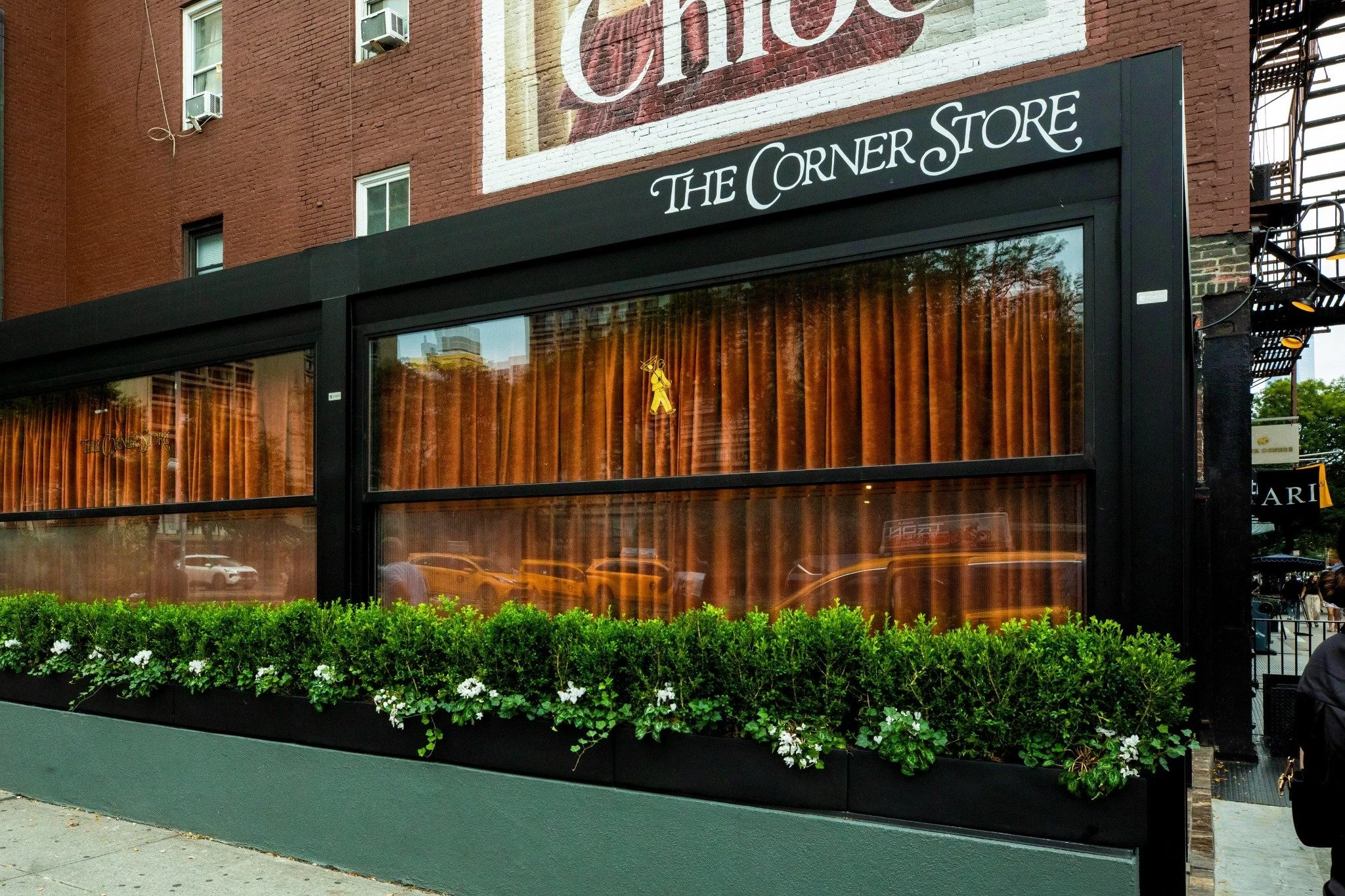
The Corner Store’s distinctive frontage recalls the architectural character of traditional New York neighborhood establishments.
The entrance at 475 West Broadway, behind which a nostalgic interpretation of American dining awaits.
After nightfall, The Corner Store becomes one of SoHo’s most fashionable gathering places.
The reception area introduces guests to Rockwell Group’s imaginative recreation of old New York.
The Art of Manufactured Nostalgia
The distinguished architectural and design firm Rockwell Group was entrusted with the considerable challenge of transforming the former Mexican restaurant into an establishment that appeared to possess a history of its own.
The original premises were extensively reconstructed. Antiqued brass, checkered marble flooring, richly polished wood and vintage-inspired lighting establish an atmosphere reminiscent of the fashionable Manhattan restaurants of an earlier generation.
Near the entrance stands a thirteen-seat bar crowned with green onyx. Beyond it, the dining rooms incorporate combinations of green velvet, tufted leather, striped upholstery and photographs celebrating the history and personalities of New York.
The principal dining room features shaded table lamps, richly patterned walls and skylights softened by striped curtains. An enclosed terrace accommodates approximately fifty additional guests.
Unlike the exceptionally small dining rooms of Rao’s and 4 Charles Prime Rib, The Corner Store accommodated approximately 130 diners at its opening. Its extraordinary reservation difficulty cannot therefore be attributed entirely to limited physical capacity.
The appeal lies partly in the unusually successful relationship between the architecture, the atmosphere and the social identity of the establishment.
The Corner Store has created something particularly intriguing: a restaurant designed to evoke the familiar comforts of a neighborhood institution while simultaneously offering the excitement of one of Manhattan's most fashionable social destinations.
Rich upholstery, warm lighting and vintage-inspired furnishings contribute to the nostalgic elegance of the principal dining room.
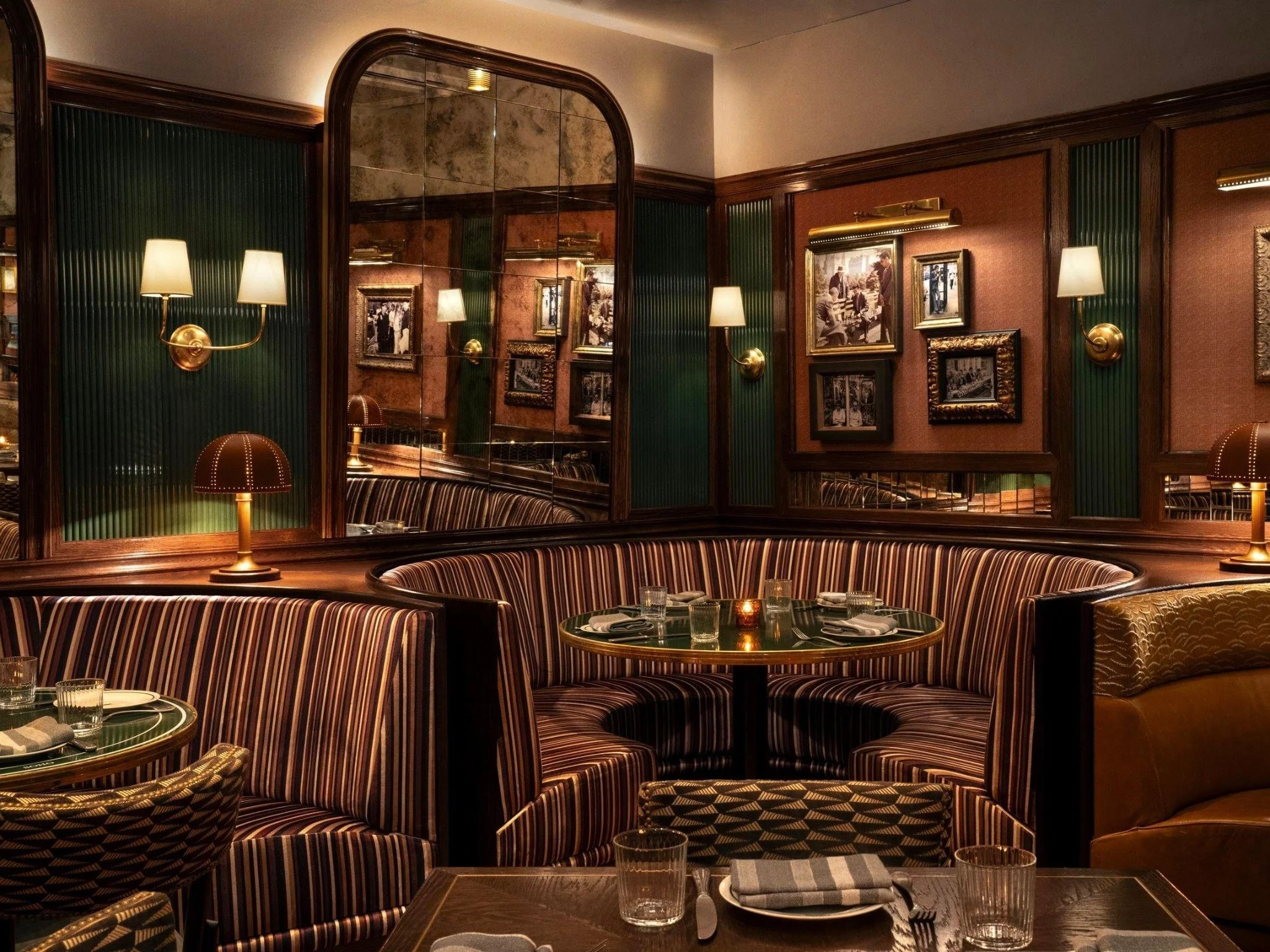
An intimate banquette offers an inviting setting for dinner and observation of the surrounding social scene.
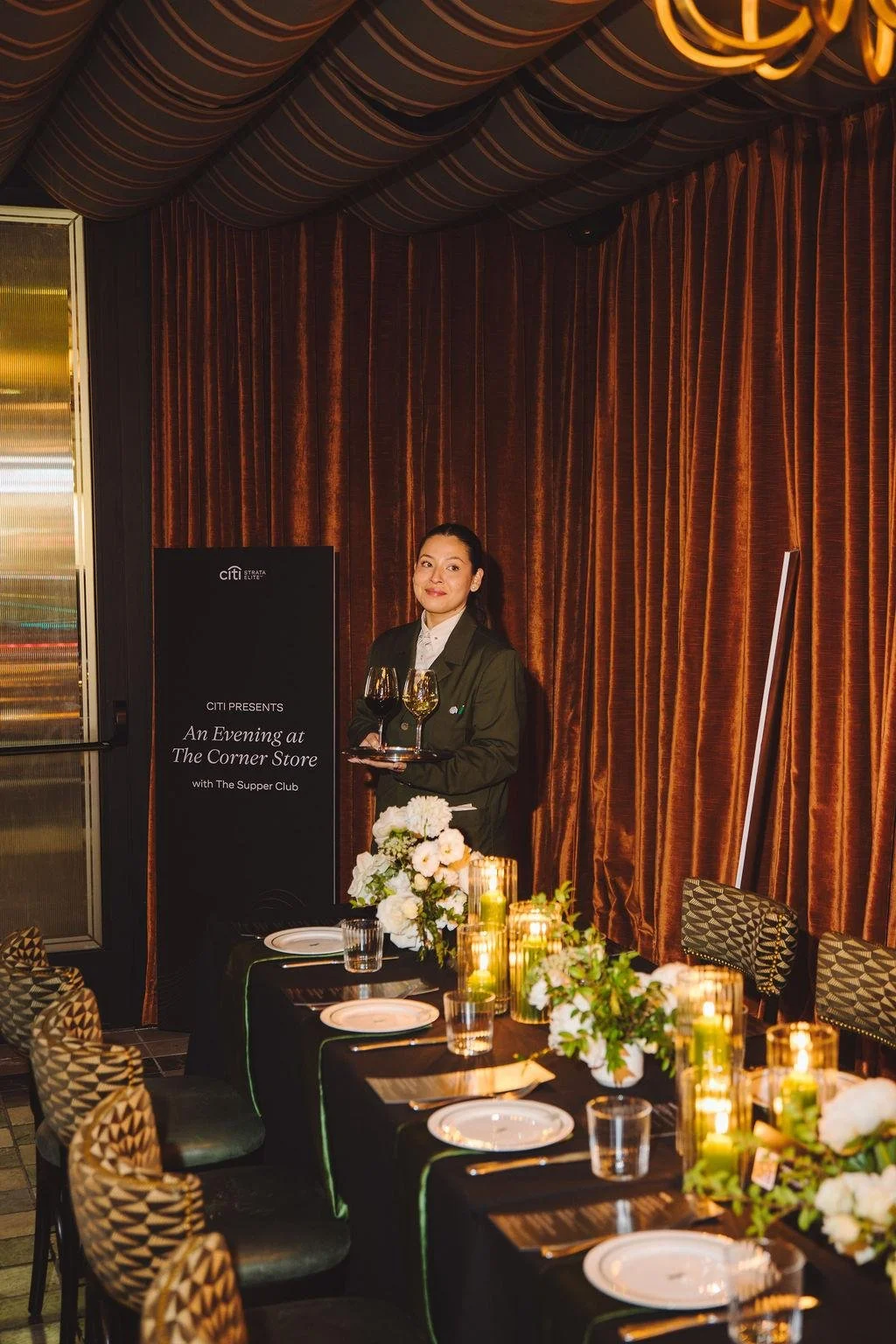
Traditional formal service complements the restaurant’s nostalgic interpretation of American hospitality.
Childhood Favorites, Elegantly Reimagined
Under the direction of culinary director Michael Vignola and opening executive chef Paul Castro, The Corner Store developed a menu that celebrates familiar American food through considerably more luxurious ingredients and sophisticated preparation.
Among its most talked-about appetizers are five-cheese pizza rolls accompanied by pepperoni, jalapeño, hot honey and ranch dressing. There is something wonderfully irreverent about transforming a familiar American freezer-aisle snack into an appetizer served in one of Manhattan's most desirable dining rooms.
The Corner Store Caesar incorporates the flavors of a New York everything bagel, complete with distinctive croutons and cream cheese.
Its miniature lobster and caviar rolls provide an altogether more extravagant interpretation of American comfort food. Wagyu French dip sandwiches, spinach and artichoke dip, Dover sole and disco steak frites similarly bridge the considerable distance between everyday American cooking and contemporary luxury dining.
The culinary philosophy is particularly interesting when compared with the ambitious multicultural cooking of Torrisi and Tatiana. The Corner Store draws much of its inspiration from the familiar pleasures of American childhood, elevating dishes whose original appeal had little to do with exclusivity.
Celebrity Versus Culinary Prestige
The Corner Store has not required a Michelin star to establish its extraordinary reputation.
Its desirability has instead been cultivated through a combination of influential clientele, sophisticated interior design, familiar cuisine and extensive media attention.
The critical reception has nevertheless been interesting. In September 2024, Wallpaper praised the restaurant's playful culinary approach and atmospheric design, while Observer expressed greater enthusiasm for the surroundings than for certain aspects of the food.
In January 2026, The Infatuation awarded the restaurant 8.2 out of 10, recognizing its appeal as a lively destination for celebrations and fashionable social gatherings.
These differing assessments reveal much about the nature of contemporary luxury dining. A restaurant can become extraordinarily successful without seeking to compete directly with the technically ambitious kitchens recognized by Michelin.
At The Corner Store, the pleasure of dinner is inseparable from the pleasure of being there.
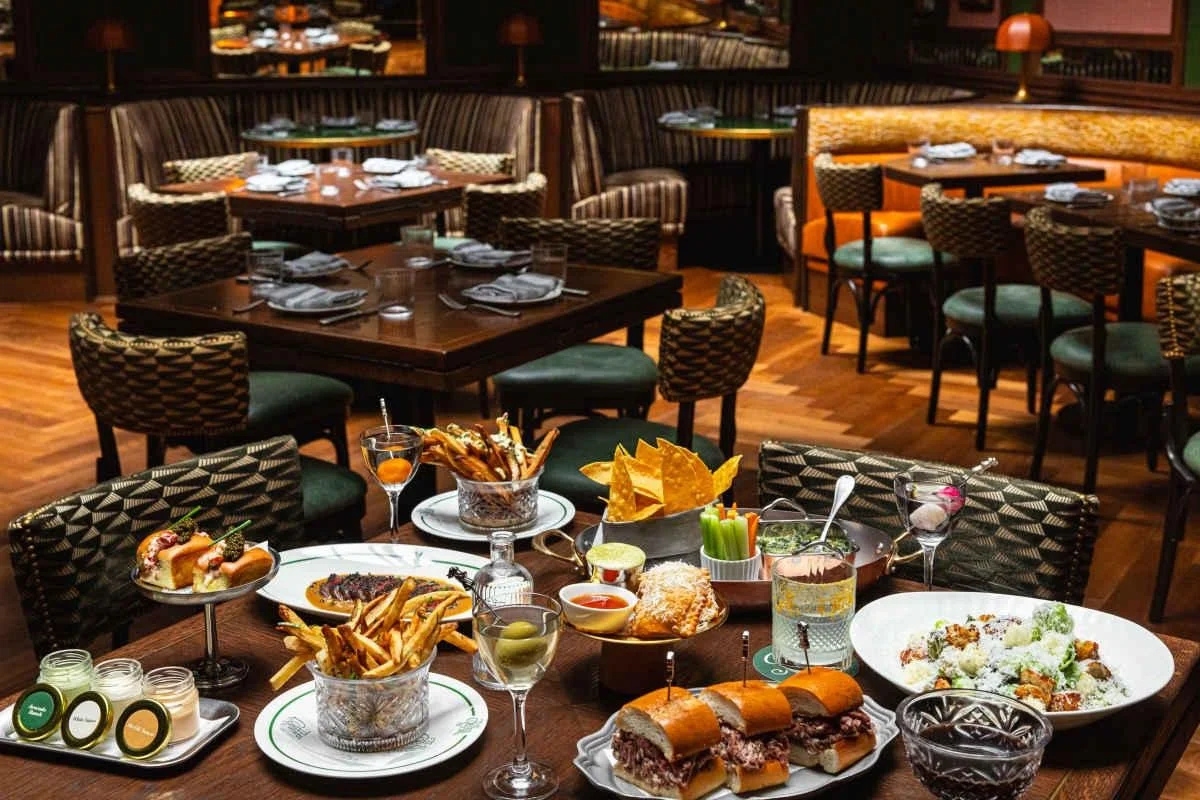
Familiar American culinary traditions presented within the sophisticated surroundings of The Corner Store.

Miniature lobster and caviar rolls illustrate the restaurant’s playful marriage of American comfort food and luxurious ingredients.
The Price of Fashionable Nostalgia
At its opening in September 2024, The Corner Store offered appetizers and salads generally priced between $18 and $25, with several main courses ranging from $28 to $89. Its miniature lobster and caviar rolls were priced at $19 apiece.
For a substantial dinner encompassing shared appetizers, main courses, dessert and beverages, including tax and gratuity, allow approximately $125 to $200 per person. More extravagant selections can increase the final bill considerably.
How to Secure a Table
The Corner Store accepts reservations through Resy, generally within a fourteen-day booking window.
Despite the restaurant's considerably larger dining capacity than several other establishments featured in our exploration, obtaining an evening reservation remains a formidable undertaking.
There is, however, another opportunity. Some of the thirteen seats at the bar near the entrance are reserved for walk-in diners.
In January 2026, The Infatuation reported that prospective diners began assembling outside the restaurant at approximately four o'clock in the afternoon, with the queue eventually extending around the block.
Unlike the discreet personal arrangements governing admission to Rao’s, the competition for a seat at The Corner Store is therefore occasionally visible to anyone walking along West Broadway.
The sight of fashionably attired New Yorkers waiting outside a restaurant whose menu includes pizza rolls and French dip sandwiches provides a particularly entertaining illustration of the peculiarities of contemporary Manhattan society.
Ultimately, The Corner Store represents a remarkably modern interpretation of exclusivity. Its founders understood that nostalgia, celebrity and the familiar pleasures of American cooking could be assembled into something sufficiently compelling to become one of the most coveted experiences in New York.
The neighborhood restaurant, traditionally celebrated for its accessibility, has become one of Manhattan's impossible tables.
Address: 475 West Broadway, New York, NY 10012
Neighborhood: SoHo
Michelin distinction: No confirmed Michelin star.
Additional recognition: Rated 8.2 out of 10 by The Infatuation, January 2026.
Reservations: Resy, fourteen days in advance.
Walk-ins: Limited bar seating, subject to availability.
Dress code: Smart casual or fashionable evening attire recommended.
Telephone: (212) 271-9240
Website: www.thecornerstoresoho.com
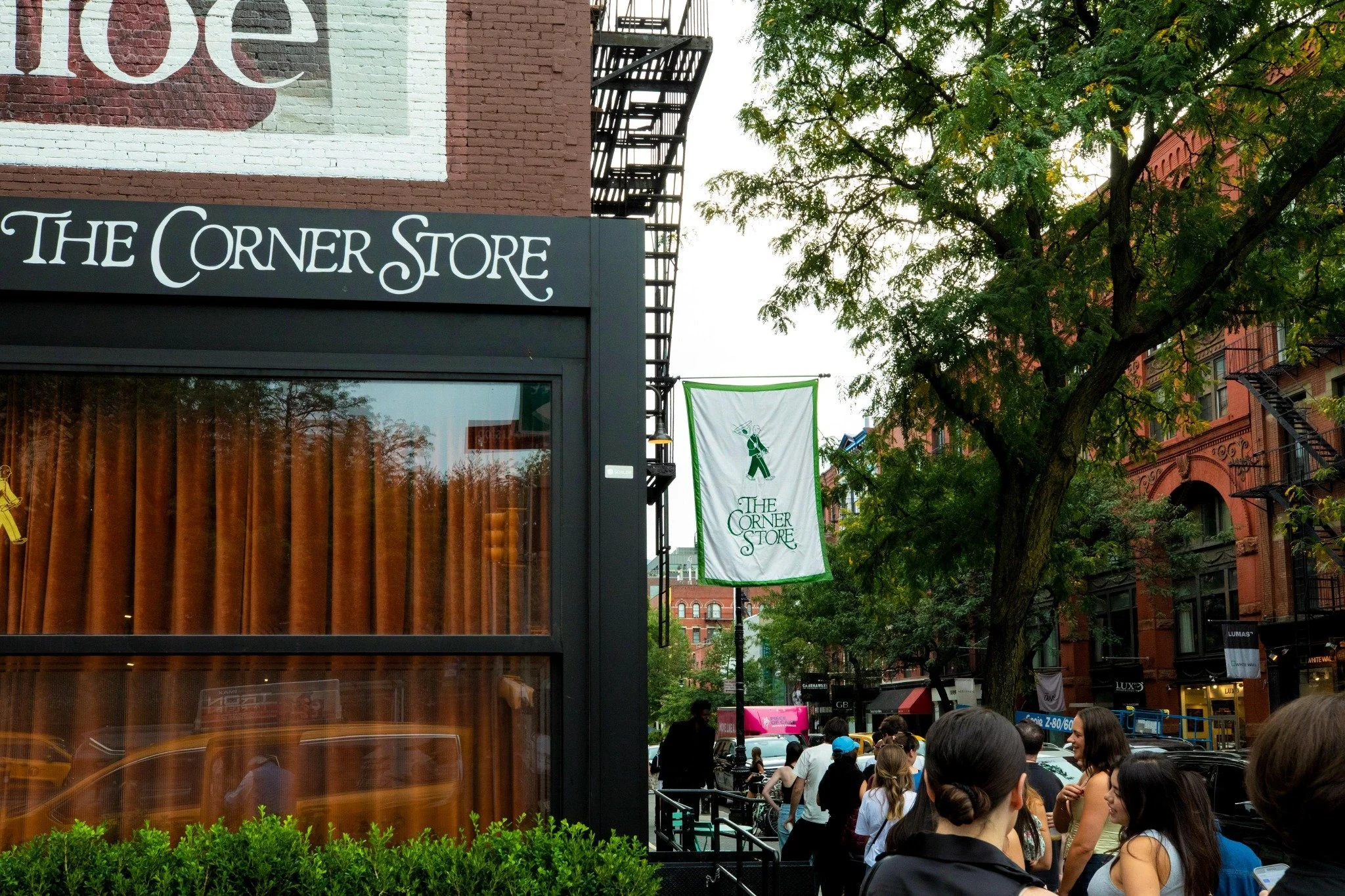
The competition for admission to The Corner Store occasionally becomes a visible feature of life along West Broadway.
09 — Atomix
NoMad / Established 2018
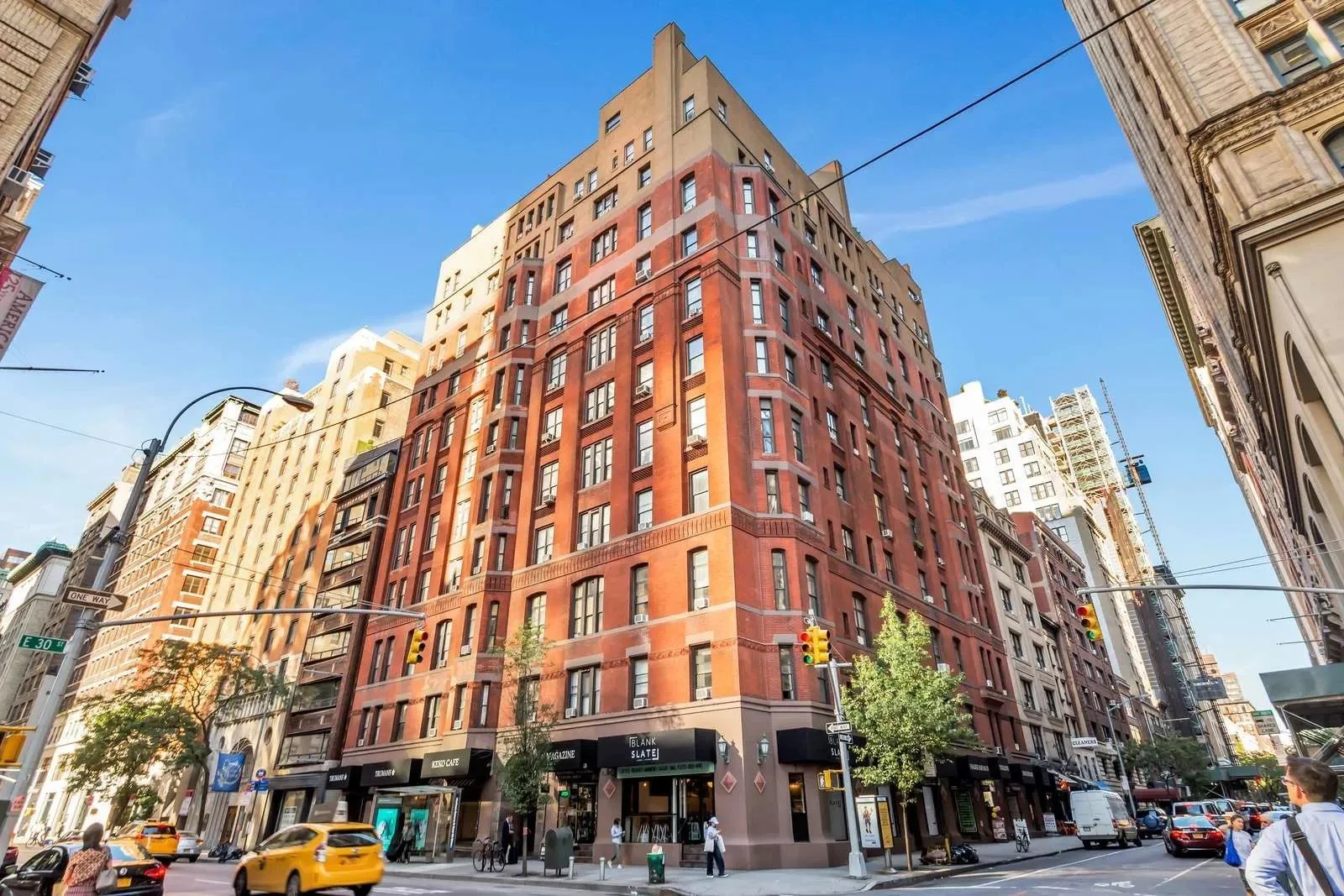
East 30th Street, where the architectural diversity of Manhattan’s NoMad neighborhood conceals one of America’s most distinguished culinary destinations.
From Seoul to Manhattan
On an unassuming stretch of East 30th Street, within the confines of a traditional Manhattan townhouse, Junghyun and Ellia Park have established one of the most internationally celebrated restaurants in America.
The couple arrived in New York in 2012, just two days after their wedding, reportedly with $7,000 between them. Junghyun, affectionately known as JP, had trained in professional kitchens internationally and worked at the distinguished Korean restaurant Jungsik in both Seoul and Manhattan.
In July 2016, the couple opened Atoboy, a comparatively informal establishment inspired by the Korean tradition of banchan, the assortment of small dishes that accompanies a meal.
Their ambitions, however, extended beyond introducing New Yorkers to Korean flavors. They wished to create an experience encompassing Korean history, craftsmanship, artistic expression and contemporary culinary innovation.
On May 30, 2018, they opened Atomix.
The husband-and-wife partnership is particularly complementary. Junghyun directs the culinary enterprise, while Ellia oversees hospitality and the artistic and cultural dimensions of the dining experience.
Together, they have created something considerably more ambitious than a fine-dining restaurant. Atomix serves as an elegant introduction to the cultural identity of contemporary Korea.
The extraordinary international recognition subsequently bestowed upon their little Manhattan townhouse would have been difficult to imagine when the newly married couple first arrived in America.
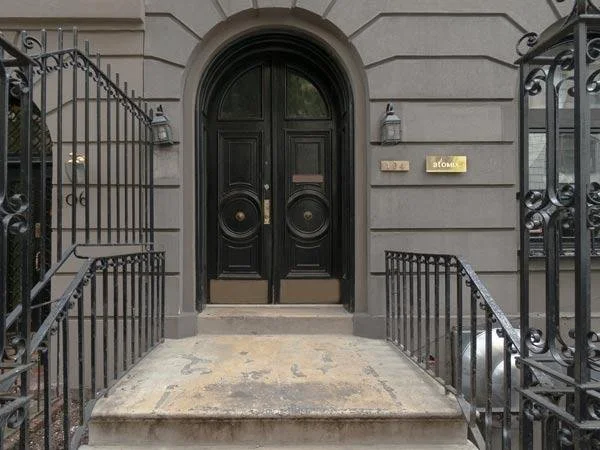
The remarkably discreet entrance to Atomix at 104 East 30th Street gives little indication of the extraordinary culinary experience awaiting its guests.

The restrained architectural palette introduces the Korean aesthetic that distinguishes Atomix.
The Architecture of Restraint
Unlike the elaborate interiors of The Polo Bar and Carbone, Atomix derives much of its visual sophistication from the deliberate absence of ornamentation.
Working with the Seoul-based architectural practice Studio Writers, the Parks conceived a restaurant that would evoke the intimacy of entering a private home.
Guests pass through a subdued entrance before encountering the upstairs bar. A staircase descends to a dramatic double-height lounge, beyond which lies the principal dining area.
Natural wood, stone, muted colors and carefully controlled lighting establish a quietly sophisticated atmosphere.
The principal dining room contains a U-shaped chef's counter accommodating just fourteen diners. Rather than observing the preparation of dinner from a distant table, guests occupy an intimate position overlooking the culinary activity.
The arrangement provides a particularly interesting contrast with traditional formal dining. There is no hierarchy of desirable corner tables or secluded banquettes. Each diner participates directly in the culinary experience.
The attire of the staff is equally distinctive. When Atomix opened, its servers wore understated gray uniforms created by Korean-born menswear designer Sungho Ahn.
Even these seemingly modest garments contribute to the Parks' larger ambition: to provide a setting in which contemporary Korean design can be appreciated alongside Korean culinary artistry.
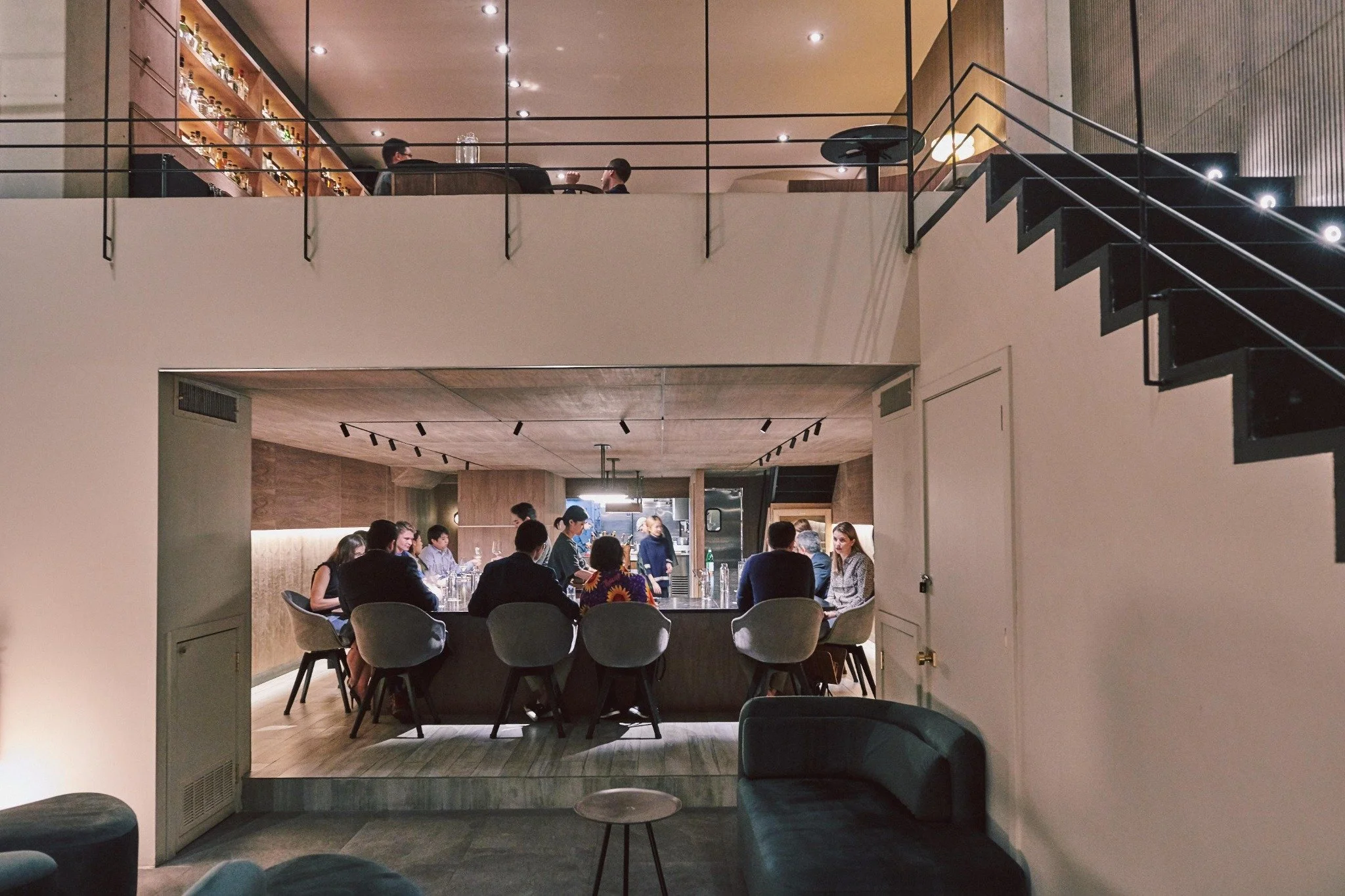
The architectural arrangement of Atomix creates a gradual transition from the entrance and lounge to the intimate dining counter.
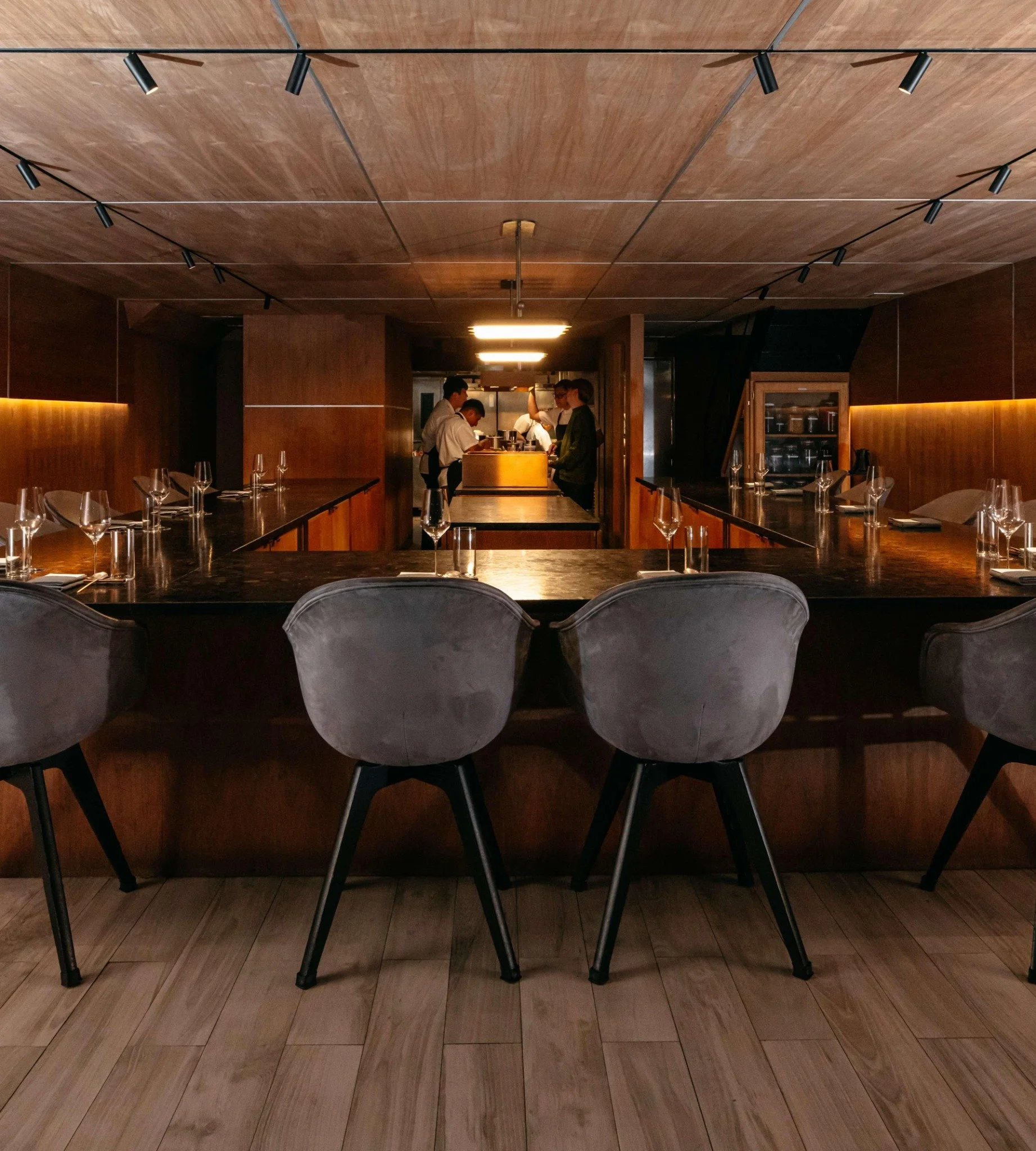
The fourteen-seat chef’s counter, where the preparations of the kitchen become an integral part of the dining experience.
Dinner at Atomix unfolds within an unusually intimate architectural setting.
Restrained contemporary tailoring complements the understated Korean aesthetic of the restaurant.
The presentation of each course celebrates Korean craftsmanship as well as culinary artistry.
The Art Upon the Table
At Atomix, the dinnerware deserves almost as much attention as the food.
The Parks incorporate the work of Korean ceramicists and contemporary designers into the dining experience, allowing their restaurant to serve as a platform for artists whose work might otherwise remain unfamiliar to American diners.
The vessels are not merely decorative accessories. Their proportions, colors and textures become part of the visual composition of each course.
The menu itself is equally extraordinary.
Rather than presenting a conventional printed list of dishes at the beginning of dinner, Atomix introduces its courses through individually designed cards. These explain the ingredients, culinary techniques and cultural traditions that inspired the preparation.
A dish incorporating the Korean cooking method known as jjim, for example, provides an opportunity to introduce diners to traditional techniques of steaming or braising.
The cards also preserve something that would otherwise disappear when the meal concludes. Guests may take them home, retaining a beautifully designed record of their evening.
Ellia Park has described the particular pleasure of discovering that former guests have framed their menu cards and displayed them in their homes.
In a restaurant where dinner is necessarily temporary, these little works of art provide a tangible connection to the experience.
The cuisine itself evolves with the seasons. Traditional Korean preparations, fermented ingredients, rice, seafood and carefully selected meats are interpreted through techniques acquired during Junghyun Park's international culinary training.
The objective is not merely to reproduce the culinary traditions of Korea but to examine how those traditions might evolve within the contemporary world of fine dining.
A course presented alongside its explanatory menu card, introducing diners to the cultural and technical traditions behind the preparation.

The individually designed menu cards transform the ephemeral experience of dinner into a collection of enduring artistic keepsakes.
Two Stars and the Admiration of the World
Unlike several of the fashionable establishments featured in our exploration of Manhattan's impossible tables, Atomix owes much of its international reputation to extraordinary critical acclaim.
The restaurant received its first Michelin star in 2018, the year it opened, and subsequently earned a second.
Its ascent through the international restaurant rankings has been equally remarkable.
In 2022, Atomix occupied thirty-third position on the World's 50 Best Restaurants list. The following year, it rose to eighth place, reaching sixth in 2024.
In 2025, Atomix achieved first position in the inaugural North America's 50 Best Restaurants ranking.
Yet perhaps its most remarkable international distinction arrived in November 2026.
At the annual awards ceremony in Lima, Peru, Atomix was ranked eleventh among the world's finest restaurants, becoming the only American establishment included in the prestigious international top fifty.
Junghyun Park received an additional distinction of considerable personal significance: the Estrella Damm Chefs' Choice Award, an honor bestowed through the votes of fellow chefs.
Such recognition is particularly meaningful because it represents the admiration of those who understand the considerable discipline, creativity and professional sacrifice involved in operating a restaurant of this caliber.
The achievement is extraordinary when one considers the physical proportions of Atomix. An internationally celebrated restaurant, regarded by its peers and critics as one of the most distinguished culinary destinations in the world, accommodates just fourteen guests at its principal dining counter.
For Atomix, exclusivity is not principally a consequence of celebrity patronage or fashionable social arrangements. It arises from the remarkable intersection of culinary achievement, artistic craftsmanship and severely limited capacity.
The Price of Culinary Artistry
When Atomix opened in May 2018, its tasting menu was priced at $175 per person.
By November 2026, the price of its twelve-course Chef's Counter experience had risen to a reported $424 per person, including the administrative fee. For December 2026, the published price increased to $495.
The upstairs Bar Tasting experience provides a comparatively accessible alternative, with reported prices of $314 in November and $352 in December, including a beverage pairing.
Atomix operates without conventional gratuities. Guests should nevertheless account for applicable taxes, optional beverages and any additional charges when calculating the total cost of their evening.
For two people enjoying the principal Chef's Counter experience, an expenditure exceeding $1,000 is entirely conceivable.
How to Secure a Table
Reservations at Atomix are obtained through Tock rather than Resy or OpenTable.
Unlike restaurants offering conventional à la carte dining, Atomix requires guests to commit financially to their selected tasting experience when making a reservation.
Reservations are generally released in monthly installments. For example, the January 2027 reservations are scheduled for release on December 1, 2026, at 3 p.m., Eastern Time.
Prospective diners should establish their accounts and familiarize themselves with the available experiences before reservations are released.
Those unsuccessful in obtaining a seat at the principal dining counter should consider the separate upstairs Bar Tasting experience or register for notifications of cancellations.
Given the extraordinary international recognition bestowed upon Atomix, flexibility regarding dates is particularly advantageous.
Yet perhaps the most compelling reason to pursue a reservation is the opportunity to experience the extraordinary creative partnership of Junghyun and Ellia Park.
Within the modest architectural confines of a Manhattan townhouse, the couple has established an internationally celebrated expression of Korean culinary identity.
At Atomix, the ultimate luxury is not the opportunity to be seen but the opportunity to experience something genuinely exceptional.
Address: 104 East 30th Street, New York, NY 10016
Neighborhood: NoMad / Rose Hill
Michelin distinction: Two Michelin stars, as reported in November 2026.
Historic Michelin recognition: First star awarded in 2018.
International recognition: No. 11, World's 50 Best Restaurants, 2026.
North American recognition: No. 1 in 2025; No. 7 in 2026, North America's 50 Best Restaurants.
Individual distinction: Junghyun Park, Estrella Damm Chefs' Choice Award, 2026.
Principal dining capacity: Fourteen guests.
Dinner: Tuesday through Saturday.
Closed: Sunday and Monday.
Dress code: Smart, elegant attire recommended.
Reservations: Tock; advance payment required.
Website: www.atomixnyc.com
10 — Semma
West Village / Established 2021
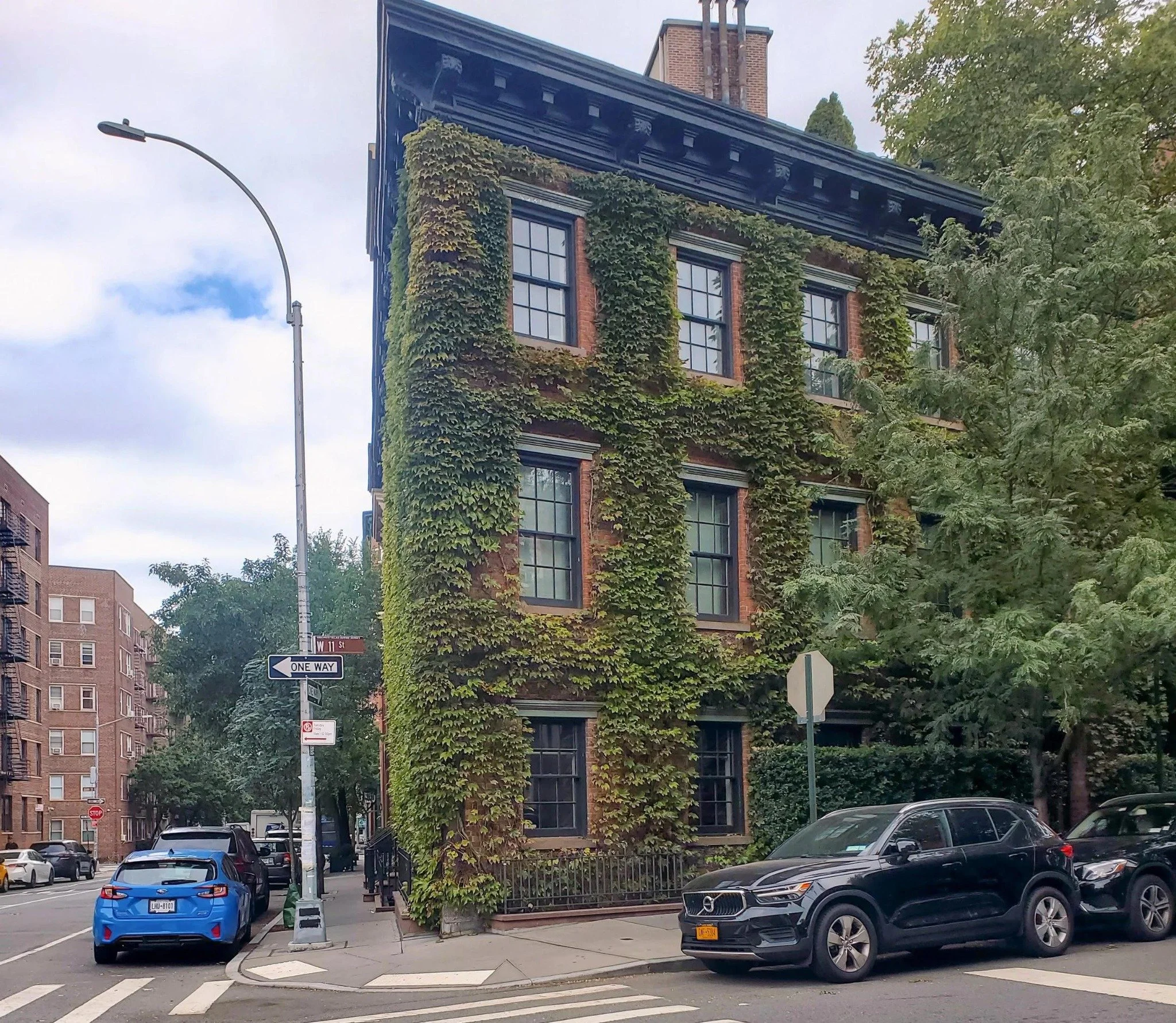
The historic West Village, where the culinary traditions of communities from across the world have found a home among Manhattan’s intimate residential streets.
From the Rice Fields of Tamil Nadu to Manhattan
Of all the remarkable personal histories encountered in our exploration of Manhattan's impossible tables, perhaps none is more compelling than that of Vijay Kumar.
Raised on a family farm near Madurai, in the southern Indian state of Tamil Nadu, Kumar spent his childhood helping his mother and grandmother cultivate and prepare the ingredients that sustained their household.
The surrounding landscape provided an extraordinary culinary education. Rice fields, agricultural markets and village kitchens introduced him to ingredients and preparations rarely encountered in the fashionable Indian restaurants of Western cities.
Among his childhood memories was the experience of gathering freshwater snails in the rice paddies near his grandparents' home. What was once regarded as humble rural food would eventually find its way onto the menu of an internationally celebrated Manhattan restaurant.
Kumar's professional journey took him far beyond the agricultural communities of southern India. He worked aboard a cruise ship and subsequently established himself in the distinguished restaurant kitchens of California.
In 2021, he crossed the country to join restaurateurs Roni Mazumdar and Chintan Pandya, whose restaurant group, Unapologetic Foods, had already attracted considerable attention for its willingness to present regional Indian cooking without modifying its essential character to accommodate conventional American expectations.
Together, they opened Semma in October 2021 at 60 Greenwich Avenue.
The restaurant's name is a Tamil expression of enthusiastic approval, roughly equivalent to magnificent or fantastic.
Kumar's ambition was intensely personal. Rather than reproduce the familiar repertoire of Indian restaurants abroad, he wished to present the food of his childhood with all its regional complexity, distinctive ingredients and extraordinary diversity of flavor.
Within four years, the little boy who had gathered snails in the rice fields of Tamil Nadu would become one of the most celebrated chefs in New York.
Semma at 60 Greenwich Avenue, where the culinary traditions of rural southern India have acquired an extraordinary Manhattan distinction.
The warmly appointed interior of Semma introduces a decidedly different aesthetic to our exploration of Manhattan dining.
The Warmth of Southern India
The interior of Semma offers a particularly interesting contrast to the restrained Korean aesthetic of Atomix and the sporting elegance of The Polo Bar.
Rather than attempting to recreate the architectural grandeur of an Indian palace, the restaurant evokes something considerably more personal: the warmth, colors and familiar textures associated with the cultural traditions of southern India.
Decorative artwork, warm lighting and richly colored furnishings establish an atmosphere that is intimate without being excessively formal.
The restaurant's atmosphere is also considerably more exuberant than that of some Michelin-starred establishments. Conversation, the fragrance of freshly prepared spices and the activity of the dining room contribute to an experience that celebrates the pleasures of communal dining.
The emphasis upon sharing is particularly appropriate. Kumar's cooking draws its inspiration from a culture in which the preparation and enjoyment of food are intimately connected with family life.
The greatest luxury at Semma is not architectural extravagance but the opportunity to experience regional cooking of remarkable depth and individuality.
Warm colors and intimate table arrangements provide a welcoming setting for Vijay Kumar’s celebrated regional cuisine.
Decorative artwork introduces elements of Indian cultural heritage into the contemporary Manhattan dining room.
The culinary imagination behind Semma’s celebrated interpretation of southern Indian cooking.
A Michelin Star for the Food of His Childhood
In 2022, just one year after opening its doors, Semma received its first Michelin star.
The distinction was particularly significant because Kumar had achieved recognition not by transforming the food of his childhood into something more closely resembling European fine dining, but by preserving its distinctive regional identity.
The recognition continued to accumulate.
In 2023, restaurant critic Pete Wells ranked Semma twelfth among New York City's one hundred best restaurants. The following year, it advanced to seventh position.
Then came the extraordinary year of 2025.
In June, The New York Times placed Semma first among its one hundred best restaurants in New York City, a remarkable achievement in a city celebrated for its extraordinary concentration of culinary talent.
Later that month, the James Beard Foundation awarded Vijay Kumar its prestigious Best Chef: New York State distinction.
During his acceptance speech, Kumar reflected upon the extraordinary journey that had brought him from rural Tamil Nadu to one of the most distinguished stages in American culinary life.
Semma continued to receive international recognition in 2026, ranking forty-first among North America's 50 Best Restaurants and ninth in The New York Times' annual ranking of the city's finest establishments.
Unlike Carbone and Don Angie, Semma has retained its Michelin star according to the latest available recognition.
Its remarkable history offers a particularly compelling conclusion to our exploration of culinary prestige. Preparations once associated with modest agricultural households in southern India have earned the admiration of some of the most influential culinary authorities in the world.
The food did not need to abandon its identity to acquire distinction. The world simply needed an opportunity to discover it.
The collective achievement of the culinary and hospitality team behind one of New York’s most celebrated restaurants.
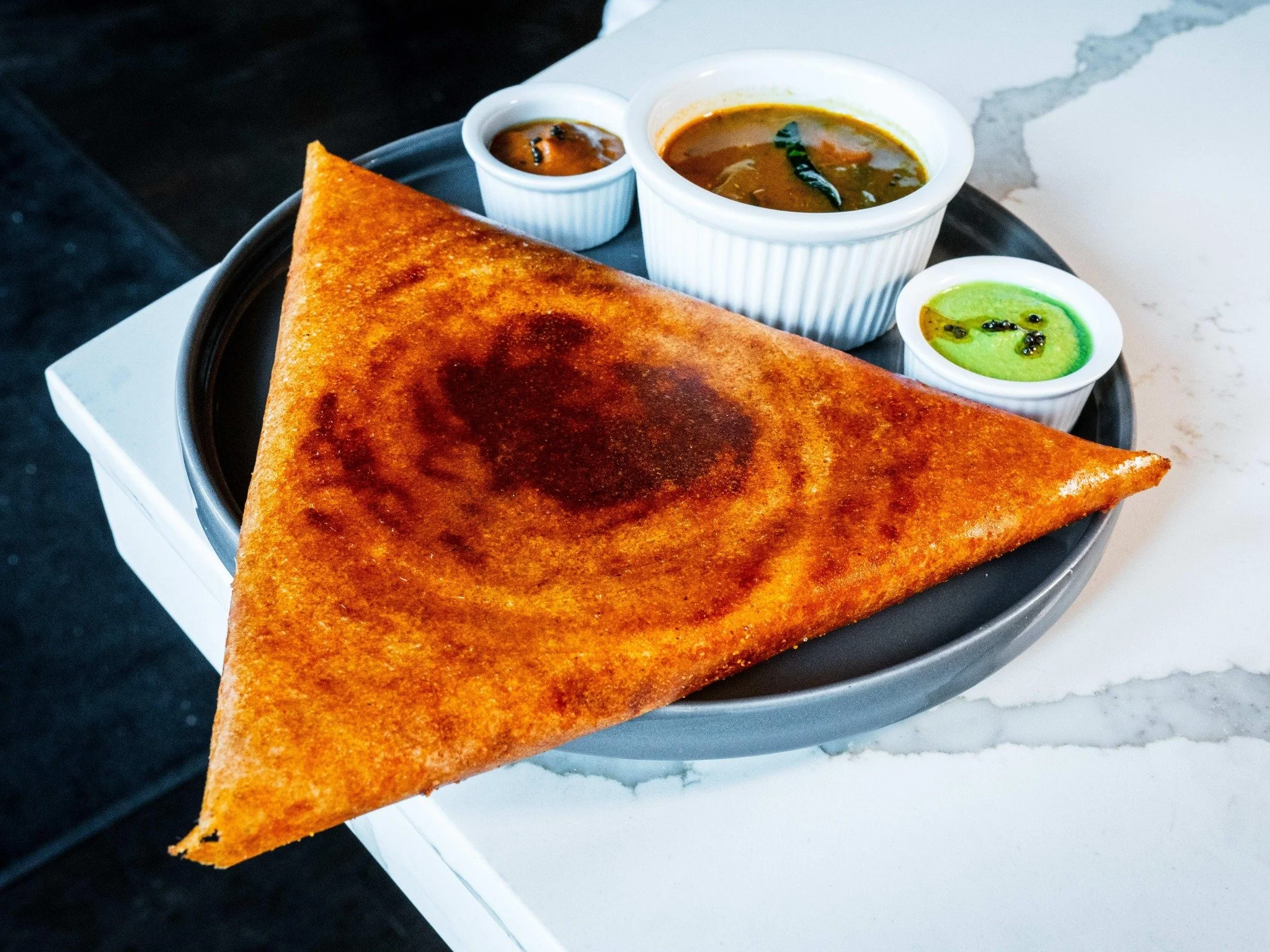
Semma’s celebrated Gunpowder Dosa, a traditional southern Indian preparation that has become one of Manhattan’s most coveted dishes.
The Extraordinary Pleasures of Regional Indian Cooking
Perhaps the most fascinating aspect of Semma's menu is the extraordinary diversity of its ingredients and regional traditions.
The celebrated Gunpowder Dosa is a delicate, crisp crêpe prepared from rice and lentils, accompanied by a spiced potato filling and sambar. Its name refers to the intensely flavored powdered spice mixture associated with southern Indian cooking.
The dish illustrates the remarkable sophistication that can be achieved through the preparation of comparatively humble ingredients.
Other specialties provide a more extensive exploration of the culinary geography of southern India.
Mulaikattiya Thaniyam, a preparation of sprouted mung beans with coconut and smoked chili, recalls the snacks of Kumar's childhood.
The Dindigul Biryani celebrates the traditions of a particular region of Tamil Nadu through fragrant short-grain seeraga samba rice, delicately spiced goat and accompanying raita.
Goanese Oxtail, Ghee Roast Lamb Chops and branzino prepared within banana leaves introduce further regional influences.
Among the restaurant's most extravagant offerings is Kanyakumari Nandu Masala, a Dungeness crab preparation for two, accompanied by coconut rice and the beautifully layered southern Indian flatbread known as parotta.
Yet perhaps the most personal preparation associated with Semma remains Nathai Pirattal, the snail dish inspired by Kumar's childhood expeditions into the rice fields.
It is difficult to imagine a more remarkable culinary transformation: an ingredient gathered by a young boy in rural India becoming a celebrated specialty in one of Manhattan's most inaccessible dining rooms.
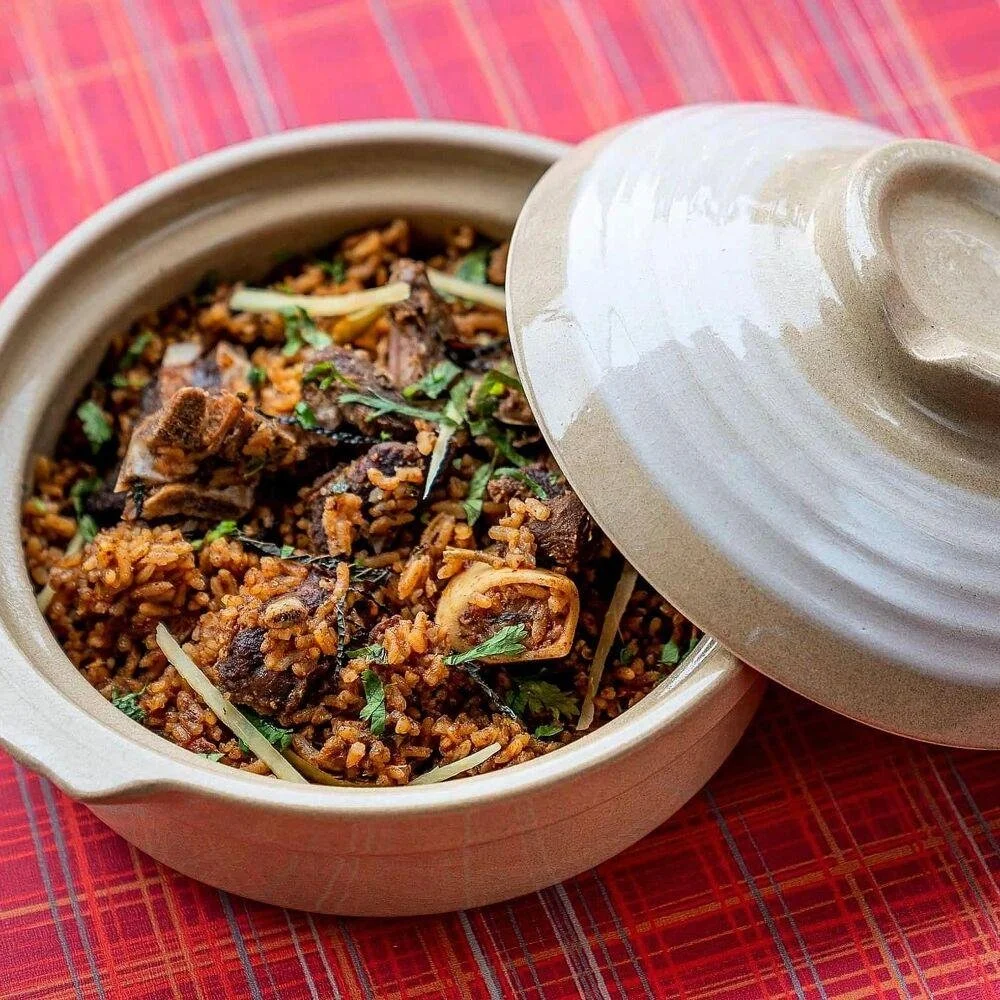
The richly aromatic traditions of southern Indian rice and meat preparations, in which regional ingredients and centuries of culinary knowledge find expression.
The Price of Extraordinary Flavor
Despite possessing a Michelin star, Semma remains considerably more accessible in price than many of Manhattan's most celebrated fine-dining establishments.
The November 2026 menu lists the Gunpowder Dosa at $21, sprouted mung beans at $12, tiger prawns at $25 and Dindigul Biryani at $42.
Goanese Oxtail is priced at $51, Ghee Roast Lamb Chops at $54 and the elaborate Dungeness crab preparation for two at $145.
For a substantial dinner encompassing several shared dishes, accompaniments and beverages, including tax and gratuity, allow approximately $90 to $150 per person.
The relative accessibility of the menu makes the extraordinary difficulty of obtaining a reservation all the more intriguing.
How to Secure a Table
Semma accepts reservations through SevenRooms, distinguishing it from the numerous establishments in our exploration that rely upon Resy.
Reservations become available fifteen days in advance at 9 a.m., New York time.
Prospective diners should familiarize themselves with the reservation platform before the appointed hour and remain flexible regarding their preferred dining dates.
The restaurant operates six evenings each week and does not offer a regular lunch service, considerably limiting the opportunities to experience Kumar's celebrated cooking.
In addition, the restaurant allocates ninety minutes to reservations for parties of two to four guests and two hours to parties of five or six.
Those unable to secure their preferred reservation should monitor the booking platform for cancellations. Parties of seven or more are directed to the restaurant's private dining arrangements.
Ultimately, Semma provides a particularly meaningful answer to the question that has accompanied our entire exploration of Manhattan's impossible tables.
The privilege of dining here is not principally associated with celebrity, inherited social connections or architectural grandeur. It is the opportunity to discover the extraordinary culinary traditions of a place many of its patrons may never have visited.
Through the remarkable achievements of Vijay Kumar, the village kitchens of southern India have found an international stage in the heart of Manhattan.
Address: 60 Greenwich Avenue, New York, NY 10011
Neighborhood: West Village
Michelin distinction: One Michelin star.
Historic Michelin recognition: First star awarded in 2022.
James Beard distinction: Vijay Kumar, Best Chef: New York State, 2025.
Additional recognition: No. 1, The New York Times' 100 Best Restaurants in New York City, 2025; No. 9 in 2026.
International recognition: No. 41, North America's 50 Best Restaurants, 2026.
Dinner: Monday through Saturday, 5 p.m. to 10 p.m.
Closed: Sunday.
Dress code: Smart casual or elegant evening attire recommended.
Reservations: SevenRooms, fifteen days in advance at 9 a.m., New York time.
Telephone: (212) 373-8900
Email: hello@semma.nyc
Website: www.semma.nyc
The Elusive Luxury of a Table for Two
Our journey through Manhattan's ten most coveted restaurants has revealed ten remarkably different interpretations of exclusivity.
At Rao’s, a table represents generations of personal relationships. At The Polo Bar, it offers admission into the cultivated world of Ralph Lauren. At Carbone, it provides an opportunity to inhabit the theatrical glamour of an earlier New York.
At 4 Charles Prime Rib, the pleasures of the traditional American supper club have become extraordinarily elusive. Torrisi celebrates the culinary diversity of the city itself, while Don Angie transforms the intimate traditions of Italian-American family life into something wonderfully inventive.
Tatiana brings the memories of a Bronx childhood to the cultural grandeur of Lincoln Center. The Corner Store demonstrates the astonishing speed with which contemporary Manhattan can create a fashionable institution.
At Atomix, extraordinary Korean artistry commands international admiration, while at Semma, the culinary traditions of rural southern India have achieved some of the highest distinctions in American dining.
We have encountered restaurants that earned Michelin stars, restaurants that lost them and restaurants that became legendary without possessing one at all.
We have discovered that considerable wealth does not necessarily guarantee admission, that a $21 dosa can inspire as much competition as a several-hundred-dollar tasting menu, and that a hamburger, served in precisely the right surroundings, can become an object of extraordinary desire.
Perhaps the most enduring fascination of Manhattan dining lies in this remarkable unpredictability. The city continually redefines what constitutes luxury, occasionally discovering it in places where previous generations would scarcely have thought to look.
And yet, beneath the extraordinary architecture, celebrated personalities, distinguished awards and elaborate reservation rituals lies a pleasure that is wonderfully ordinary: the anticipation of spending an exceptional evening in the company of someone whose presence one enjoys.
For all the sophistication of New York, perhaps its most desirable luxury remains exactly what it has always been.
A table for two.
The Camellia Stiletto™
Restaurant information, menu prices, culinary distinctions and reservation policies are reported as of November 2026 and are subject to change. Readers are encouraged to consult each restaurant’s official website before planning their visit.
Photographic Acknowledgments
The Camellia Stiletto™ acknowledges the photographers, restaurants, architectural firms and publications whose imagery illustrates this editorial feature. Copyright in third-party photographs remains with the respective rights holders. For photographic credit inquiries or corrections, please contact the editor.